Monday, July 14, 2014

Media Mondays

Happy Monday Everyone!


            Today's Media Monday post will focus on the audio and visual initiatives that the museum is tackling this year so that we can better serve our museum audience. We fortunately have the opportunity to have 5 tablets that will be placed throughout the museum. On these tablets I have just finished creating presentations that describe each room in the museum and point out specific items in each room - much like a tour guide would. These tablet presentations are perfect for self-guided tours or for those with hearing disabilities - these guests may utilize the tablets at their leisure and read along as their tour moves from room to room. 
           We have noticed this season that many people prefer to discover the museum at their own pace and would rather tour the house alone. However, when these people have questions about the objects or collections, there is no one there to answer them. Therefore, alongside the use of the self-guided tablets, I have also created self-tour booklets that guests can use while they travel throughout the house. These booklets are meant for guests to keep as a souvenir and can be referenced when they have questions. Altogether - this season we are moving forward to a more accessible and inclusive environment here at the Backus-Page House Museum.

by Sarah Johnston


Sunday, July 13, 2014

Behind the Scenes Sunday 3

Things Backus-Page House Museum staff were saying this week: "Does your computer have internet?  Nope.  (insert huge sigh here)"

The bane of my existence this week was dodgy internet.  Even when we could connect to it, it was so slow it took me over 3 hours to send one email.  They tell me there is an issue at the closest tower so if you send us an email or are expecting one from us, please have patience.  We didn't realize how many tasks require use of the internet until we lost it.  We couldn't even take credit card payments since it requires Wi-Fi.  Let's hope our technological issues are solved by Tuesday morning when we're back in the office. 

New to our collection this week is a Bible belonging to Robert Stevenson of Tyrconnell dated 1876.  It contains a pressed flower, marriage license to Sarah M. Crane and handwritten listings of the family births and deaths.  This item, along with a 1904 W.R.A. medal was donated by Jennifer (Stevenson) Worth, the great great granddaughter of Robert.  Jenny and I went through school together and her mother, Mary Jane Stevenson, volunteered with the Tyrconnell Heritage Society in the early days of the society.  Jenny recalls coming to the Backus-Page House with her Mom before all the renovations and being told to wear her work clothes.  Jenny was so excited to see the renovations complete and how we've furnished the rooms and maintained the grounds.  I was glad for the quick visit to catch up.    
 

Adding an item into our collection (called an accession) involves many steps.  When the item arrives, a Gift Form is filled out listing all the items being donated and the museum staff person and the donor sign the form, giving ownership to the Backus-Page House Museum.  I try to get as much information from the donor about their item(s) such as who it belonged to, where did they get it, how was it used and anything else they can tell me.  The next step is for me to decide whether the item will be added to our permanent or educational collection.  Educational means it can be handled and demonstrated and permanent means that it can be seen, but not handled. 

With the Stevenson Bible, I took the time to transcribe all the handwritten births and deaths for our records and for anyone interested in the genealogical information.  This way we can use or provide the information without opening the actual Bible.  I also included a copy of my transcriptions with a thank you letter to Jenny, similar to the letters we send to each and every donor. 

Every item in our collection has a worksheet for it with such information as measurements, description, history, maker, and most importantly what it's assigned accession number will be and where on the item that number is written.  The funniest description I have seen on one of our worksheets says "like the one the Honey Nut Cheerios Bee carries".  It's a desciption for a honey dipper!!   

The worksheet, gift form, and any other documentation pertaining to the artefact are filed in the current year's binder in order of accession number.  The accession number is written onto the item itself in an inconspicuous location.  Research is done to assign a monetary value to the item so we know the amount for the donor's charitable tax receipt.  These values are approved at the monthly board meeting by board motion and vote.   

Onto the computerized collection records: A photograph is taken and the computer file of the photograph is given the accession number as it's name, making it very easy to find.  The artefact is entered into the Collection Registry for the current year using only it's accession number, name of the item, and the donor's name.  All information on the worksheet is entered into the Master Card Catalogue database plus a digital scan of the gift form and photograph(s).  At this time I decide where the artefact will be placed whether that is inside the museum, the barn, the collection storage room, or for paper documents or photographs, the accessions filing cabinet in my office.  The location is an integral part of the Master Card Catalogue database.  

Once the item is in it's assigned location that ends the accessions process.  Charitable tax receipts are mailed out each February to our donors.  I hope this quick description gives you an idea of what happens after you donate something to us for the collection.  Moving an item through this process can take anywhere from an hour to all day if we have trouble finding information. 

Leave a comment below about other behind the scenes museum work or park management you would be interested in reading about and share all our posts on your social media accounts.  Thank you.

Don't forget Sunday Summer Teas 1-4pm in July and August.  $10 per person includes tea, baked goods in the parlour and a tour of the museum. 

Angela Bobier, Cultural Manager


Saturday, July 12, 2014

Tourism Talk

Dutton Library
July 10
  • School Aged Summer Reading Club  
  • 1:30PM to 2:30PM
July 11
  • Family and Me Story Time
  • 10:30AM to 11:30AM
July 14
  • Lego Mondays
  • 1:30PM to 2:30PM
July 15
  • Family and Me Story Time
  • 10:30AM to 11:30AM

Cactus, Cattle and Cowboys- www.cactuscattleandcowboys.ca
  • At the Rodney Fairgrounds on July 12
  • Opens at 9AM
  • Food and vendors, family events, and petting zoo
  • 12PM High Noon Horse Parade
  • Cattle and Horse breed displays, horse demos, wagon rides and trail rides- BYOH (bring your own horse)
Backus Page House Museum
  • Summer Sunday Tea
  • 1:00PM to 4:00PM
  • $10.00 a person
  • Includes tea, baked goods and a guided tour of the museum

Written By: Alex Goos


Service Saturday- David Ford

This weeks service saturday features David Ford, from Wallacetown. David was hired in March as the part-time book keeper for the museum. He started volunteering after he was hired. The first event that David volunteered at was the War of 1812 event, held in May. He then volunteered his time helping organize and run the Strawberry Social and the summer fundraiser, Backus-Bucks. 
David enjoys all aspects of the museum, he particularly enjoys the local history involved. He also admires the beautiful atmosphere at the Backus-Page House Museum, along with the park environment and history of the area. 

Thank- you David for all of the hard work you do for the museum! 


Kelsey Conway
Backus-Page House Museum 

Friday, July 11, 2014

Foodie Friday- Rice Waffles

Rice Waffles
 
Ingredients:
  • 1 cup of rice
  • 1 1/2 cup of flour
  • Pinch of salt
  • 2 ounces melted butter
  • 2 eggs, beaten well
  • Milk
 
Instructions:
  1. Boil the rice until quite soft, mix with it the flour, salt, melted butter, eggs, and as much milk as will make it a thick batter.
  2. Beat lightly and bake in waffle irons.
Kelsey Conway
Backus Page House Museum 
 

Wednesday, July 9, 2014

Catching Up With Catie!


Happy Wednesday Everyone!

Last week was the first week that we opened the barn for tours of our extensive antique tool collection.  We will be doing this every Tuesday to Friday and calling it “Homestead Days.”  So if you haven’t had the pleasure of viewing all of the neat tools that we have on display, come on out J  Kelsey, Mel and I also did another thorough weeding of the vegetable garden near the house and it looks so good!  We are very proud!  Mel has made the goal to go into the gardens every day to keep up with the weeds and keep them looking great.  Thanks Mel! 

Kelsey and I have been working on boards for day camp as well.  There is a board designated for each day/theme and we have been having fun painting to decorate them.  The object of them is to introduce the theme for the day, but each child will have their name on the shape of an object for that day and we will take attendance by having them stick their name tag onto the day’s board, into the shaped space that corresponds.  For example, on “Neutral Indians” day, their names will be on arrowheads and they will put their arrowhead onto the board, on the outline of an arrowhead that is already on the board.  There is a picture of a few of our boards below J

Lastly, this past Sunday was the first of our summer teas here at the museum!  We got the parlour ready last week and all of the fine china is out and ready to serve our guests.  Teas are every Sunday from 1-4 pm and are $10 a person, which includes tea, treats and a tour.  We hope to see your lovely faces soon!  Have a wonderful week.

Catie!


Tuesday, July 8, 2014

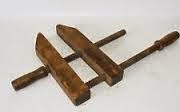
Toolbox Tuesday- Carpenter's Hand Screw Clamp


Carpenter’s Hand Screw Clamp
 
 
A hand-screw clamp Carpentry. is a clamp having two wooden jaws that are adjusted by two long screws.  A clamp is a fastening device to hold or secure objects tightly together to prevent movement or separation through the application of inward pressure. In the United Kingdom and Australia, the term cramp is often used instead when the tool is for temporary use for positioning components during construction and woodworking;  There is historical evidence that clamps made of iron and or wood have been used since at least the 17th century.  Both wooden and wood-and-steel designs can be loosened or tightened by gripping them with both hands, a handle in each hand, and rotating the clamp. A clockwise rotation tightens the clamp.  A hand-screw clamp, like that pictured above, can be used when you do not want to mar the surface of the object you are clamping or when you are working with odd shapes. Choose a hand-screw clamp when working with fabric, wood and plastic, as well.  This tool is quite easy to use; you simply open the jaws of your hand-screw clamp and positionhttp://images.intellitxt.com/ast/adTypes/icon1.png it on either side of the object you want to clamp. Keep the clamp and object parallel.  Use both of your hands to tighten each of the clamp's screws. Apply equal pressure to both screws. Keep the vise jaws parallel to the edges of the clamped object to ensure it is held equally by both wooden jaws of the clamp.