Showing posts with label Music of WWII. Show all posts

Wednesday, September 30, 2015

World War Wednesdays: Country Music and the World Wars


     This week's post is for any country music fans out there! I've always been a huge fan of the good old country classics, and this week I thought it would be interesting to combine two of my favourite things and discuss how it was affected by wartime. You'll be sure to recognize some names and hopefully even some songs!

First World War

     Commercial country music as we know it has its origins in the aftermath of the First World War, during the 1920s. America was determined to return to a peaceful, normal life, and country recordings in the 20s and 30s reflected that sentiment. A noteworthy exception is one side of Jimmie Rodgers's very first recording, "A Soldier's Sweetheart", which recalls "that awful  German war". In general, most songs from this period which dealt with war as a theme were about the American Civil War two generations earlier, usually told from the Southern perspective.
Jimmie Rodgers
   
 Here is a link to the 1927 recording: https://www.youtube.com/watch?v=s0BSfRSouhs

Second World War

     Between 1939 and 1941, America once again saw itself surrounded by a world in conflict, before the Japanese attack on Pearl Harbor in December 1941 caused them to fully enter the war. Denver Darling recounted that fateful day in his song "Cowards Over Pearl Harbor".
Denver Darling
   Singer-songwriter Carson Robison produced a number of wartime ballads that would cause quite a stir with audiences today, such as "Here We Go to Tokio, Said Barnacle Bill the Sailor," "We're Going to Slap the Dirty Little Jap," and the double-sided "Hitler's Letter to Hirohito" and "Hirohito's Letter to Hitler".
   
    The real patriotic hit for 1941 came out of New York through singer Elton Britt. Called "There's a Star-Spangled Banner Waving Somewhere", the song told the unforgettable story of a crippled mountain boy wanting the "help bring the Axis down a peg".

     Here's a link to the catchy patriotic tune: https://www.youtube.com/watch?v=lG3y4dyBqTs

     Remarkably, country music experienced some major changes as a result of the Second World War. Before 1941, it was a regional product of the American south, but as the war threw Southerners all over the world for service and domestic war industry jobs, they took their music with them. The audience thus exploded and songs became recognized not only nationally but globally.

     Eight months into the war, in August 1942, a musicians' union strike resulted in a ban on all new recordings which lasted up to two years. By 1944, of course, the war was still being fought, and country music had not lost any of its previous patriotic enthusiasm. Gene Autry, then a pilot in the Asian theater, released "At Mail Call Today", Eddy Arnold had "Mother's Prayer" and "Did You See My Daddy Over There", And Bob Wills recounted the Pacific war with "White Cross on Okinawa" and "Stars and Stripes on Iwo Jima".

    In addition, Ernest Tubb released the song that inspired this week's post: "Soldier's Last Letter". It's a moving and emotional tune written by Redd Stewart during his time as a sergeant in the South Pacific. When Tubb released it in 1944, it became a No. 1 hit on the country charts and stayed there for four weeks. Merle Haggard later had a hit single with the song in 1970.
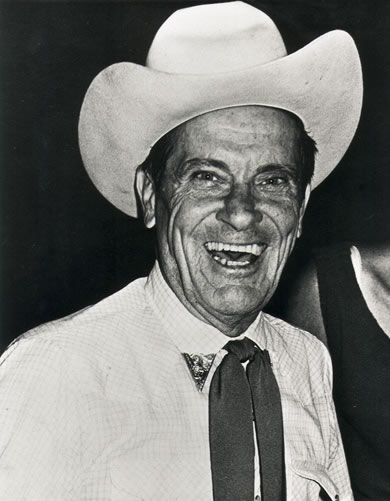
The great Ernest Tubb
     Here's a link to the song: https://www.youtube.com/watch?v=DBTN9ABhlSc

    Overall, the Second World War saw a major shift in the tradition of country music and wartime, which was born out of the post-WWI period. Some of these songs are tied to the most infamous names in country music, and they're as great to listen to today as they were in the dark days of their release. Country music owes a lot to this time in history, as well as the artists who gave it both a voice and a twang.

Supplementary Information courtesy of "Country Music At War" by Ronnie Pugh for CMT.

Thanks for reading,
Delany

Wednesday, May 27, 2015

World War Wednesdays: Music of the Second World War

Fay McKenzie dancing the jitterbug with a serviceman at the Hollywood Canteen.
    
     One of the most popular aspects of history (and one of my favourites) is social/cultural history because it really allows us to get a glimpse of life was like for people in the time period of study. In the case of the Second World War, this aspect is of particular interest because it was the first conflict that occurred when technological advancements allowed for the popularity of media such as radio, film and music. An especially interesting component of this is the manner in which these media were used by government organizations to influence the perspectives of the people through propagandistic means. This week's post will focus on a few major elements of music during the Second World War from the various sides of the conflict.

America
Popular pop trio The Andrews Sisters
     The U.S just like any other country was able to utilize the exponential growth of the technological age to compose music for various reasons.
With the war brewing through the 1940s, initiatives to help the soldiers continue fighting arose. With drafting numbers reaching close to 500,000, the Army along with other Defense institutions began to make military bands which would serve the purpose of boosting morale in the Home Front, while at the same time keeping Patriotism and Nationalism at an all-time high. The first patriotic war song of WWII in the U.S was “God Bless America” written by Irving Berlin for a World War I wartime review, but was withheld and later revised and used in World War II. There were many other popular patriotic wartime songs during this time like, “A Nightingale Sang in Berkeley Square” by Glenn Miller and “Arms for the Love of America” by once again Irving Berlin in 1941.
     After successful incorporation of music into the war efforts, more was needed in order to keep hopes alive and stable both back in the U.S and in the Home Front. Various times music was used as a tool for battle in the war, whether it was to entertain or to recuperate the soldiers during the war. More importantly was the impact that the music during the 1940s had on the people then and the effect that it continues to have now.
    

V-Disc 39A, "Moonlight Serenade", by Glenn Miller and His Orchestra, November 1943
     V-Disc ("V" for Victory) was a morale-boosting initiative involving the production of several series of recordings during the World War II era by special arrangement between the United States government and various private U.S. record companies. The records were produced for the use of United States military personnel overseas. Many popular singers, big bands and orchestras of the era recorded special V-Disc records.

     One of my favourite examples of American WWII music is the song "There'll Be a Hot Time in the Town of Berlin" performed by Bing Crosby and the Andrews Sisters in 1944. Here's a link to the song from its Decca recording: https://www.youtube.com/watch?v=8vQo70E42gY

Britain
Dame Vera Lynn
    
Before the war, BBC radio had had quite an elitist approach to popular music. Jazz, swing or big band music for dancing was relegated to a few late night spots. During the war, the BBC was obliged to adapt, but not without conflict. The BBC establishment reluctantly increased the amount of dance music played, but censorship was severe. The American hit "Coming in on a Wing and a Prayer" for example was censored because of its almost blasphemous mix of religious words and a foxtrot melody. BBC heads were also worried about American-style crooners undermining the virility of British men. The BBC establishment tried hard to stick to the jaunty tone which they felt had helped to win the first world war - so George Formby and Gracie Fields were very much played on the radio. Indeed, these two stars were undoubtedly more heroes to working-class people in Britain than was Winston Churchill, since they were seen to "come from the ordinary people."
     The most famous single performer was Vera Lynn who became known as "the forces' sweetheart".
She has become known for performing such songs as "(There'll be Blue Birds Over) The White Cliffs of Dover", "We'll Meet Again", and "When the Lights Go On Again".
     "We'll Meet Again" is a very powerful song which reminds us of the relationships built and torn apart during the course of the war. I've included a ling to Vera Lynn's performance of the song along with a touching video: https://www.youtube.com/watch?v=cHcunREYzNY

Germany
 
German composer and infamous anti-Semite Richard Wagner
     The Nazi government took a strong interest in promoting Germanic culture and music, which returned people to the folk culture of their remote ancestors, while promoting the distribution of radio to transmit propaganda. The Nazi government had an obsession with controlling culture and promoting the culture it controlled. The Nazis were determined to the concept that German Culture was the greatest in history, but as with all parts of art Hitler took an interest in suppressing the work of all those considered unfit while promoting certain composers as proper Germans. Therefore, the Government officially acknowledged certain composers as true Germans while seeking to eliminate Jazz and other styles seen as inferior.
     Even when new songs and other media were released which seemed to be free from a propagandistic message, there was still an underlying theme present which adhered to Nazi ideology. The example I've included is this catchy little clip from the 1936 film Gluckskinder with  song called "Ich wollt, ich war ein Huhn", which means "I wish I were a chicken". It's not exactly from wartime but it was released during Nazi leadership. Even if you aren't a German speaker, you can still note the traditional appearance and role of the female character. There is also a portion of the song which discussed various areas in Germany, which is in accordance with the ideas of German regionalism prevalent at the time. Here's a link: https://www.youtube.com/watch?v=1hgUx9h3nU4

     Overall, the music of the Second World War is one of my favourite things to study. I hope you enjoyed hearing some of the different pieces, and maybe even remember some of them!

    Thanks for reading,
    Delany