Showing posts with label Anniversaries. Show all posts

Wednesday, August 23, 2017

World War Wednesdays: Dieppe 75th Anniversary

 A German photograph of the aftermath of the Dieppe raid, Royal Canadian Air Force
     This past Saturday marked 75 years since the Dieppe raid during the Second World War. Dieppe is a complicated event to commemorate, and I hope to do it justice, so I wanted to begin with a link to the official Government of Canada overview:
http://www.veterans.gc.ca/eng/remembrance/history/second-world-war/1942-dieppe-raid
Followed by oral testimonies of veterans who served there: https://www.youtube.com/watch?v=otYbcd9sFrQ
     In the case of Dieppe, it is important to understand the soldiers' perspectives and truly account for their horrific experiences. This event, more than any other, demonstrates the futility of warfare and the vast distinction between those who send the orders and those who must act upon them.

     As with most anniversaries, I like to tie in a local connection, and found an interesting one with the story of Lieut.-Col. John Andrews. It is told through a series of articles in the St. Thomas Times-Journal over around 20 years and demonstrates how people on the home front were informed of the fate of their local soldiers.
St. Thomas Times-Journal, Jan. 16, 1942
PROMOTED LT.-COLONEL
     The promotion of Major John Andrews, son of Col. and Mrs. W. A. Andrews, 33 Roseberry Place, to the rank of Lieutenant-Colonel about the first of December last has been learned of here. At the age of 32, he is one of the youngest men of that rank in the Canadian Army, either in Canada or overseas, there being only two younger so far as is known. Lt.-Col. Andrews is now in command of the Calgary Tank Battalion with the Canadian Corps overseas, succeeding Lt.-Col. Bradbrook, of Calgary, who recruited the battalion and took it overseas, and who has since been posted to other duties with the Middle East Command. The battalion is part of the Canadian Corps troops and is understood to have the newest of British tank equipment. Lt.-Col. Andrews has been overseas since about the middle of last year, having preceded to England as brigade major of the tank regiments which left Canada at that time. He had previously been stationed at Camp Borden as a tank expert, his special training having been with tanks and other armored fighting  machines for several years prior to outbreak of the war. He had taken senior officers' tank courses in England before the war and was thoroughly grounded in all their features and uses.

St. Thomas Times-Journal, August 1942
      Lieut.-Col. John Andrews, son of Lieut.-Col. and Mrs. W. A. Andrews, 33 Roseberry Place, who is reported missing from the Dieppe raid last Wednesday. He was in command of the Calgary Tank Battalion, and was one of the youngest men in the Canadian Army to hold the rank of lieutenant-colonel. He was 33 years old, a native of St. Thomas. By a coincidence, his paternal grandfather, Foster Andrews, a pioneer resident of St. Thomas, observed his 91st birthday, Friday, the day that word came that Lt.-Col. Andrews was missing. The message was received by Mrs. Andrews of Barrie, Ontario who was on vacation in the northern part of the province with her two-year-old daughter. Mrs. Andrews is a Winnipeg young woman. She communicated with her husband's parents in this city Friday night. Although official details have not been received, Lieut.-Col. Andrews is believed to have per-" (article not continued)

St. Thomas Times-Journal, September 1942
LIST BARRIE OFFICER MISSING AFTER RAID
Fear Was on Boat Hit by Shell at Dieppe
Barrie, Sept. 16
     Lieut.-Col. John Gilby Andrews, 33, officer commanding 14th Army Tank Battalion (Calgary regiment)is reported missing in the official Dieppe casualty list. His wife, Mrs. Eleanor Catherine Andrews, Clapperton St., Barrie, has been informed the young officer was last seen leaving his tank with his crew for a launch, and that the launch was hit directly. Col. Andrews was one of the "originals" of the Canadian Armored Corps at Camp Borden, who established the Canadian Armored Fighting Vehicles school there, May 1, 1938. Mrs. Andrews and their two-year-old daughter Susan reside at Barrie; his parents and a sister, Geraldine, live in St. Thomas, and another sister, Jean, wife of Lieut. Pat McGiverin, Royal Regiment of Canada, in Toronto.

St. Thomas Times-Journal, Oct. 4, 1958
Col. Andrews to Attend Unveiling at Brookwood
     When Queen Elizabeth on Oct. 25 unveils the Brookwood Memorial in England, which commemorates 3,500 men and women of Commonwealth land forces who died at sea, on raids and in other missions and actions during World War II, and who have no known graves, among the many Canadians watching will be Lt.-Col. Warren A. Andrews, St. Thomas Civic Defense co-ordinator. The Brookwood Memorial, standing in the Brookwood cemetery near Woking, Surrey, contains the names of 148 Canadians- among them the name of Lt.-Col. John Gilby Andrews, the son of Col. and Mrs. Andrews was a 33 year-old officer commanding the 14th Armored Battalion (Calgary Tanks), when he was killed at Dieppe. An "original" of the Canadian Armored Corps at Camp Borden, he helped establish the Canadian Armored Fighting Vehicles School there in 1938. Col. Andrews will sail from Montreal to England on Oct. 14. Arriving Oct. 20, he will visit his granddaughter, Miss Susan Wallace, who lives in Southport. Together, they will attend the unveiling ceremony of the Brookwood Memorial.

St. Thomas Times-Journal May 6, 1961
New Hangar at Meaford Range Named for Col. Jack Andrews
     Military personnel of the Meaford Armored Fighting Vehicle Range will be hosts in a dedication ceremony on Sunday, May 14, to commemorate the name of Lt.-Col. J. G. Andrews, who commanded the Calgary Regiment at Dieppe and who died in that action. The name, "Andrews Hangar" is being given to a new tank hangar which was built at the Range. This occasion affords the Royal Canadian Armored Corps an opportunity to record its appreciation for the services rendered by one of its original officers. Lt.-Col. Andrews was born in 1902 in St. Thomas, the son of Lt.-Col. W. A. Andrews and Mrs. Andrews, Roseberry Place, and attended school at St. Thomas Collegiate Institute. After graduation, he was employed in a local bank and soon became interested in the Militia and was appointed as a provisional lieutenant in the Elgin Regiment in 1928. This was his father's regiment. In 1930 he decided to make the Army his career and was attached to the Royal Canadian Regiment in August of that year. After completing a course at Royal Military College, Kingston, he was posted to the Princess Patricia's Canadian Light Infantry.
IN AT THE START
     In 1936, a Canadian Tank School was established at London, Ont. This school was commanded by Major F. F. Worthington, MC and bar (afterwards Major-General F. F. Worthington, CB, MC, MM, CD). Lt. Andrews was selected for posting to this school as an instructor. In 1938 the school moved to Camp Borden and was redesignated the Canadian Armored Fighting Vehicle School. Lt. Andrews was promoted to captain at this time and transferred to the AFV School, still as a member of the PPCLI. During the next year he held posts at National Defense Headquarters and the Directorate of Military Training in Ottawa and later was brigade-major at headquarters, Army Tank Brigade. In June 1941 he went overseas in that capacity, and thus ended his five years as a technical officer and instructor in the use of tanks. Major Andrews has been in on the birth of what is now the Royal Canadian Armored Corps. On December 3, 1941, Major Andrews was promoted to the rank of lieutenant-colonel and appointed to command the 14th Army Tank Battalion (Calgary Regiment). This was the first unit of the Canadian Armored Corps to go into action. The Dieppe Story is well known and the loss of Lt. Col. Andrews was one of the many tragedies of the day. Lt.-Col. Andrews was married in 1937 in Winnipeg to Eleanor Catherine Allan. They had one daughter, Susan, born in Barrie, who will unveil the memorial plaque on the "Andrews Hangar." His wife has since remarried, and is now Mrs. Ben Wallace, of Toronto. 
ATTENDING FROM HERE
     The ceremony next Sunday will be attended by Col. Andrews's father and mother, who will accompany their daughter, Mrs. T. Patrick McGiverin and Mr. McGiverin; Lt.-Col. F. H. Medcalf, honorary lieutenant-colonel of the Elgin Regiment, and Mrs. Medcalf; Lt.-Col. J. W. McNeil; and Mr. and Mrs. Hugh Agnew.

     The Doc Alexander Blog describes the circumstances of Lt.-Col. Andrews's death:
"Andrews, Lt.-Col. John Gilby- The 33-year-old commanding officer of the CATR was Killed in Action on Aug. 19, 1942 during the Dieppe Raid. Andrews, who was commanding 'Regiment,' a Churchill MkII, attempted to land his tank on White Beach. But unknown to him, it appears that the waterproof cover had ripped as Regiment left Tank Landing Craft No. 8. The tank sank into roughly six feet of water and the engine flooded and died. Doc Alexander reports in his Dieppe journal that a few of the men climbed out of Regiment and were picked up by a small L-boat. Doc Alexander wrote: 'Some of the men escaped from the turret and I saw them picked up by a small L-Boat which immediately put out to sea, but only traveled a short distance when it received a direct hit from one of the shore batteries and burst into flames. I saw the men again jump into the water, but we do not know whether they were again picked up or not." Andrews was initially reported missing following the Dieppe Raid, but it was later confirmed that he had indeed been killed."

     Finally, check out this collection of artifacts from Dieppe, including Lt.-Col. Andrews's Memorial Cross: https://www.thestar.com/news/insight/2017/08/18/shackles-pebbles-and-posters-the-raid-on-dieppe-in-10.html

     Thanks for reaching the end of this little Dieppe conglomeration; I hope that it enriched your reflections on that tremendous event.
     Thanks for reading,
Delany (@DLeitchHistory on Twitter) 

Tuesday, June 13, 2017

166th Anniversary of the First Backus Meal

 Today, June 13, 2017 marks 166 years since Andrew and Mary Jane Backus and their family ate their first meal together in the kitchen of their completed home (June 13, 1851). Enjoy some great photos of the kitchen today, taken during our Road to Culloden event in May by Education Coordinator Kaitlin Crow!


Wednesday, June 7, 2017

World War Wednesdays: "Today not Tomorrow:" The First Hussars on D-Day

Tank and Plaque commemorating the First Hussars on Juno Beach, Tillsonburg Military History Club
     Yesterday marks 73 years since the momentous D-Day landings during the Second World War. To honour the occasion, I've chosen one of Southwestern Ontario's greatest stories and hope it makes you proud to be both Canadian and from the area!

     I don't want to get too much into a history of the First Hussars Regiment because I hope to do a full-length one in the future, but I'll just begin by saying that it was based in London and was formed from a highly decorated Cavalry militia troop dating back to 1835.
     The First Hussars were the first Non-Permanent Militia unit to be mobilized upon the outbreak of the Second World War, moving overseas as part of the 5th Canadian Armored Division in 1941, and continued training until D-Day. The Juno Beach website describes the Regiment's experience on June 6, 1944:
"The 1st Hussars Regiment was from London, Ontario. The 1st Hussars were equipped with DD (Duplex Drive) tanks. The tankers of the Hussars supported the Regina Rifles at Courseulles, the Winnipeg Rifles at Graye-sur-Mer and the Canadian Scottish on the right.
'B' squadron supporting the Reginas, landed at Courseulles at 0755 hours with 14 out of the 19 tanks remaining. The DD tanks engaged the German guns from a distance of 200 yards. An 88mm beside the harbour exit and a 50 mm behind it fired continuously until their protective shields were pierced by shells. A 75 mm on the right flank fired 200 rounds before it was knocked out. No tanks were lost in the spirited duel. When the Regina Rifles landed, they fought their way into Courseulles, and once beyond the town the tank squadrons reunited with their affiliated infantry battalions and worked their way inland against machine-gun nests and entrenched infantry.
Sherman tanks on the move.Seven 'A' squadron tanks landed a few minutes after the Winnipeg Rifles, on the beach west of Courseulles where the German defences included three blockhouses and more than thirteen concrete gun emplacements. The tanks fired on the 50 mm anti-tank gun emplacements. Five more tanks were landed by a LCT that earlier had had problems with its ramp. As soon as the anti-tank guns on the beach had been destroyed, the DD tanks began to cruise up and down the beach engaging the machine gun nests permitting the infantry to sweep over the dunes to begin their push inland. There were delays in creating beach exits, but the engineers were able to clear a path and complete a causeway at 0920 hours and 'A' squadron began to move toward their first objective, Graye-sur-Mer.
The regimental history gives the following description: "D-Day Operation Overlord. At 0730 hours 6th June, 1944, the 6th Canadian Armoured Regiment (1st Hussars) in support of the 7th Canadian Infantry Brigade of the 3rd Canadian Division assaulted and overpowered the Hun's beach defences between Courseulles-sur-Mer and Bernières-sur-Mer and after wiping out enemy resistance moved inland…. During the rest of day the Shermans scurried here and there as the Winnipeg Rifles pressed inland and gave fire support to neutralize enemy positions. Whenever the 'Pegs' were pinned down the tanks played a role in helping the infantry to clear each successive town as the advance moved on."
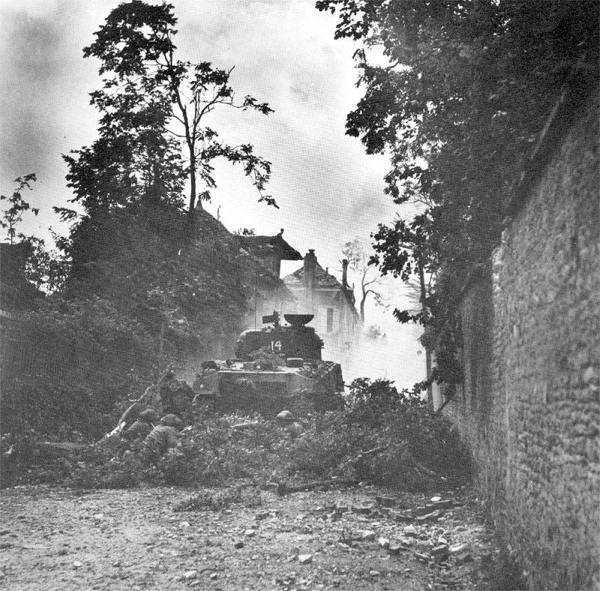
Infantry take cover behind Sherman tank during street fighting. 'B' squadron, reduced to half-strength and numbering only nine tanks, was severely hit when hurrying to the aid of infantry attacking Pierrepont. Five tanks were lost to fire from a well handled 88mm gun. Sgt Leo Gariepy: "I saw Lieutenant McLeod's tank burst high in flame. The troop corporal's tank suffered the same fate, and I saw several other tanks knocked out." Gariepy saw the muzzle on an 88mm gun rising from a hidden emplacement 30 yards ahead, the barrel pointing directly at him. "I gave rapid evasive orders to my driver and told my gunner to blast him. He fired two rounds; the second scoring a direct hit. I moved up to the gun emplacement and shot all the crew of 14 cowering in the trench."
After helping the Winnipeg Rifles through Creully, one troop of 'C' Squadron commanded by Lt. W.F. McCormick pushed on towards the objective and made it all the way to the north edge of Secqueville-en-Bessin without encountering any opposition. The troop had probably got closer to the final objective than any other element of the Allies' seaborne assault forces, but finding themselves isolated without infantry or anti-tank support they retraced their steps and rejoined the regiment.
The regimental history: "In view of the losses in DD tanks due to the unsuitable weather, the First Hussars ended D-Day with a considerably smaller number of tanks than was desirable for their first night in Europe. In addition, the infantry continually had to anticipate Jerry counter-attacking heavily with armour in an attempt to kick them back on the beaches. However, the eventual appearance of the tanks with their capability of needling out the MG posts raised the morale of the infantry, so that by nightfall Harry Foster's 7th Brigade was firmly astride the line running through Fontaine-Henri, Pierrepont and St. Gabriel."
After dark the First Hussars tanks rallied in a harbour on high ground south-west of Pierrepont." (www.junobeach.info/juno4-8.htm)
Elgin County Archives
     Among them was Crinan, Ontario's own Cpl. Albert Cook. The son of Mr. and Mrs. Charles Cook, he had enlisted with the First Hussars in September 1939 and ultimately served six years. He was wounded during the D-Day Operations. (Crinan Women's Institute Tweedsmuir History)

     Ultimately, tanks of the First Hussars were the only ones to reach their D-Day objectives during that fateful operation (Phil Egan, The Sarnia Journal, Nov. 10, 2016). Following their Normandy landing, they went on to take part in the brutal fighting in the bridgehead, the closing of the Falaise Gap, and the clearing of the cross channel guns at Calais. "They fought with distinction through Belgium and Holland and ended the war in Germany. During this period, the First Hussars won 72 Decorations, Certificates, or Mentioned in Dispatches, more than any other unit in the 1st Canadian Army, and were awarded 20 Battle Honours for outstanding Bravery." (1st Hussars Cavalry Fund)
First Hussars D-Day veterans William Reed, left, Aris Domnas, Arthur Boyle and Philip Cockburn were among more than 200 people who attended the annual D-Day reunion ceremony at Victoria Park Sunday, June 1, 2014. (DEREK RUTTAN/ The London Free Press)
     "William Reed, sitting near the “Holy Roller” tank that had once rumbled up the beaches of Normandy, wiped his eyes and remembered.
Nearer to the moment than most of the 200 people in the crowd as part of a D-Day remembrance reunion, Reed had been in that same tank as a 21-year-old gunner when his crew landed on Juno Beach.
They were Reed, Frank White, Frank Fowler (who came up the name “Holy Roller”), Terry Doherty and Everett Smith — five men among thousands of Allied forces to take part in a turning-point battle of the war.
“I was almost in tears last night,” reliving those days and his comrades, said the 91-year-old who made the trip to London from his home in Fort Erie.
He was one of four D-Day veterans to attend Sunday’s remembrance event in London’s Victoria Park.
There, the Holy Roller, a permanently mounted Sherman tank, stands tribute to the Canadian war effort and to the 700 men of the First Hussars regiment.
The tank is believed to be the only one that made it all the way from D-Day through France, Belgium and Holland into Germany. 
Reed served during every year of the war. But he laughs off notions that he was a war hero.
“My biggest achievement was staying alive,” he said. “I did what my dad said: ‘Don’t volunteer for anything and keep your head down.’ ”
Derek Ruttan, The London Free Press, Sunday, June 1, 2014
     In addition to the "Holy Roller" in London, "Calamity," another First Hussars tank, is on permanent display outside the Sarnia Legion (Royal Canadian Legion Branch 62), and "Bold" remains stationed in Normandy (seen in title). These powerful machines, now silenced, stand as moving tributes to the men who served on them that fateful day in June 1944 and throughout the Second World War. May we never forget for a second how lucky we are that they did. 
     Thanks for reading,
Delany (@DLeitchHistory on Twitter)

Wednesday, April 5, 2017

World War Wednesdays: Vimy Ridge 100th Anniversary


A replica of the Canadian Vimy Ridge memorial carved from ice at Winterlude in Ottawa, February 2017
     As I'm sure you're all well aware, this upcoming Sunday, April 9 marks one hundred years since the start of the battle of Vimy Ridge, an iconic moment in Canadian history. As such, it has been one hundred years since Wallacetown's own Ellis Wellwood Sifton lost his young life on the ridge in a selfless act of bravery. In past years, we've looked at the battle in detail, explored the Ellis Sifton story, and reflected on past commemorations of the battle in Elgin County. This year being such a significant anniversary, I thought it would be better to encourage you all to experience, rather than read about, this centenary. I've put together a guide to commemoration events wherever I may have readers, and hope you'll all find the opportunity to participate in at least one.

Elgin County
A young Ellis Sifton at home with his dog, courtesy of Elgin County Archives
     The Elgin County Museum is hosting a special edition of its annual Vimy Lecture featuring local history buff Blair Ferguson at St. Peter's Anglican Church, Tyrconnell (where Ellis Sifton attended church), on Sunday at 11AM. Here is some further information: http://www.elgincounty.ca/museum/news/7th-annual-vimy-lecture
http://www.stthomastimesjournal.com/2017/03/27/elgin-county-museum-commemorates-vimy-ridge-soldier-ellis-wellwood-sifton
General Sir Arthur Currie being knighted 
Strathroy
     The hometown of General Sir Arthur Currie is working on a wonderful project to commemorate the anniversary, which features the planting of an "honour guard" of one hundred maple trees on the east side of Adair Blvd as a living tribute to those who served. The ceremony is scheduled for Sunday beginning at 11AM with the tree planting event on April 22 at 8AM. More details: https://www.eventbrite.ca/e/vimy-100th-anniversary-commemoration-and-lgh-groundbreaking-ceremony-tickets-32591777885?aff=es2
https://www.eventbrite.ca/e/vimy-100th-anniversary-commemoration-and-lgh-groundbreaking-ceremony-tickets-32591777885

Chatham-Kent
     Local history buffs in Chatham-Kent have organized an anniversary ceremony to be held on Sunday at Christ Church, beginning at 2PM. Details: http://chathamvoice.com/2017/04/05/local-historians-remember-the-fallen-at-vimy-ridge-during-100th-anniversary/

Ottawa:
     An evening of remembrance and overnight vigil will be held at the National War Memorial on Saturday, April 8 starting at 7PM, followed by the official government ceremony also at the memorial on Sunday beginning at 8:30AM. Here is some more information: http://www.veterans.gc.ca/eng/remembrance/history/first-world-war/vimy-ridge/100-anniversary/events-in-canada

     Also, the Canadian War Museum is offering free admission on Sunday so that the public can join them in commemorating the anniversary with the unveiling of the new Vimy Ridge exhibit in Gallery 2. Find out more here: http://www.warmuseum.ca/event/gallery-2-vimy-renewal/

     I hope you'll endeavor to take in some of your area's Vimy programs, and please advise if I've missed any events or you don't see your community on the list!
     Thanks for reading,
Delany (@DLeitchHistory on Twitter)

Wednesday, December 21, 2016

World War Wednesdays: The Christmas Truce, 1914


     When we think of the First World War, which, for many of us, was a regular occurrence this year, we often think of a period marked by unprecedented levels of horror and hardship with no clear rationale. Indeed, between 1914 and 1918, over twenty-five million people were killed or wounded around the world. However, what we do not often reflect upon are the moments of joy that did come from those mud-filled trenches; the few periods of respite from the suffering and carnage. I feel that World War Wednesdays would be remiss if we did not dedicate one of the most legendary of such moments to the annual Christmas post, and hope it will serve as another humbling reminder of how fortunate we are today.

     It was during the first Christmas of the war when men from both sides of the Western Front laid down their arms, emerged from the trenches, and shared in food and drink, games, and fellowship in an unofficial and illicit truce. While it lasted, it was an extraordinary flicker of humanity amid one of civilization's darkest hours, even prompting the sober Wall Street Journal to observe: “What appears from the winter fog and misery is a Christmas story, a fine Christmas story that is, in truth, the most faded and tattered of adjectives: inspiring.”


British and German troops meeting in No-Mans's Land during the unofficial truce. (British troops from the Northumberland Hussars, 7th Division, Bridoux-Rouge Banc Sector), Imperial War Museums

   
The first signs of abnormality began appearing on Christmas Eve, when at around 8:30 p.m. an officer of the Royal Irish Rifles reported to headquarters: “Germans have illuminated their trenches, are singing songs and wishing us a Happy Xmas. Compliments are being exchanged but am nevertheless taking all military precautions.” Further along the line, both sides serenaded each other with carols, including the German "Stille Nacht" (Silent Night) and "The First Noel" by the British, as scouts cautiously began meeting in No Man's Land between the two sides. The war diary of the Scots Guards reads that a Private Murker “met a German Patrol and was given a glass of whisky and some cigars, and a message was sent back saying that if we didn’t fire at them, they would not fire at us.” 

     An important thing to remember is that this same basic understanding seemed to occur in various places all down the Front, with various groups of enemy soldiers arranging their own form of spontaneous Christmas truce. The most detailed estimate, made by Malcolm Brown of Britain’s Imperial War Museums, is that the truce extended along at least two-thirds of British-held trench line that scarred southern Belgium. Private Frederick Heath on the British side included in a letter home that “all down our line of trenches there came to our ears a greeting unique in war: ‘English soldier, English soldier, a merry Christmas, a merry Christmas!’” Then, the voices added: "‘Come out, English soldier; come out here to us.’ For some little time we were cautious, and did not even answer. Officers, fearing treachery, ordered the men to be silent. But up and down our line one heard the men answering that Christmas greeting from the enemy. How could we resist wishing each other a Merry Christmas, even though we might be at each other’s throats immediately afterwards? So we kept up a running conversation with the Germans, all the while our hands ready on our rifles. Blood and peace, enmity and fraternity—war’s most amazing paradox. The night wore on to dawn—a night made easier by songs from the German trenches, the pipings of piccolos and from our broad lines laughter and Christmas carols. Not a shot was fired."
British and German soldiers fraternizing at Ploegsteert, Belgium on Christmas day 1914, Imperial War Museums 

     According to Smithsonian Magazine, several factors contributed to the Christmas Truce. For one, the men in both sides of the trenches would have become veterans by December 1914, familiar enough with the realities of combat to have diminished the idealism they had carried with them to war that August, and most longed for an end to the bloodshed. They had so firmly believed that the war would be over by Christmas, but yet still they fought, freezing in rudimentary dugouts. Then, on Christmas Eve itself, several weeks of mild yet miserably soaking weather yielded to a sudden and hard frost which created a dusting of ice and snow along the lines. As a result, men on both sides felt that something spiritual was taking place.

     Interestingly, it was only in the British sector that the troops noticed at dawn that the Germans had placed small Christmas trees along the parapets of their trenches and responded with conviviality. As the Smithsonian discusses, this could be attributed to the fact that the Russians at that time still adhered to the old Julian calendar, which observed Christmas as January 7, and the French would have generally been far more sensitive to the fact that Germans were occupying about a third of France at the time. 

     The obvious language barrier between English and German meant that communication was difficult among the newly-acquainted troops, but they quickly found a common interest in "football" (soccer). Somehow, in one section a ball was produced, and British and German soldiers proceeded to take pleasure in kicking it about in a match which the Germans claim to have won 3-2. Due to the subsequent atmosphere of downplaying and condemning the truce on the part of the British, some of the most detailed accounts of the football matches come from the German side. These report that the 133rd Royal Saxon Regiment played a game against Scottish troops, which was reflected upon in a 1960s interview by 133rd participant Johannes Niemann: 
     "The mist was slow to clear and suddenly my orderly threw himself into my dugout to say that both the German and Scottish soldiers had come out of their trenches and were fraternizing along the front. I grabbed my binoculars and looking cautiously over the parapet saw the incredible sight of our soldiers exchanging cigarettes, schnapps and chocolate with the enemy. Later a Scottish soldier appeared with a football which seemed to come from nowhere and a few minutes later a real football match got underway. The Scots marked their goal mouth with their strange caps and we did the same with ours. It was far from easy to play on the frozen ground, but we continued, keeping rigorously to the rules, despite the fact that it only lasted an hour and that we had no referee.  A great many of the passes went wide, but all the amateur footballers, although they must have been very tired, played with huge enthusiasm... Us Germans really roared when a gust of wind revealed that the Scots wore no drawers under their kilts—and hooted and whistled every time they caught an impudent glimpse of one posterior belonging to one of “yesterday’s enemies.” But after an hour’s play, when our Commanding Officer heard about it, he sent an order that we must put a stop to it. A little later we drifted back to our trenches and the fraternization ended."

     Overall, the Christmas Truce was a temporary respite from the horrors of battle for both sides of No Man's Land that fateful night. In most places, it was accepted that the peace would be short-lived, but in a few cases the ceasefire was allowed to persist into the new year. After that, there were no further truces until the armistice of 1918 which many, if not most, of the Christmas Truce participants did not live to see. For those who did survive the war, it was certainly not something to be forgotten, and that story lives on in infamy a hundred and two years later.
     Many thanks to Smithsonian Magazine for the information. If you are interested in a phenomenal filmic portrayal of this story, I encourage you to check out Joyeux Noel (2005), which is based on a true story and includes the perspectives of Scottish, German and French forces during the truce. I'd like to take this opportunity to wish you and your families a Merry Christmas and safe and relaxing holiday, and thank you for taking the time to read this post.
       Gratefully,
Delany Leitch (@DLeitchHistory on Twitter)

Wednesday, August 17, 2016

World War Wednesdays: The Canadians at Hill 70

Canadians take a break in a captured German trench during the Battle of Hill 70 in August 1917. The soldiers on the left are scanning the sky for aircraft, while the soldier in the centre appears to be re-packing his gas respirator into the carrying pouch on his chest. Dust cakes their clothes, helmets, and weapons.
George Metcalf Archival Collection 
CWM 19920085-686
     This month marks yet another 99th anniversary related to the events of the First World War, and one that has not as of yet had any coverage by World War Wednesdays. I thought it would be a fitting tribute to give readers an overview of the events and what they meant for Canadians, while adding in some of the local research I compiled this past spring. 
Overview
     The central concept of Hill 70 is that the Canadian Corps attacked the northern France city of Lens in August 1917 in order to relieve pressure on other Allied troops who were fighting in Passchendaele, near Flanders.
     Sir Douglas Haig, commander of the British Expeditionary Force on the Western front, launched a strategic offensive in Flanders, east of Ypres, on 31 July 1917. Known as the infamous Passchendaele campaign, it was marked by intense fighting, heavy rain, and mud. All of these factors combined to result in a diminishing hope for significant breakthrough. In order to divert German reinforcements from the Passchendaele battlefield, Haig ordered attacks further south. One of these, involving the First Army, meant an attack at Lens by the Canadian Corps. 

Canadian soldiers used this ruined house west of Lens to shelter their water tanks. From here, water would be carried forward to soldiers in the trenches. This photo was taken in September 1917, about a month after the battle.
George Metcalf Archival Collection 
CWM 19920085-786
     Haig ordered Strathroy, Ontario's own Sir Arthur Currie, who in June had been placed in command of the Canadian Corps, to launch a frontal attack on the city of Lens. Instead of attacking the heavily-fortified city directly, however, Currie's studies of the land were enough to convince his British superiors that a better plan would be to capture Hill 70, directly to the north. If the significant hill could be taken, the Germans would have no choice but to counterattack. Currie thus planned for artillery and machine guns to smash the German concentrations in order to weaken their hold on the entire sector. 
     The Canadians attacked on 15 August and captured many of their objectives, including the high ground. They were then able to hold their positions despite 21 determined German counterattacks over the next four days. Subsequent Canadian probing attacks against Lens on 21 and 23 August were unsuccessful, but Currie's forces had inflicted severe casualties on the enemy and gained the high ground overlooking the city. 
     Ultimately, over 9,000 Canadians were killed at Hill 70, but an estimated 25,000 Germans were killed or wounded. Currie proved himself as an able and innovative commander, and his Canadian Corps soon moved north to assist Haig and his faltering Passchendaele campaign. 
Canadian troops inspect a captured German gun position near Lens, France in September 1917. Its concrete construction helped protect the defenders from bullet and shrapnel fire.
George Metcalf Archival Collection 
CWM 19930013-964
Commemoration
     On 15 August 2016, the Hill 70 Memorial Project commemorated the 99th anniversary of Canada's "Forgotten Victory" by recreating the photo used as the top of this post (which was taken at Hill 70) in tableau. It was staged in various locations across downtown Ottawa, with a piper leading the way to each spot. The event began at the Drill Hall at 11, and was seen at:
Valiants Gallery at 11:15-11:45
Parliament Hill at Noon to 1 pm
Sparks and Metcalfe at 3.30-4 pm
George Street near the Bay at 5 to 6 pm.
    Local Connections 
     As part of my research for the 100th anniversary of the departure of Elgin's own 91st Battalion, I was able to identify the battles at which some of our local veterans served. I wanted to include a list, with images where possible, of the Dunwich and West Elgin men who are known to have served at Hill 70. In doing so, I recognize that this is only a partial list, and hope that any readers with further information will share any additions to my database. 
William Doolittle, Dutton
William McNernie, Dutton
William Lodge, Iona
Leonard Munn, Dutton (wounded at Hill 70)

Ernest Rycroft, Iona 
Lance Corporal Wesley E. Sloan, Iona 
Leon Russell Auckland, Rodney
David Gill, Rodney
Frank Winfield Jannaway, Rodney
Hilton Day McNally, Rodney
Ross Farnham Peace, Rodney
Earl Russell Peace, Rodney 
George Henry Sayer, Rodney
Reuben Byfield, West Lorne
Roy Erskine, West Lorne
Boyd Erskine, West Lorne
Victor Earl Lemon, West Lorne
John Gyde, West Lorne

  Finally, I'd like to make special mention of the one local soldier who is known to have lost his life at Hill 70, William Harold Jacques. A native of Eagle, he enlisted in October 1915 and served at the Somme and Vimy Ridge with the 70th and 91st Battalions, as well as the 75th French Battalion. He was killed at Hill 70 exactly 99 years before this post was published, on August 17, 1917.

They were young, as we are young,
They served, giving freely of themselves.
To them, we pledge, amid the winds of time,
To carry their torch and never forget.
We will remember them

Special thanks to the Canadian War Museum for information and images, Lost Ottawa, and Elgin County Archives. Thanks for reading,
Delany (@DLeitchHistory on Twitter)

Wednesday, May 4, 2016

World War Wednesdays: Historical Randomness and Updates

"A Bridge in Tyrconnell," unidentified children, ca. 1900 courtesy of Elgin County Archives
     Hopefully you don't mind the break from tradition too much, but I was thinking it's been a long time since I've done a good old update and and general mismatched post! There just hasn't been as much time lately for me to write a good long one thanks to exams and wrapping up my third year at uOttawa, but I'm happy to say that it's all behind me now and I've returned to the Backus-Page House for the summer. I look forward to meeting as many readers as possible and hope to see you at all the exciting events we have coming up this season! Without further ado, I've compiled a random assortment of things I've been meaning to tell you for ages now and finally have enough of to compile:

Battle of the Atlantic Sunday
Veterans awaiting the arrival of dignitaries at the Battle of the Atlantic memorial ceremony in Ottawa
     This past Sunday, May 1 was observed as the occasion commemorating the Battle of the Atlantic during the Second World War, which is always done during the first weekend in May. As has been mentioned in previous posts which can be found to the right, the Battle of the Atlantic was the longest engagement of WWII and lasted the war's entire duration from 1939 to 1945. The Naval Association of Canada describes the Battle as the Royal Canadian Navy's "defining moment," making it "the lifeline for democracy and the key to ultimate victory." This was due to the Navy's essential role in escorting large Merchant Navy convoys which carried vital supplies between Canada and the United Kingdom. In addition to recognizing the incredible service of the men and women involved in the Battle of the Atlantic, I would also like to highlight the experience of Atlantic Canadians and Newfoundlanders who found themselves on the edge of such a dramatic and lengthy theater of war.

Local WWI Tune that's Worth a Listen
     You're not going to want to miss out on this one, especially not if you're from the local southwestern Ontario region. If you've ignored every other YouTube link I've ever posted up until now, this number is one to change your tune! The song is called "Stammering Song" or "K-K-K-Katy," and was composed by Chatham native Geoffrey O'Hara in 1917 and published in 1918. The sheet music advertised it as "The Sensational New Stammering Song," and "The Sensational Stammering Song Success Sung by the Soldiers and Sailors." It was first played at a garden party fundraiser for the Red Cross in Collins Bay on Lake Ontario. The inspiration for the "Katy" character in the song was Katherine Craig Richardson of Kingston, Ontario (who did not stutter), a friend of O'Hara's sister whose parents recall his writing the song in their living room.
     From May 1918 to January 1919, the song was a top 20 hit, and number one from July to September. It was recorded by Billy Murray on March 8, 1918 and released on Victor 18455. The song also made a comeback during the Second World War, when WWI songs became popular at training camps and were often preferred over more modern tunes. It was one of many brought to the front by officers who had heard it while on leave in England.
     Listen for yourself here: https://www.youtube.com/watch?v=BukkBfrVOHQ
Photo of Geoffrey O'Hara from the George Grantham Baine collection, Library of Congress
     Geoffrey O'Hara was born in Chatham, Ontario on February 2, 1882. Initially planning for a military career, he attended the prestigious Royal Military College in Kingston, Ontario at age 18 and trained with the 1st Hussars. After his father's death, he abandoned that career path and moved to the United States in 1904, where he began performing in Vaudeville. In 1905, he began recording for Edison Records, later conducting the recording of traditional Indian songs for the American government. During the First World War, he was a singing instructor of patriotic songs for the American troops. "K-K-K-Katy" was his most popular work by far and one of the most notable from the war in general, and O'Hara was later commissioned by the Woodrow Wilson administration to compose the modern-day version of the Star Spangled Banner.
   
91st Battalion Anniversary Weekend
     If you've been following my posts or the Backus-Page House blog in general, you've likely seen the calls for relatives of those who fought with our local 91st Battalion during the First World War to share some information in regard to the upcoming commemorative event this summer. The official schedule for the event was released today, so I thought I'd share it so that it can be fit into the busy summer schedule:
Friday, Saturday and Sunday June 24, 25 and 26, 2016
On June 25, 1916, the 91st Battalion, Canadian Expeditionary Force, numbering over 900 men, mostly from Elgin County and St. Thomas, marched to the MCR station on Talbot Street and departed for Halifax to fight overseas. Now exactly 100 years later the citizens of St. Thomas, the County of Elgin and the descendants of the original Battalion will again celebrate this proud moment in our history. 
Follow the 91st Battalion as we retrace their final weekend in St. Thomas!
Friday, June 24th, 2016
7-9 pm - come visit the historic encampment of the 91st Battalion set up on the grounds of the Armoury, 40 Wilson Avenue, St. Thomas. Meet with re-enactors; visit the tented camp, complete with a medical facility as it would have been in 1916. 
At sunset, 9:00 pm, plan to be at the Armoury as the re-enactors and serving members of 31 CER (The Elgins) lower the flags for the day and prepare for the evening routine. Once dark the names and stories of all 901 members of the original Battalion will be displayed on the outer wall of the Armoury – a roll call of the men who answered the call to duty 100 years ago. 
Saturday, June 25th, 2016
At 11:00, Saturday morning, the Battalion will march past City Hall on its way to the MCR station (now known as the CASO station). Be on Talbot Street to watch as the parade re-traces part of the historic march. 
Beginning at 11:30 a memorial plaque will be unveiled by descendants of the original 91st Battalion at the CASO station. Members of the community, friends and family are all welcome to attend this special event. At the conclusion of the dedication the troops will board trains, the band will play and the train will depart the station!
Join the 91st and their friends and family at a picnic at Pinafore Park. At 1:30 pm be at the band shell in the park for a 1916 picnic and music concert. Period music from the Henry Meredith Plumbing Factory Band, vintage vehicles, patriotic speeches and more! Bring a lunch and a lawn chair, no food or beverage will be provided. 
7-9 pm - come visit the historic encampment of the 91st Battalion set up on the grounds of the Armoury, 40 Wilson Avenue, St. Thomas. Meet with re-enactors; visit the tented camp, complete with a medical facility as it would have been in 1916. 
7-9 pm - Registered families and friends of the 91st Battalion will be welcomed into the recreated “Soldiers Canteen” to share stores, photographs and hear the stories of Battalion members. The Canteen, located at the Armouries is open only to registered participants. 
At sunset, 9:00 pm plan to be at the Armoury as the re-enactors and serving members of 31 CER (The Elgins) lower the flags for the day and prepare for the evening routine. Once dark the names and stories of all 901 members of the original Battalion will be displayed on the outer wall of the Armoury – a roll call of the hundreds of men who answered the call to duty 100 years ago. 
Sunday, June 26th, 2016
Trinity Anglican Church, 55 Southwick St., will again open its doors to members of the 91st Battalion as they host a memorial Church Parade and Remembrance Service starting at 10:00 am. The colours of the 91st were laid up at Trinity Anglican Church in 1935 within a chapel dedicated to the battalion and to the 173 men they lost. Everyone is welcome to the service and for a reception that will follow. 

    Well, that seems to be all I have in the mix for this week! Thanks so much for your continued interest in the Dutton letters and I'll be sure to continue with the rest of the collection in the weeks to come. 
     Thanks for reading, 
Delany (@DLeitchHistory on Twitter)

Wednesday, March 9, 2016

World War Wednesdays: Elgin County's Own: The 91st Battalion

The 91st Battalion colours

      It's come to my attention recently that there's a 100th anniversary coming up for Elgin County's own 91st Battalion, so I decided to make a post in honor of this amazing group of local heroes! Information is courtesy of a lovely project by James L. McCallum, which you can read in full here: http://www.elginogs.ca/Home/ancestor-indexes/military/age-shall-not-weary-them and photos are thanks to Elgin County Archives.
An assembly of the battalion, including their goat mascot, outside the barracks opposite the Wilson St. Armory, St. Thomas

     Elgin County's overseas battalion was formed on 25 October 1915, a year after Great Britain declared war on Germany. 940 men were trained for service under the command of Lt.-Col. Green, and it received its colours on 24 May 1916 after a parade through St. Thomas which ended at Pinafore Park.
Marching west on Talbot Street, St. Thomas

     A month later on 25 June 1916, the battalion was dispatched overseas after a march down Talbot Street that was witnessed by a crowd of 20,000 people. They traveled by train to Halifax, where on 28 June they set sail on the ship Olympic, arriving in Liverpool, England on 5 July.
Departing for deployment at the Michigan Central Railway Station, St. Thomas
     After ten days at Otterpool Camp, the battalion was transferred to the 3rd Canadian Training Brigade and split up in order to provide reinforcement to other units that had been depleted of manpower. Meanwhile, recruiting still continued in Elgin County, and over 2,400 men from the area volunteered their service during the course of the Great War.

Some interesting tidbits:

Recruitment Article from the Aylmer Express, 10 September 1914:
FIRST RECRUIT DRILL OF THE 30TH BATTERY
Will be Tomorrow Night at 7:30 p.m.
Names are Coming in Fast.  Get Your Name in Before Tomorrow Night

Have you joined the 30th Battery?  This is the question for every able bodied man in East Elgin. This is our own militia unit and is being raised by the people of this county for the defense of our own borders. No man who values his home or his loved ones, who believes in his country or honors his King will refuse to join.  The task before our own people here in Canada and possibly in Elgin may be very serious before this war is over.  If our shores were invaded by a hostile army every man would be a soldier if he could; but he would be no use without training.  This is the point.  The time to get the training is now. The 30th Battery Canadian Field Artillery requires at once one hundred men. The battery roll is at Mr. Wm. Warnock’s office in Aylmer. The young men of East Elgin should enlist. They should do it at once.
The first recruit drill will be held at 7:30 p.m., Friday, Sept. 11. The men will form up on Talbot St. in front of the new post office. The elements of infantry drill will be taught. Every man should be on hand for the first drill.  Lt.-Col. Walter James Brown will be in charge.
So far as Canadians and Britishers are concerned military service is no longer optional.  It is a duty that no true man will shirk.  Only those who have the necessary physical qualifications will be asked to go on duty; but the obligation of working and fighting for our country is on the shoulders of every man.  No one is exempt.  Every man in Canada between 18 and 60 may be called if required.  It would be an outrage if Canadians were forced to use the ballot to fill the ranks of the militia.  Let us have volunteers.  This is your opportunity. The Canadian Militia is a home defense force, organized, trained and maintained for the defense of our own homes and loved one. Every man should be a citizen soldier.  Will you?
Presentation of the 91st Battalion colours at Canterbury Cathedral, England, 1916

Excerpt from a diary entry by Pte. John William Cracknell (from the Kingsmill area) describing the voyage of the 91st Battalion:
     We have been on the boat now about two days.  After arriving in Halifax on June 28, about midnight, we stayed on the train until morning, then we boarded about noon and started to look over the ship.  This is the sister ship to the Titanic.  Is sure some size.  It’s main measurements are 822 feet long, 72 feet wide, height 104 feet from boat deck to keel. The boat deck is the one that the lifeboats are on.  There is another deck above this with a bridge.  No doubt you will be able to form some idea of the size of it from these measurements.  There are four smoke stacks on it and everyone of them is as big as an ordinary silo.  It is about 60 feet from the boat deck to the water level and about forty feet of this canoe is below the water.  By the time we get off this boat we will not have seen one quarter of it.  There are about 7,000 men on the boat, including the crew.  I might say here that I would like to have seen her as a passenger ship. Since being turned into a troopship she has been almost completely remodelled, all the costly fittings have been torn down and all staterooms but a few to accommodate the officers.  The ship is armed, carrying a rapid-firing gun fore and aft, besides a machine gun on the corners of the boat deck.  We had our first meal of hardtack when we came on the boat.  No wonder the government wants every man to have good teeth, until you get used to these biscuits, it is like eating bricks, besides there is scarcely any taste to them...

The Battalion marching along Main Street, Rodney, 18 February 1916
     The 100th Anniversary celebration event will take place from 24-26 June in St. Thomas. Anyone with relatives who served with the 91st Battalion is urged to contact markrobinmorse@bell.net to be a part of the commemoration!

Thanks for reading, 
     Delany (@DLeitchHistory on Twitter)