Showing posts with label Italian Campaign. Show all posts

Wednesday, August 26, 2015

World War Wednesdays: Time Machine 1943


     Life Magazine is synonymous with Second World War photography, and has captured and featured numerous iconic shots from the most critical moments of the war. At the beginning of the summer, I had the opportunity to purchase one of these original wartime magazines with the intention of using it as a primary source of information, and now seems like a great time to do so. The issue I bought is from 23 August 1943, so it seemed fitting for us to venture back in time to see what was making headlines exactly 72 years ago. I hope my amateur iPhone photography isn't too unbearable!

     The hot topic featured on the front cover of this issue is the newest dance style, the Lindy Hop. As the magazine declares, "A true national folk dance has been born in U.S.A.". Along with some instructional floor step instructions which also pay homage to the dance's roots in the black communities, the magazine had this to say about the country's latest dance craze:
     "In content, the Lindy Hop encompasses hundreds of individual steps, breaks and mutations originated by Americans inspired by American music. With the exception of the tap dance, it is this country's only native and original dance form. All others, "square" or "round", are importations and derivations from European prototypes. American dancers, however, have always been gifted with an aptitude for improvisation. And American jazz imperatively demands more exuberant responses than traditional dance steps can provide. Out of American impatience with the restrictions of conventional forms, the buoyant choreography of the Lindy Hop was born". (p.95)


     In terms of the action overseas, a critical area of focus at the time was the Italian Campaign. A large feature in the magazine is devoted to the surrender of the city of Palermo, during which iconic Life photographer Robert Capa entered the city with the American troops and captured some timeless shots.


     Life reported the events as follows:
     "The Germans last week were reported evacuating Sicily. Across narrow Messina Strait, under a protecting barrage of 500 AA guns, they were ferrying troops and equipment. But in spite of this evacuation, the spectacular Allied successes of the first few days of the campaign had given way to a slow undramatic advance. Over massive peaks and through deep, tumbling gullies American and British infantrymen inched ahead. On the north U.S. troops twice speeded up the advance by landing behind the Germans, but in the center of the line, near Randazzo, and beyond captured Catania, nothing much could be done except knock out the enemy pockets one by one".
"An American Medical Corpsman has shoes shined in Palermo while another soldier, his arms around a girl, waits in line"

     Features like this are interesting to see what life was like in August 1943 in terms of the major events happening in the world, but I am also interested in the content geared towards the everyday life of the time. For instance:

Advice for pickling and canning season


Hair tips for the dog days of summer

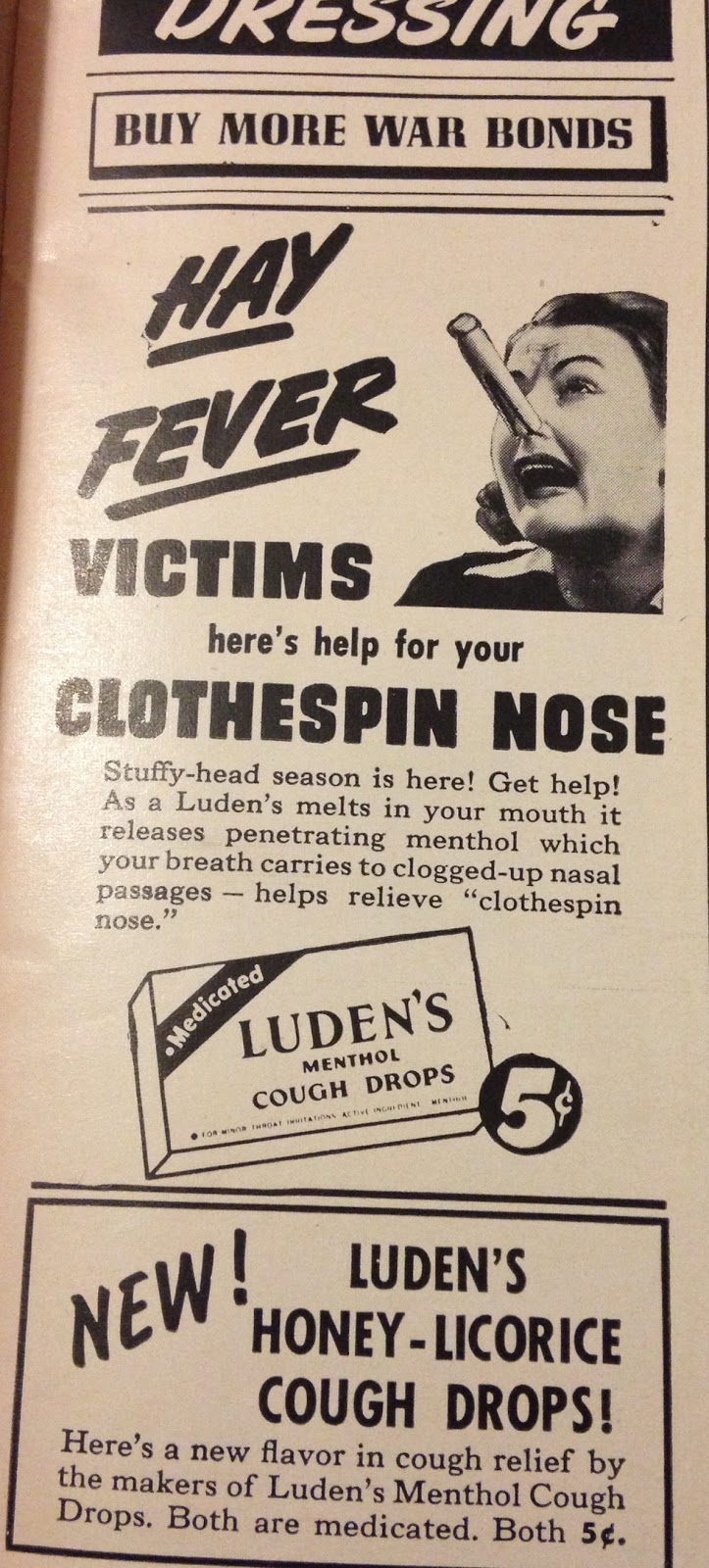
Ads for the poor "clothespin nose" hay fever sufferers like myself
And the beautiful yearnings for peacetime homes


I hope you enjoyed this little blast from the past! Life Magazine is a great source for getting a glimpse into what life was like at any given time, and I'm very happy to have found this edition.

     Thanks for reading,
         Delany

Wednesday, June 17, 2015

World War Wednesdays: Profile of a Hero

Ernest Alvia "Smokey" Smith
      I stumbled upon this crazy story recently and thought I'd use it to make yet another new feature for the blog to spotlight some of the most legendary wartime characters. This week's post is dedicated to Ernest Alvia "Smokey" Smith, who without a doubt is among the biggest hell-raisers to have ever lived.

     Like most of our heroes, Ernest Smith came from humble beginnings. He was born in 1914 in New Westminster, British Columbia, which meant that he had the misfortune of coming of age during the Great Depression. It is said that he earned the nickname "Smokey" for his blazing footspeed as a member of his high school track team. At age 25, he joined the Canadian Army and became part of the Seaforth Highlanders of Canada. He first entered combat in 1943 and remained active in the Sicily and Italian Campaign until 1945. He had a remarkable knack for annoying his superiors, and promoted to Corporal and demoted back to Private nine times!

     However, during this time, Smokey established himself as an unbelievable hero over the course of the events of a single night. Here's what went down, courtesy of the London Gazette, December 20, 1944:
"In Italy on the night of 21st–22nd October 1944, a Canadian Infantry Brigade was ordered to establish a bridgehead across the Savio River. The Seaforth Highlanders of Canada were selected as the spearhead of the attack, and in weather most unfavourable to the operation they crossed the river and captured their objective in spite of strong opposition from the enemy.
Torrential rain had caused the Savio River to rise six feet in five hours, and as the soft vertical banks made it impossible to bridge the river no tanks or anti-tank guns could be taken across the raging stream to the support of the rifle companies.
As the right forward company was consolidating its objective it was suddenly counter-attacked by a troop of three Mark V Panther tanks supported by two self-propelled guns and about thirty infantry and the situation appeared hopeless.
Under heavy fire from the approaching enemy tanks, Private Smith, showing great initiative and inspiring leadership, led his P.I.A.T. Group of two men across an open field to a position from which the P.I.A.T. could best be employed. Leaving one man on the weapon, Private Smith crossed the road with a Private James Tennant and obtained another P.I.A.T. Almost immediately an enemy tank came down the road firing its machine-guns along the line of the ditches. Private Smith's comrade, Private Tennant was wounded. At a range thirty feet and having to expose himself to the full view of the enemy, Private Smith fired the P.I.A.T. and hit the tank, putting it out of action. Ten German infantry immediately jumped off the back of the tank and charged him with Schmeissers and grenades. Without hesitation Private Smith moved out on the road and with his Tommy gun at point-blank range, killed four Germans and drove the remainder back. Almost immediately another tank opened fire and more enemy infantry closed in on Smith's position. Obtaining some abandoned Tommy gun magazines from a ditch, he steadfastly held his position, protecting Private Tennant and fighting the enemy with his Tommy gun until they finally gave up and withdrew in disorder.
One tank and both self-propelled guns had been destroyed by this time, but yet another tank swept the area with fire from a longer range. Private Smith, still showing utter contempt for enemy fire, helped his wounded friend to cover and obtained medical aid for him behind a nearby building. He then returned to his position beside the road to await the possibility of a further enemy attack.
No further immediate attack developed, and as a result the battalion was able to consolidate the bridgehead position so vital to the success of the whole operation, which led to the capture of San Giorgio Di Cesena and a further advance to the Ronco River.
Thus, by the dogged determination, outstanding devotion to duty and superb gallantry of this private soldier, his comrades were so inspired that the bridgehead was held firm against all enemy attacks, pending the arrival of tanks and anti-tank guns some hours later."
     This incredible act was recognized with the highest of honours. King George VI bestowed the Victoria Cross on Smith personally at Buckingham Palace. Allegedly, Smith was placed in a jail cell in Rome the night before he was to be commended for his actions at Savio, in order to "keep him out of trouble"; for years, Smith would neither confirm nor deny that such a measure was enacted. After receiving the VC, Smokey Smith was made a "poster boy" for the Canadian War Bonds drive.

     Smith left the service after World War II, but returned in 1950 when he re-enlisted during the Korean War. Because of his iconic status, he was not put into combat. He retired from service again in 1964, having served for some time in Vancouver as a recruiting sergeant. As a result of his extended service, he received the Canadian Forces Decoration for 12 years of service.

     Smokey Smith died at his home in Vancouver on August 3, 2005 at the age of 91. His body was placed in the foyer of the House of Commons to lie in state on August 9, 2005, making him only the ninth person to be accorded this honour; government flags flew at half-mast on that day. He lay in repose at Vancouver's Seaforth Armoury on August 12, with a full military funeral in Vancouver on August 13. His ashes were scattered at sea in the Gulf of Georgia.
     This incredible story of an incredible man has caught my attention and gained my utmost respect, and I hope that it does the same for you. If you'd like to read more about this hero and don't mind some strong language, here's another story: http://www.badassoftheweek.com/ernestsmith.html
Thanks for reading,
      Delany