Showing posts with label 1944. Show all posts

Wednesday, June 7, 2017

World War Wednesdays: "Today not Tomorrow:" The First Hussars on D-Day

Tank and Plaque commemorating the First Hussars on Juno Beach, Tillsonburg Military History Club
     Yesterday marks 73 years since the momentous D-Day landings during the Second World War. To honour the occasion, I've chosen one of Southwestern Ontario's greatest stories and hope it makes you proud to be both Canadian and from the area!

     I don't want to get too much into a history of the First Hussars Regiment because I hope to do a full-length one in the future, but I'll just begin by saying that it was based in London and was formed from a highly decorated Cavalry militia troop dating back to 1835.
     The First Hussars were the first Non-Permanent Militia unit to be mobilized upon the outbreak of the Second World War, moving overseas as part of the 5th Canadian Armored Division in 1941, and continued training until D-Day. The Juno Beach website describes the Regiment's experience on June 6, 1944:
"The 1st Hussars Regiment was from London, Ontario. The 1st Hussars were equipped with DD (Duplex Drive) tanks. The tankers of the Hussars supported the Regina Rifles at Courseulles, the Winnipeg Rifles at Graye-sur-Mer and the Canadian Scottish on the right.
'B' squadron supporting the Reginas, landed at Courseulles at 0755 hours with 14 out of the 19 tanks remaining. The DD tanks engaged the German guns from a distance of 200 yards. An 88mm beside the harbour exit and a 50 mm behind it fired continuously until their protective shields were pierced by shells. A 75 mm on the right flank fired 200 rounds before it was knocked out. No tanks were lost in the spirited duel. When the Regina Rifles landed, they fought their way into Courseulles, and once beyond the town the tank squadrons reunited with their affiliated infantry battalions and worked their way inland against machine-gun nests and entrenched infantry.
Sherman tanks on the move.Seven 'A' squadron tanks landed a few minutes after the Winnipeg Rifles, on the beach west of Courseulles where the German defences included three blockhouses and more than thirteen concrete gun emplacements. The tanks fired on the 50 mm anti-tank gun emplacements. Five more tanks were landed by a LCT that earlier had had problems with its ramp. As soon as the anti-tank guns on the beach had been destroyed, the DD tanks began to cruise up and down the beach engaging the machine gun nests permitting the infantry to sweep over the dunes to begin their push inland. There were delays in creating beach exits, but the engineers were able to clear a path and complete a causeway at 0920 hours and 'A' squadron began to move toward their first objective, Graye-sur-Mer.
The regimental history gives the following description: "D-Day Operation Overlord. At 0730 hours 6th June, 1944, the 6th Canadian Armoured Regiment (1st Hussars) in support of the 7th Canadian Infantry Brigade of the 3rd Canadian Division assaulted and overpowered the Hun's beach defences between Courseulles-sur-Mer and Bernières-sur-Mer and after wiping out enemy resistance moved inland…. During the rest of day the Shermans scurried here and there as the Winnipeg Rifles pressed inland and gave fire support to neutralize enemy positions. Whenever the 'Pegs' were pinned down the tanks played a role in helping the infantry to clear each successive town as the advance moved on."
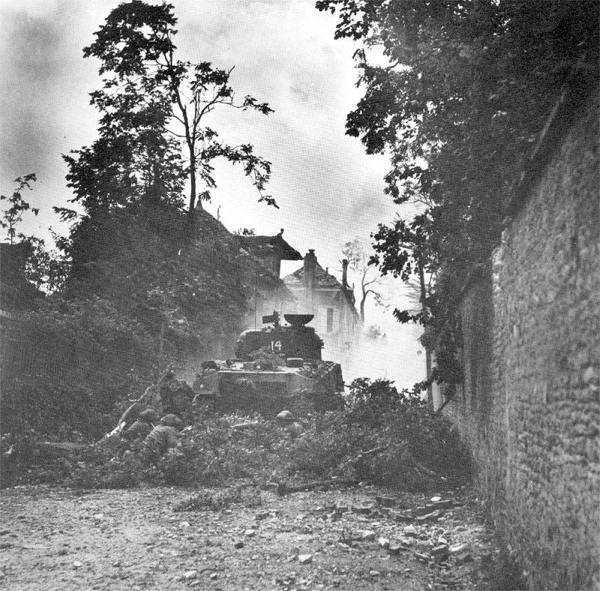
Infantry take cover behind Sherman tank during street fighting. 'B' squadron, reduced to half-strength and numbering only nine tanks, was severely hit when hurrying to the aid of infantry attacking Pierrepont. Five tanks were lost to fire from a well handled 88mm gun. Sgt Leo Gariepy: "I saw Lieutenant McLeod's tank burst high in flame. The troop corporal's tank suffered the same fate, and I saw several other tanks knocked out." Gariepy saw the muzzle on an 88mm gun rising from a hidden emplacement 30 yards ahead, the barrel pointing directly at him. "I gave rapid evasive orders to my driver and told my gunner to blast him. He fired two rounds; the second scoring a direct hit. I moved up to the gun emplacement and shot all the crew of 14 cowering in the trench."
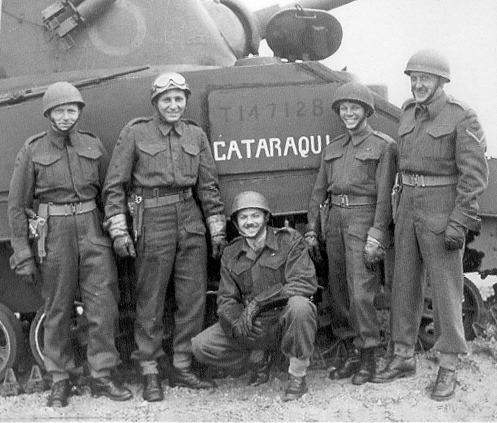
After helping the Winnipeg Rifles through Creully, one troop of 'C' Squadron commanded by Lt. W.F. McCormick pushed on towards the objective and made it all the way to the north edge of Secqueville-en-Bessin without encountering any opposition. The troop had probably got closer to the final objective than any other element of the Allies' seaborne assault forces, but finding themselves isolated without infantry or anti-tank support they retraced their steps and rejoined the regiment.
The regimental history: "In view of the losses in DD tanks due to the unsuitable weather, the First Hussars ended D-Day with a considerably smaller number of tanks than was desirable for their first night in Europe. In addition, the infantry continually had to anticipate Jerry counter-attacking heavily with armour in an attempt to kick them back on the beaches. However, the eventual appearance of the tanks with their capability of needling out the MG posts raised the morale of the infantry, so that by nightfall Harry Foster's 7th Brigade was firmly astride the line running through Fontaine-Henri, Pierrepont and St. Gabriel."
After dark the First Hussars tanks rallied in a harbour on high ground south-west of Pierrepont." (www.junobeach.info/juno4-8.htm)
Elgin County Archives
     Among them was Crinan, Ontario's own Cpl. Albert Cook. The son of Mr. and Mrs. Charles Cook, he had enlisted with the First Hussars in September 1939 and ultimately served six years. He was wounded during the D-Day Operations. (Crinan Women's Institute Tweedsmuir History)

     Ultimately, tanks of the First Hussars were the only ones to reach their D-Day objectives during that fateful operation (Phil Egan, The Sarnia Journal, Nov. 10, 2016). Following their Normandy landing, they went on to take part in the brutal fighting in the bridgehead, the closing of the Falaise Gap, and the clearing of the cross channel guns at Calais. "They fought with distinction through Belgium and Holland and ended the war in Germany. During this period, the First Hussars won 72 Decorations, Certificates, or Mentioned in Dispatches, more than any other unit in the 1st Canadian Army, and were awarded 20 Battle Honours for outstanding Bravery." (1st Hussars Cavalry Fund)
First Hussars D-Day veterans William Reed, left, Aris Domnas, Arthur Boyle and Philip Cockburn were among more than 200 people who attended the annual D-Day reunion ceremony at Victoria Park Sunday, June 1, 2014. (DEREK RUTTAN/ The London Free Press)
     "William Reed, sitting near the “Holy Roller” tank that had once rumbled up the beaches of Normandy, wiped his eyes and remembered.
Nearer to the moment than most of the 200 people in the crowd as part of a D-Day remembrance reunion, Reed had been in that same tank as a 21-year-old gunner when his crew landed on Juno Beach.
They were Reed, Frank White, Frank Fowler (who came up the name “Holy Roller”), Terry Doherty and Everett Smith — five men among thousands of Allied forces to take part in a turning-point battle of the war.
“I was almost in tears last night,” reliving those days and his comrades, said the 91-year-old who made the trip to London from his home in Fort Erie.
He was one of four D-Day veterans to attend Sunday’s remembrance event in London’s Victoria Park.
There, the Holy Roller, a permanently mounted Sherman tank, stands tribute to the Canadian war effort and to the 700 men of the First Hussars regiment.
The tank is believed to be the only one that made it all the way from D-Day through France, Belgium and Holland into Germany. 
Reed served during every year of the war. But he laughs off notions that he was a war hero.
“My biggest achievement was staying alive,” he said. “I did what my dad said: ‘Don’t volunteer for anything and keep your head down.’ ”
Derek Ruttan, The London Free Press, Sunday, June 1, 2014
     In addition to the "Holy Roller" in London, "Calamity," another First Hussars tank, is on permanent display outside the Sarnia Legion (Royal Canadian Legion Branch 62), and "Bold" remains stationed in Normandy (seen in title). These powerful machines, now silenced, stand as moving tributes to the men who served on them that fateful day in June 1944 and throughout the Second World War. May we never forget for a second how lucky we are that they did. 
     Thanks for reading,
Delany (@DLeitchHistory on Twitter)

Wednesday, December 14, 2016

World War Wednesdays: Christmas at Auschwitz

SS officer Karl Hoecker lights a candle on a Christmas tree only weeks before the liberation of Auschwitz, USHMM
     Thanks for bearing with me through some weird technology weeks! As of now I believe things are back to normal and hopefully that won't ever happen again. I realize that this week's topic is a bit dark for the holiday season, but I've been doing some work on the Holocaust lately and happened upon this story. It's important to point out before we start that the Jewish prisoners would not have observed the holiday, but Christian Polish inmates did celebrate to the best of their ability during the five Christmases during the camp's operation. In addition, the Nazis employed at the camp held their own horrific festivities, as will be mentioned. These descriptions come from the testimonies of Polish prisoners who survived the infamous death factory and were compiled by the Auscwitz-Birkenau Memorial and Museum.

     The first Christmas Eve behind the barbed wire in 1940 was one of the most tragic, and created a terrible tradition which was repeated in subsequent years. On the roll-call square, the Nazis set up a Christmas tree complete with electric lights. Beneath it, they placed the bodies of prisoners who had died while working or freezing to death at roll call. Former prisoner Karol Świętorzecki later recalled that Lagerführer Karl Fritzsch referred to the corpses beneath the tree as “a present” for the living, and forbade the singing of Polish Christmas carols.
A Christmas tree standing in front of Block 15 in Auschwitz I, Auschwitz-Birkenau Memorial and Museum
     The next year, the Nazis organized another dark Christmas. During the return from slave labor on the construction of Auschwitz II-Birkenau, they killed around three hundred Soviet POWs who were too weak to walk that day. According to an eyewitness account by former prisoner Ludwik Kryński, there was a second roll call at 6:00pm after the SS men had finished the first roll call and eaten their supper. In temperatures well below freezing, the prisoners were forced to listen to Pope Pius XII's Christmas Eve proclamation recited in German. Forty-two prisoners succumbed to the cold, and numerous others were brought to the point of nervous breakdowns at the sight. 
     Prisoners also tried to celebrate in their blocks and attempted to help their fellows whose spirits had been broken. An account in the Museum collections by Józef Jędrych from Block no. 10a describes how “the singing of German carols began, and then like the waves of the sea came the powerful words [from a Polish carol] ‘God is born, the powers tremble’ and others, until the final chord in the form of the Dąbrowski Mazurka [the Polish national anthem]. Everyone exchanged warm, cordial embraces and cried for a long time. There were those who sobbed out loud. . . . Such a grand moment never fades from memory. That Christmas is fixed forever in my heart and memory.”
     Henry Bartosiewicz smuggled in a small Christmas tree, which stood in room 7 block 25. Polish Army cavalry-platoon commander Witold Pilecki, a hero of the camp resistance movement, adorned it with a White Eagle carved from a turnip.
Christmas Eve Władysław Siwek. Auschwitz State Museum (APMA-B-I-1-107)
     The Germans set up another tree at Auschwitz II-Birkenau in 1942 and once again placed the bodies of murdered men beneath it. Former prisoner Krystyna Aleksandrowicz recalls their deaths: Before Christmas in 1942, the SS men put up a Christmas tree for us. On Christmas Eve, they gathered the labor details from the men’s camp and ordered them to carry soil in their coats. They shot any man who gathered up too little soil. Then they stacked a whole heap of corpses underneath the Christmas tree.”
     That Christmas was twenty-two year-old Walentyna Nokodem's first at the camp, and she later reflected on that horrible tree: "I remember my first Christmas in Birkenau. There was a Christmas tree and they gathered us up in the roll-call square, and under the tree they put the bodies of man, the bodies remained there for the whole Christmas, and they forced us to look at them. They put the Christmas tree by the end of our section, just by the barbed wire. I can't remember exactly but there were hundreds of bodies of male prisoners. It was my first Christmas in the camp. The women didn't want to look. We all cried."
     In her Auschwitz Chronicle, the late Danuta Czech, the Museum historian, notes under the date December 24, 1942 that, in the evening, Polish women prisoners in the Stabsgebaude [staff building] lighted candles on a fir bough that had been smuggled in. Carols were sung in many places around the camp, which lifted people’s spirits and gave them hope of surviving. In Block 18a, Christmas Eve had a religious dimension. A prisoner who was a Roman Catholic priest obtained some bread and used it as a substitute Host.

     By 1943, the November arrival of new camp commandant Arthur Liebehenschel had improved the prisoners' lives and there were no macabre "presents" that year. Many of the Polish prisoners received communion wafers in parcels from their families and shared them with other prisoners, including the Jews. In many blocks, the prisoners organized Christmas observances. 

     1944 was the last Christmas spent at Auschwitz. Since the days of the Third Reich were numbered, the holiday atmosphere was completely different. Father Władysław Grohs de Rosenburg, the prisoner priest, was even allowed to hold a midnight mass. The women in Birkenau prepared “Christmas gifts” for the children in the hospital, using material supplied by other women to sew about 200 toys. They attached two lumps of sugar or a piece of candy to each, and wrote the children’s names on the presents. One of the women dressed up as St. Nicholas and passed out the presents on Christmas Eve. Fifteen children from another block also received presents.
    Auschwiz-Birkenau Museum historian Teresa Świebocka says that in 1944, Leokadia Szymańska, who was then a patient in the camp hospital, made a small Christmas tree that is now part of the Museum’s collections. It features Polish flags and a Polish eagle at the top.
     The camp was liberated shortly after, on January 27, 1945,  finally granting the wishes made during the five Christmases observed there.   

      I hope this glimpse into some of history's most terrible Christmases was an interesting and thought-provoking reminder of how much we all have to be grateful for this holiday. I'm looking to explore the camp's celebrations held by Nazi guards and staff next week so that the two stories can be compared. Thanks so much for spending part of your busy holiday season reading this post!
     Delany Leitch (@DLeitchHistory on Twitter)

Wednesday, May 25, 2016

World War Wednesdays: Dear Mrs. Duncanson, Part Two: The End of WWII


     This week marks the final installment of the Letters Home to Dutton during WWII courtesy of the Canadian Letters and Images Project, as published over the past few months. As always, please feel free to share any memories you have of the people mentioned in the post-- I'm always looking to add to the stories!

July 11, 1944
Dear Mrs. Duncanson:
I am once again writing a few lines to inform you of the arrival here of the parcel sent by the Institute. It has come at a highly opportune time because I have lately been thinking that it would be nice to get something from Canada. As you notice from my address I am spending another short time in hospital, much to my dislike, because I had been looking ahead to big things. Since I am practically fit enough to be going again, that opportunity may still be at hand. I haven't met up with many Dutton fellows lately. I hope to see some of them soon. I seem to have difficulty in obtaining sufficient letter materials so thanking you and the Institute for your very good work, I will conclude for now,
Sincerely, Elgin Sutton
July 27, 1944
Much French Mud
Following is a letter from Lieut. Dorothy Godfrey, formerly of Crinan, now a nursing sister on the Western front. It describes the conditions under which these girls work:
Hearing about the mud over here doesn't sound too bad, but actually when a person has to drag one foot after the other it becomes rather a tiresome job. It rains every day here and that's one thing we definitely know for sure. This country is even worse than England for rain, so se just ignore it.
Have been to the cemetery near Dieppe for the Canadians who were killed in '40, and it's really going to be lovely for its well kept now. Have several pictures of it taken at different angles.
We were the rubber boots everywhere we go even hitch-hiking on our day off and think nothing of trapsing 150 miles or more for we usually get rides easily.
Haven't had to bad a time, but it gets very monotonous and discouraging at times to say the least its nothing new to be low in spirit for three or four days at a time. Mail is rather grim at times to say the least. Well if you want to know what is the best to come over - fruit juices, soups, canned meat or fish, cheese for we certainly aren't fussy over here. One thing surprised us was white bread and it sure seems grand to get back to it.

 July 27, 1944
Dear Mrs. Duncanson:
Received your lovely and welcome parcel on the 1st of July. Thanks a million. Was talking to Alex. Scott; he received his the same day. Also Earl Halpin. There are not many of the Dutton boys together any more. But all are fine, as far as I know. Things sure are looking up over here. We hope to be home in the next year. Thanks again for the parcel.
E. S. Killins.

October 12, 1944
Dear Mrs. Duncanson: This is my third letter to your enterprising ladies, and I hope if really indicates how much your parcels are appreciated. My parcels all seem to arrive in groups of three, so that I often have a hard time deciding which one to open first. Actually it's sort of silly when you can read what's in them on the label, but fun anyway. What I intended to say originally was that your parcels to me are almost (she may read this, so have to safeguard myself) on a par with those sent by my wife. You may consider that an extreme compliment, if slightly left-handed. Nevertheless, the boys in the front line do really appreciate the little treats and it bolsters up a fellow's morale just go get a parcel of any kind. I expect you are as disappointed as the rest of us, that the war is not over yet, however, it is merely a matter of time. There's no point in telling you what were are doing here - the newspapers are doing that. The people and homes in Belgium are something to see. The homes are the cleanest I ever want to see. They shine and sparkle. Also they are extremely modern and up-to-date. The people of course vary from one area to another, but most of them, if you are billeted near by, will give you their doorstep and pump handle. The supply of pears, apples, tomatoes, eggs and the largest grapes I've ever seen, continues good. Well, must be off again and the word thanks doesn't even scratch the surface. Very best regards to you all and the very fullest of thanks.
Al Burslem
P.S. - That honey was a knockout.

June 23, 1944
Dear Mrs. Duncanson:
Just a few lines to let you know that I received your parcel and was certainly glad to get it, and many thanks for it. Everything is going fine over here now. I am in the best of health once more and hope these few lines find you the same. I met an old chum, Harry Jones, over here, and we certainly had a swell visit together. He is in the best of health after a spell in the hospital. Haven't seen Lou Burns for some time. Once again wishing to thank you and the ladies of the Institute very much for the parcel. As ever.
Harold Hoffman

February 1, 1945
Flt. Lieut. A. Graham Writes From Italy
What the men who have been serving overseas for some time have been thinking about the reinforcement question and demobilization plans is indicated in the following letters from Flt. Lieut. Alex Graham, son of Mr. And Mrs. J. D. Graham, of Iona Station, now in Britain after serving in Italy. They also describe points of interest he has visited.
November 23, 1944
Dear Dad, Mum, and boys:
I am up in Italy now. I had hoped for a U.K. posting and then I have visions of getting home for a short while before going to the Far East, but nothing like that could ever come my way. As it was there were only two of us who come up here. Everyone else went back to the U.K. I suppose I can't hope to spend all my life in hot climates, but they might have let me down a little more easily, don't you think? I seem to be minding the cold pretty badly. I think it's possibly just because I'm not used to it, and I had better hurry up and get used to it, or it won't be necessary.
I have had a jaunt around Naples, and wasn't particularly impressed. I am afraid I can't quite see how the expression "see Naples and die," was born. Still, one must remember that the country has been undergoing a war for the last few years, and that the city itself was actually in enemy hands and had to be wrested from them. Since my look around the place. I have been told that I didn't see the center of the city, so I may try it again some day soon. There seems to be scarcely nothing in the shops, except shoes, and these are very very costly[...]
When we were in S.A. we used to laugh very loudly about the situation down there. They had their so-called "famous" 6th Armoured Division situated up at Cairo "in training" and howling for recruits to get its strength up and the recruits just weren't coming in, that was all. And what is more, they never will! And now I suddenly discover that things are the same way at home for the overseas army. Just what the hell is the matter with everything anyway? I was talking to some chaps before I left Cairo, who were saying that they R.C.A.F. is discharging a lot of men because they don't need them. What happens to them? Instead of discharging them, they should just transfer them to the army, the same as they did in England. These chaps were telling me that the boys who were discharged were rather upset about the whole thing. Apparently by joining the air force they thought they were in on a good thing. As any sane person would figure, by the time they had finished their training there would be nothing else doing in the war line, so they would just go back into civies having had a darn good time and worn a uniform and learned to fly at the expense of someone else. It seems they were quite put out when it didn't come off for some of them.
What is the general opinion of the plans for demobilization? I don't know a great deal about it except that every man is going to be a millionaire and be given a home and a cushy job. Somehow, or other, that doesn't sound right to me, but then I'm not genned up on these things. I'll know more about it when I get time to study it. I also got a pamphlet on the Veteran's Land Act. What is your opinion on that?
Bye now, and Merry Christmas to you all. Loads of Love.
Alex

Wednesday, December 23, 2015

World War Wednesdays: Christmases 1942-1944 at No. 4 B&G, Fingal

    Merry Christmas to readers old and new of World War Wednesdays! For the past two weeks, we've been discussing the first festive celebrations at No. 4 B&G, Fingal thanks to Winston B. St. Clair. This week will be an extra holiday feature with three years in one post, from 1942-1944. So, take a break from all the preparations and get comfy!

Christmas #3, 1942
     Christmas of 1942 took much the same format as that of 1941. Committees were more experienced and improvements had been made to the physical plant. Aside from the water pipeline from Port Stanley, the biggest changes during 1942 were  systemic. In January and February 1942, a high level training conference was held in the United Kingdom to discuss changes to the Empire Air Training Plan. In the future the greatest stress would be placed on the quality of the graduates of the various training schemes instead of their numbers. Allied to this change was the decision, in March, to restructure the composition of aircrews of Royal Air Force heavy and medium bombers. Both events would add significantly to the load placed on the BCATP in Canada, especially at Air Observer Schools and Bombing and Gunnery Schools. The end result was a training conference at Ottawa in May 1942 that formalized what had been decided earlier. Another very important change took place in May when members of the RCAF (Women's Division) arrived at Fingal, adding many more capable minds and willing hands to the strength of the social fabric of the school. The arrival of the young women was also given credit for effecting a marked improvement in the appearance of the airmen. It was reported that the sales of hair tonic and aftershave lotion rose to record levels after the WDs arrived.

     In a sense the first event of the Christmas Season of 1942 took place on 27 November when the Christmas edition of the Fingal Observer went to press. This would inform the Fingalites of what events were scheduled to take place during the coming season. The Observer's nominal date of publication was 15 December, and it advised those people who wish to "let loose" over the holidays, to do their celebrating at the station.
Christmas #4, 1943
     Christmas of 1943 found No. 4 Bombing and Gunnery School to be a thriving and nearly self-contained community of 1,500 people. The school was, based on the census figures of 1941, the fourth largest community in Elgin County. Its social structure was well developed and well managed, and morale appears to have been very high. The school's physical plant had just about reached the limits of its growth, and the long hours of hard work that had gone into station beautification projects had given the place a definite park-like appearance. Because of the poor bus service between No. 4 B&GS and St. Thomas, additional emphasis had been placed on developing the school's own recreational facilities. Year 1943 had been a particularly busy, exciting and rewarding time of change and accomplishment, and Fingalites, not being fully aware of the consequences of downsizing of the BCATP, expected no less in 1944.

     The Christmas activities at Fingal followed the general pattern that had evolved within the school. The basic parameters being a season of activities that lasted for about two weeks, with approximately one half of the school's personnel taking a short leave at Christmas, and the remainder being away for New Years.

     The Christmas 1943 issue of the Fingal Observer was released on 13 December, and it was full of all sorts of good stuff that could be considered as being gifts from the gnomes at AFHQ. For example, airmen were told that laundry tubs were to be installed in their barracks. In fact, four already had been! This was a luxury that their WD cohorts had enjoyed for some time, but one that would not, at least for the foreseeable future, be extended to male NCOs and officers. 

     Another article said that airwomen could  now wear silk stockings with their uniform while on leave or after duty hours, but they must be the same colour as the authorized lisle hose. Ottawa neglected to tell them, however, where these stockings could be purchased. The CO's gift was that he was made responsible for ensuring that only the approved colour of stockings were in fact worn. The Observer did not mention who was delegated to perform this awesome task.

     The WDs did not get all the goodies being given to the fair sex. Readers were reminded that a recent pay increase gave airmen's wives, with children, a $1.52 per month increase in their cost of living allowance, bringing the total up to $4.02. In spite of this bounty they still could not afford to compete with the WDs for the scarce supply of silk stockings. The latter had just had their pay adjusted from 67% to 80% of men's rates, and there were rumors of lots of back pay forthcoming. 

     Not all presents came from Ottawa. The editor of the Observer ran an article on the history of the coal pile, and he suggested that it be cut out and saved as a souvenir, "Something to show your children...", he said. The coal pile at Fingal was, it seems, more than its name implied. It was in addition to its intended purpose, I am told, a place where young lovers would meet and do whatever young lovers do. Whatever went on, the mere mention of "coal pile" today in the presence of former Fingalites frequently brings forth giggles, gales of laughter, or a quick change of subject. For those readers with over active imagination who find the picture of young love being played out on top of a 100 ton pile of soft coal a bit too much to take, I hasten to remind them that the coal compound included a building, No. 46, to be specific.

     The Christmas Season proper got off to a good start on Sunday, 19 December, with a party held at the YMCA Hostess House. The following day's St. Thomas Times-Journal reported that the place was beautifully decorated for the occasion, with the center-piece being a splendidly decorated Christmas tree, and that every available square foot of space was used to accommodate the 300 or so guests. I suspect the figure of "300" was an exaggeration, a bit of journalistic license, perhaps. It said that unlike other open house events where the guests came and stayed only for a short time, that on this occasion they came and stayed. The party lasted all afternoon and for most of the evening. A short sing-along movie of Christmas carols was shown that evening in the Recreation Hall.

     The entertainment highlight of the season took place on the evening of 20 Dec., with the appearance of Mart Kenney's "Victory Parade of Canada's Spotlight Band." Mart Kenney and His Western Gentlemen were the foremost dance band in Canada, and arguably one of the finest in North America. The band's visit to Fingal coincided with its weekly Monday evening radio broadcast sponsored by Coca-Cola. These broadcasts originated from an armed force's establishment or a war production facility and took the form of a salute to the host establishment. 
Mart Kenney
     The "Salute to Fingal" broadcast was preceded by a short warm up concert and followed by a station dance. The next day's Times-Journal said that the Drill Hall was decorated and set-up in cabaret style, and there was a buffet lunch for the 1,000 people who attended the dance. Tickets to the dance cost $1.00 for a couple.

     On 21 Dec. the station got a splendid present with the opening of a four-lane bowling alley in one of the lean-tos recently added to the Drill Hall. A snack bar, to be operated by airwomen volunteers, was being built nearby, and would open in early January. A Christmas party was held for the children in the Recreation Hall on the same day with about 250 parents and children in attendance. Movies were shown and Christmas carols were sung to the accompaniment of the station orchestra. An interesting feature of the event was that a number of young men from several different countries went on the stage and told the children how Christmas was celebrated back home. Santa arrived by aircraft with presents and treats for the children. The candy was made at the school by Cpl. Van Buskirk because it was not available from outside sources in the quantities required.

     On 23 Dec., men of the Air Bomber Course #92, and Wireless Air Gunner Course #68 graduated, and were presented with their wings. That evening the airwomen held a party in the canteen, using the proceeds of a raffle to defray the costs of decorations and refreshments. Presents were exchanged by all the young women remaining on the station. The Daily Diary indicated that Christmas Eve was spent by many at an informal dance held in the Recreation Hall.

     On Christmas Day, Senior NCOs and Warrant Officers entertained the Officers in the Sergeants' Mess. At noon they all went to the Other Ranks mess hall where they served the Airwomen their Christmas dinner. Later, an informal dance and movie were enjoyed. Some personnel were the guests of local residents for Christmas dinner. 

     From 26 Dec. on, flying exercises took place whenever the weather permitted. Organized evening entertainment consisted mainly of movies supplied by the YMCA. The Daily Diary reported that on New Year's Eve 250 attended a dance in the Recreation Hall. 


The Last Noel: Christmas #5, 1944
     The Christmas Season of 1944 at Fingal differed in a number of ways from those of previous years. Perhaps the principal difference was that in spite of the German successes, in what we now call the "Battle of the Bulge", there was a general feeling that the war in Europe was just about over. This attitude was strengthened by the remarks of the Commanding Officer that put the future of Fingal in question. The RC Padre added to the uncertainty when he reminded the readers of the Observer "that this may well be the last Christmas that we RCAF people spend together as a uniformed family."

     In spite of the overall reduction in training, Fingal fared well as it was training Wireless Air Gunners, Air Bombers and Flight Engineers, categories of aircrew for which there was still a demand. In terms of Monthly Unit Strength this school reached its peak of 1,850 in July 1944. This was the result of an increase in the student population during the summer, combined with an increased intake of repatriated, tour expired, aircrew officers. For the latter, Fingal was a holding unit,- a warehouse- where they would stay and be prepared for release, or to wait for other service assignments. From September onward, there was a drop in the student population, and barrack blocks were closed or converted to other uses. 

     The festive season, that was definitely low-key compared to a year earlier, started off on 19 December with a Christmas Box Dance in the drill hall. Young women came from St. Thomas, with transportation provided free by Richards Coach Lines. On 21 Dec., a children's Christmas party was held at the school, and Richards again provided free transportation from St. Thomas. On Christmas Eve, a candlelight service was held in the Recreation Hall, and later a Midnight Mass was celebrated in the Catholic Chapel.

     Christmas Day followed the usual Fingal routine. The Warrant Officers and Senior NCOs entertained the Officers in the NCOs Mess, and then they went over to the Other Ranks Mess to to serve Christmas dinner to the airmen and airwomen. Various entertainments were provided between Christmas and New Years. On New Years Eve a dance was held in the Recreation Hall. Both the Senior NCOs and Officers Messes held an open house, but bad weather kept attendance to a low level. On New Year's Day, the Warrant Officers and Senior NCOs were entertained in the Officers Mess and then they served dinner to the airmen and airwomen, in the OR Mess Hall.

     The Christmas Season, then, as now, served as a time of reflection, anticipation and resolve; but at that particular time there was also a deep sense of nostalgia that permeated events. The men and women at Fingal celebrated the season with many familiar faces missing, but that in itself was not unusual. What was different, was that a significant number of those absent had been retired from the Air Force: their services were no longer required. They had gone home!

     This was to be the last Christmas held at No. 4 Bombing and Gunnery School, Fingal, for on 11 January 1945, Organization Order 509 was signed authorizing the disbanding of the school, effective 17 February 1945. There would be other Christmases celebrated at Fingal but not of the magnitude of the five celebrated during the war years.

Wednesday, April 8, 2015

World War Wednesdays: Panic in Port Stanley: The Loss of the 'Olga', 1944

Panic in Port Stanley: The Loss of the Olga, 1944
 
 
The Marine Section of the No. 4 Bombing and Gunnery School (Fingal) at Port Stanley (note: the building seen in the photo is a converted shipping crate from a Fairey Battle aircraft)
 
 
     The six years of the Second World War (1939-1945) saw unimaginable hardship and destruction across the globe. Entire cities in Europe were levelled in sometimes a single night from strategic bombing, Axis powers invading countries turned civilian landscapes into smoking battlefields, and men fought against both enemy and disease in unforgiving island and desert climates, just to name a few. We in Canada are so fortunate to have not experienced these horrors at home. I discussed in a previous blog how the British Commonwealth Air Training Plan and RAF training schools in Elgin County brought an element of wartime conditions to our area, especially through the accidents and fatalities that occurred during their operation. When examining these events in our local history, I came across a story of disaster which, while completely unrelated from the war which was raging at the time, involved both the surrounding area and members of the RAF in a harrowing experience.
 
 
From the memoires of Cpl. Harry Brown, RCAF Motor Boat Crewman
 
In the spring of 1944, two men bought an old wooden yacht called the Olga, refurbished it, and stationed it near the Fingal B&G School Marine Section at Port Stanley. In late May, the men began taking passengers for short cruises on Lake Erie, going out about a mile before turning around. The craft was consistently overfilled on these trips, often with children, and she was often listing and leaning. The owners were warned repeatedly about this hazard.
 
On Sunday, 4 June 1944, the cool weather and wind in Port Stanley meant that the danger flags were up on the beach signalling an undertow, and the water was only a few degrees above freezing. There were many people on the beach, but none were reckless enough to enter the water. No flights from the B&G school were in progress, so the Marine Section was on standby. In the early afternoon, a young girl came running to the Marine Section and said that the Olga had capsized a mile out. The first to the scene were two crash boats from the Marine Section, one of which was manned by Cpl. Harry Brown. Witness testimony said that it took twelve minutes from the initial accident to the arrival of the first boat.
 
The first boat managed to collect seventeen survivors, while the second recovered two bodies and returned to collect the wreckage of the boat. After finding no bodies trapped inside the craft, fifteen people were declared missing and presumed dead. Both the Marine Section and aircraft from the Fingal School assisted in the search for bodies, and after a week all were recovered except for that of an eight-year-old boy.
 
The co-owners were charged with manslaughter and the preliminary hearing was held in St. Thomas, but was moved to Toronto to ensure a fair trial. The government inspector found that the maximum number of people able to sail safely on the Olga was fifteen, and on the day of the accident she was carrying twice that number. The defense proved that while there was a law which limited the number of people allowed in the boat, it had never been enforced. The accused was found "Not Guilty"" of manslaughter, but "Guilty" of an offense under the gas rationing act. THE FINE WAS FIFTY DOLLARS.
 
Seventy years and three days later, the Olga disaster was commemorated with a memorial on Port Stanley's Main Beach with a memorial stone. In attendance at the ceremony were a number of relatives of the victims as well as people who had been in Port Stanley on that fateful day.


              Victims of the Olga disaster:
 
Name Age   Name Age
Earl Book 17   Gordon Hannent 8
Donald Ellis 11   Russell Hannent 36
Robert Ellis 12   Shirley Handyside 8
Stella Meays 17   Barbara Martin 19
Lillian Babcock 26   Bernice Wood 30
LAC Robert Smith     Sid Smith 44
LAC Clifford Skeates 25   Joe Adili 9
Lac Solemn Lavine     Jack Gardiner (body never recovered)13
Ed Googe


Thanks for reading,

Delany