Showing posts with label spicer trail. Show all posts

Tuesday, June 5, 2018

Trailblazer Tuesdays


🐢Trailblazer Tuesdays🐢 

       Ontario boasts eight turtle species, which is more than any other province in Canada. But that’s in danger of changing; of the eight species, seven are at risk. What humans have done through contributing to habitat loss, hunting, and poaching, is target adult turtles. That increased adult mortality is actually what’s driving the population down. This, combined with the fact that few young turtles live to adulthood; only seven of every 10,000 snapping turtle eggs; means that species are being driven toward endangerment. You’re most likely to spot turtles in marshy areas where there is native aquatic plant life. But during nesting season, which runs from late May to early July, you’ll also spot them crossing roads and in sandy or gravel areas. Spring is important time to watch for turtles. If you can save one turtle by moving it off the road, that makes a big difference to the overall conservation of the species. Take a picture of the turtle with your phone and upload it to Ontario Nature’s Reptiles and Amphibians Atlas, which features the most up-to-date maps of turtle species across Ontario.
If you see an injured turtle don't be afraid to contact  https://ontarioturtle.ca/ourmission/drop-off/ 
they will be able to help save and rehabilitate the turtle. 

1. Blanding’s Turtle
  • Unlike snapping turtles, which have yellow spots, look for a bright yellow chin and throat.
  • If you spot a turtle eating on land, it might be a Blanding; most aquatic turtles feed exclusively in the water.
  • They’re also likely to be seen on the move; Blanding’s make the largest overland movement of any Ontario turtle to move from their summer nesting spots to overwintering habitat.
Fun fact: These turtles can live to be 75.

2. Eastern Musk Turtle
  • With an upper shell that is brown with black flecking and a yellowish lower shell, these guys are easily confused with painted turtles, snapping turtles, and Blanding’s turtles. However, this small turtle only reaches a maximum length of 13 cm.
  • Keep an eye out for a light stripe above and below the eye on each side of the head in adult turtles.
  • Generally nocturnal creatures, Eastern musk turtles also rarely swim.
Fun fact: This turtle is named for the odour it emits when it’s threatened, which; you guessed it; is strong and musky. It’s also called “stinkpot.”

3. Midland Painted Turtle & Western Painted Turtle 
  • Painted turtles feature distinctive black shells with dark red or orange markings. No other species native to Ontario claims these colours.
  • Easily spotted on the move, painted turtles will move over large areas overland in search of nesting sites.
  • These are the only non-threatened turtle species in Ontario, but they are still susceptible to the threats that face other turtles.
Fun fact: With a natural “antifreeze” that prevents them from freezing, these turtles can survive temperatures as low as -9º C.

4. Northern Map Turtle

  • Named for its markings, this turtle has contour lines on its upper shell that look like a topographical map.
  • They also feature a yellow spot behind their eyes. Don’t confuse them with snapping turtles though; snapping turtles are larger and lack the distinctive shell markings of the map turtle.
Fun fact: One of the largest threats to this turtle’s pollution is water pollution. It can cause mass die-offs of mollusks, one of their primary food sources.

5. Snapping Turtle
  • The most prehistoric-looking of all of Ontario’s native species, the snapping turtle has triangular spikes along its tail.
  • Most likely to be confused with musk turtles, snapping turtles are significantly larger and grow up to 47 cm long.
  • Not the strongest of swimmers, these aquatic turtles are usually observed walking on the bottom of small ponds and rivers or crossing roads.
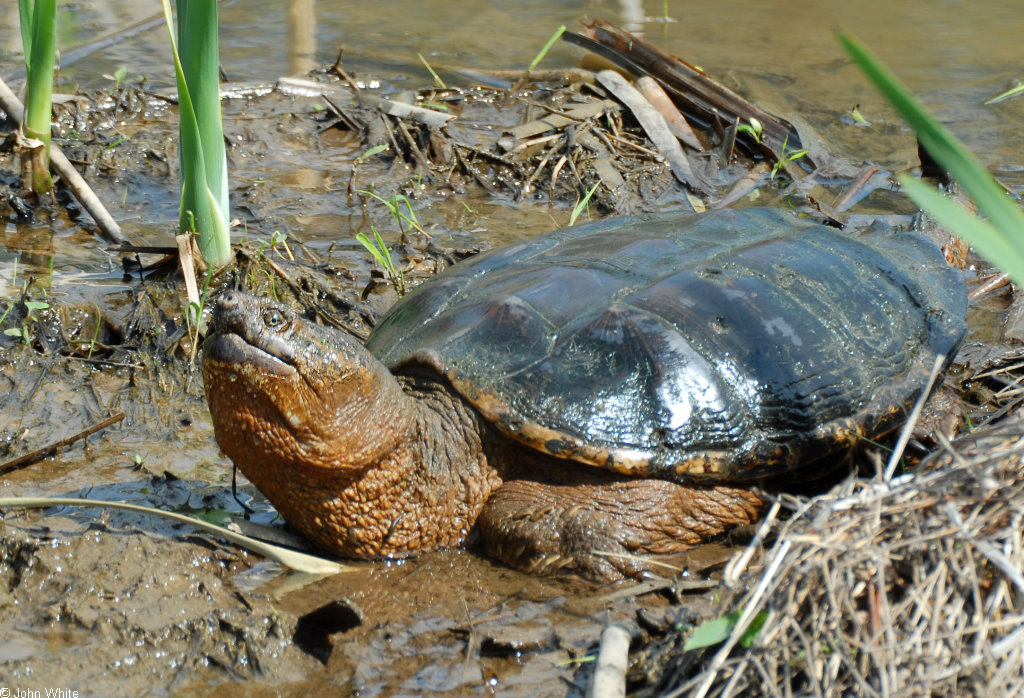
Fun fact: Most Ontario turtles only lay somewhere between three and 15 eggs. The snapping turtle lays around 50.

6. Spiny Softshell 

  • As the name implies, the softshell turtle has a soft, leathery shell.
  • A long snout makes this peculiar-looking creature unmistakable from its counterparts.
Fun fact: With the ability to get nearly half the oxygen they require by breathing through their skin in the water, they’re able to stay submerged for up to five hours.

7. Spotted Turtle

  • The spotted turtle features orange-yellow markings on its limbs, neck, and legs. However, it’s most clearly identifiable from the yellow spots marking its shell.
  • While males have dark eyes and a dark chin, females of this species have orange eyes and a yellow chin.
Fun fact: Unlike most other turtles, spotted turtles spend the summer or dry season in a state of inactivity to avoid hot dry weather.

8. Wood Turtle

  • With a highly sculpted upper shell, Ontario Nature calls this species “one of Ontario’s most attractive turtles.”
  • The neck, chin and and front legs are a vivid orange-yellow colour.
  • Like their name implies, these turtles are likely to be found in woodlands or floodplains during the summer months.
Fun fact:  They’re considered extremely intelligent and have been documented using creative methods to get their food, including stamping their feet to cause earthworms to come to the surface.

References:
Sabrina Merks

Tuesday, May 29, 2018

Trailblazer Tuesdays


🌳Trailblazer Tuesdays🌳

     This week the outlook opens and we cant be more excited! The John. E Pearce park was named after the John. E Pearce who generously donated the land in the 1950s and this property had been held by his family since it was first settled in 1809.  The park was classified as a natural environmental class farm but has been re-classified as a nature reserve to more appropriately recognize the heritage aspects and earth/life science characteristic found here. The park incorporates a sample of eroding Lake Erie Bluffs in association with the deciduous forest. A small picnic area sitting atop 30 m bluffs on the lakeside provides visitors with a beautiful vista looking out over Lake Erie, this opens June 1st! 
And as erosion continues, the fence will be moved inland when needed.

     Plant diversity is very high in the park. 405 species of plants were found in the park. 15 of which are considered rare in Ontario and 3 of which have not been recorded elsewhere in Elgin County. The most common tree found in the park is the sugar maple. Walnut, ash, hickory, ironwood and beech are also found in the park as well. Covering the forest floor is a lush matt of wild flowers. Trilliums, hepaticas, touch-me-nots, violets, jack-in-the-pulpits, and blood roots can be seen blooming in their respective seasons. Bird migrations can be seen from the lookout as well, especially in the fall with the hawk migration. 

Don't forget that the museum is park of the provincial park too, walk the Spicer trail and the Mary Storey Wetlands trail. How can you be a trailblazer of conservation and help to foster an appreciation of nature in your community? 

Sabrina Merks 


Tuesday, May 15, 2018

Trailblazer Tuesdays

🌿 Trailblazer Tuesdays 🌿

       In Southern Ontario there are so many deer that there are collisions between cars and deer almost daily.We get many deer here at the park! Just this week I saw two beautiful deer across the street from me. The reason is  the female  deer often leaves her fawn unattended for hours at a time while she searches for food. And in Southwestern Ontario, and across the province, the White Tailed Deer is the most common deer found.  This graceful white-tailed deer Odocoileus virginianus is well known to most North Americans and is easily recognized.  Hunters and non-hunters alike recognize the animal by its habit of flipping its tail over its back when it is startled, revealing the white underside and white buttocks.

      This "flag" of the white-tailed deer is often glimpsed as the high spirited animal dashes away from people. The tail has a broad base and is almost a foot long. When lowered, it is brown with a white fringe. Male Deer can grow to a height of 1 meter at the shoulder and can weigh around 110 kg when full grown and occasionally weigh up to 200 kg in the northern part of their range. In the summer time there is abundant food which makes almost any forested or bushy area suitable for deer. In the winter and the snow deepens, the deer concentrate in "deer yards," or areas that provide food and shelter from storms and deep snow.


      Human activities, such as the cutting and burning of blocks of forests, the seeding of agricultural crops, the winter feeding of cattle, the reduction of competitors such as mule deer, elk, moose, and the restriction on hunting of white-tails have helped this deer to extend its range northward and westward. In addition the long-term easing of the severity of winters may have been an important factor. Whatever the exact combination of causes, the range of the white-tailed deer extended considerably during the late 19th  and the first half of the 20th centuries. Now the deer is found throughout the majority of northern Ontario, but also through Manitoba, Saskatchewan and parts of Alberta and British Columbia. 

      If you are wanting to spot a White Tailed Deer the best times of the day to take a picture are the first two hours after day break, and the last two hours before sunset. Grab your camera, head down to John. E Pearce park, take a walk down Spicer Trail, or Mary Storey wetlands trail and see if you can take a picture of these beautiful deer. 

How can you be a trailblazer of conservation and help to foster an appreciation of nature in your community? 

Sabrina Merks 

Tuesday, May 8, 2018

Trailblazer Tuesdays


🌿Trailblazer Tuesdays🌿  

Good morning everyone! Its Sabrina back again at the museum for the summer. Trailblazing Tuesdays are all about how West Elgin is home to a unique range of species and landscapes that cannot be found anywhere else in the world. And how its up to us to ensure that these legacies are preserved and appreciated for years to come. This weeks blog is all about the trillium, Ontario’s provincial flower. These beautiful flowers are abundant all over John. E Pearce provincial park and along Spicer trail! Most people know of the White Trillium, also referred to as Wake Robin or Large-leaved Trillium and because it’s Ontario’s flower; this is the flower featured on many of our provincial documents, from health cards to driver’s licenses to road signs.


Trilliums' most striking characteristic is the single three-petaled flower perched above three leaves. The flowers vary by species and can be white, deep red, pink, yellow or green. Trilliums also vary in size but most plants reach from about 8 to 18 inches tall. The leaves are usually bright to dark green. Contrary to popular belief it is not illegal to pick White Trilliums in Ontario. However, if the leaves as well as the flower are picked, the plant could die as it no longer has any means to produce the energy it needs to take it through the winter into another spring.


Due to the popularity of Trilliums as a garden specimen, conservation concerns have been raised as the vast majority of plants sold in commercial nurseries are believed to be collected from the wild.  And because of the heavy collecting, combined with other pressures such as habitat destruction and grazing, may effectively endanger the plants in some areas.The greatest threats to Trilliums are habitat loss and degradation caused by urban development or habitat alteration and damage due to recreational activities, such as hiking and ATV use.
White-tailed deer also eat Trilliums, which is a problem in areas where there are large deer populations. Invasive species, such as Garlic Mustard, also threaten this species as well.


Trillium grandiflorum the beautiful white trillium is legally listed as vulnerable in Quebec, primarily due to habitat destruction as the plant is found in forests neighbouring the province's most populous regions. The drooping trillium is listed as endangered in Ontario as well and can be found in our area of the park and other Provincial Parks in Ontario such as the Pinery, and Rondeau.


Next time you are out in nature and you see these beautiful flowers don’t pick them for your garden, take a picture, save the moment in your memories, and leave the flowers for others to see. How can you be a trailblazer of conservation and help to foster an appreciation of nature in your community?

Thanks for reading!
Sabrina Merks

Thursday, May 3, 2018

Tourism Thursdays


Tourism Thursdays are back! 

         Welcome back everyone! Now the Backus-Page House Museum is open again our regular hours. Tuesday through Friday 10am -4:30pm, & Weekends and holidays 12 - 4:30pm. We hope to see you in for a tour! 

         Come out the the Museum May 5th for our grand opening of our new exhibit! Trailblazers! Curated by our very own Delany Leitch. From 1-4pm come see our beautiful exhibit, where Lorne Spicer himself will make a short address, stay after for coffee and goodies!   


        “Western Elgin features numerous places to appreciate nature. this is largely due to the efforts of local conservationists. Throughout history, people from a variety of backgrounds have impacted how our community experiences and understands the landscapes we share. 
John. E. Pearce, Lorne Spicer and Dr. James Wellington Crane were three such individuals. Each of their stories demonstrate how love of community and nature are deeply connected.“

         Our next event at the museum is The Road to Culloden! A Scottish Living History Weekend! Saturday May 19th & Sunday May 20th 10:00 am - 4:00pm! 
         Step Back in time to 1745, and follow the loyal Scots through triumph and tragedy in their quest to reclaim the throne for Bonnie Prince Charles! 
         Battles, black-powder weapons demonstrations, historic merchants, a piper’s call, traditional singers, story tellers, the life of a jacobite solider, British Military Punishment and an historic church service are just a few of the things planned for this weekend! 


General Admission for ages 13+ is $8.00, 12 and under are free! 
Food is available at fair prices at the site. Proceeds to the Museum!

29424 Lakeview Line, Wallacetown. Approx, 10km south of Hwy #401. Take exit 149 and follow currie road south to Lakeview Line  (519)-762-3072. 


Sabrina Merks

Saturday, August 6, 2016

Behind the Scenes with Ben - The Battle for Spicer Trail

The Battle for Spicer Trail


Today we have heard reports that a battle has happened at Backus-Page House on the Spicer Trail.  General Bobier had heard reports that Mother Nature had sent in weed and tall grass divisions to invade what we know as Spicer Tail.
 In response to this General Bobier sent in Captain Buchanan who is under the command of the MNR battalion.  Captain Buchanan’s orders were simple.  Go in to enemy territory on Spicer Tail and destroy any enemy resistance.  Captain Buchanan had put together a small division from the MNR battalion which consisted of Sergeant Weed Wacker, Corporal Hard-Hat, Private First Class Safety Glasses, Private Garden Gloves, and Private Work Boots. 
As Captain Buchanan and his division set out towards Spicer Tail Colonel Leitch was left behind to guard Backus-Page House in case of a full scale invasion from Mother Nature from surrounding areas. 
Captain Buchanan and the MNR division headed into Spicer Tail and the battle lasted for about an hour until Sergeant Weed Wacker suffered an injury and an emergency evacuation was put into action.

Reports say Captain Buchanan and his MNR division have taken back half of Spicer Tail and little resistance remains until Captain Buchanan and his MNR division head back to calm the rest of Spicer Tail.

                                                                               Captain Ben

Sunday, July 6, 2014

Behind The Scenes Sundays

Things Backus-Page House Museum staff said last week: "It's not giant hogweed, it's cow parsnip."

A belated Happy Canada Day and Happy Independence Day!  Sarah and I spent the afternoon on Tuesday at the Canada Day Celebrations in Dutton.  We took our new banner (shown in the photo), some gift shop items, and upcoming event flyers.  As always, the salt water taffy and maple kisses were the favourite with shoppers and History Camp for Kids was our most asked about event.  Thank you to everyone who stopped by to say Hello. 
 
 
Our 2013 financial audit is completed and I was able to submit two grant applications (Community Museum Operating Grant and Ontario Seniors Community Program) before month end.  Last year was the first time we reached the $100,000 in revenue milestone.  As a charitable organization, this comes with many changes in bookkeeping, which I won't bore you with, but does take extra time from staff.  Now that we've had the first audit, next year should be a much quicker process for us and our accountant. 
 
This has been a sad week for nature with high winds coming through last weekend and knocking down a large walnut tree just to the east of the museum and branches blocking part of the Spicer Trail.  By the time you read this post, all will be cleaned up thanks to Talbot Tree Service and volunteers Larry and Paula Graftsein and Rob and Janice Ellis.  Betty McLandress and staff spent alot of time weeding vegetable gardens.  Everything (including the weeds) are growing really well, except for the beans I planted which some birds decided looked tasty, so no Lazy Housewife Beans this year.   
 
Since our Sunday Summer Teas start today (1-4pm, $10/person includes tea and tour), the parlour was set up on Thursday to accomodate 2 tables of 4.  Tablecloths, linen napkins, flower arrangements, and cups and saucers are all ready for our visitors.  Volunteers will be donating the weekly baked goods made from 1850's recipes and I hear seed cake and apple cake might be served today.  Traditionally Mary Jane Backus would have hosted tea in the dining room of the house for her guests. 
 
Listen on St. Thomas MyFM for our summer commercials.  Leave a comment below telling us what baked goods you prefer to have with your tea and what topics you are curious about "Behind the Scenes at Backus-Page".  
 
 
Cultural Manager
 
As always please LIKE, SHARE, AND COMMENT ON OUR POSTS