Showing posts with label Winston Churchill. Show all posts

Wednesday, March 22, 2017

World War Wednesdays: WWII Over the Wireless

An American family listening to the radio in 1942
     When thinking back on some of the recent posts for inspiration, I was shocked that I wrote about television and wartime before I wrote about radio! I'm currently taking a course on the history of American television and radio with Dr. Shawn Graham, and it's been a fascinating opportunity to explore my interests in radio history while learning new things about TV. I'm sure we've touched on a few of these topics over the years, but it's always good to bring it all together and add some new content.

     It's important to begin by considering just how important radio was to everyday life at the start of the Second World War. In America, eighty percent of households owned a radio by 1940, and in 1939 a survey of housewives revealed that the radio was a more indispensable household appliance than the refrigerator. Throughout the 1930s, stations had been getting involved in news broadcasts and were providing live coverage of key events, and the rise of the Nazi Party in Germany was covered by the American Press. CBS sent Edward R. Murrow to London to head their European Operations, and he became an important voice in relaying details of major events to Americans back home. In the interest of keeping things brief for you all, I will limit the general overview section but provide you with a great link for further reading if you're interested: https://www.otrcat.com/world-war-ii-on-the-radio There, you can find details on radio's role in the war effort plus listen to original recordings from major moments throughout the war.
Princesses Margaret (L) and Elizabeth in front of the radio microphones on Oct. 10, 1940
     One of the first aspects of Second World War radio that comes to mind is the technology's use by the British royal family. The day that war was declared, 3 September, 1939, King George VI delivered his infamous 6pm BBC broadcast to Great Britain and the Empire speaking of the difficult times ahead and urging his people to stand firm. Then, on 10 October 1940, during the height of the Battle of Britain, his fourteen year-old daughter Elizabeth delivered her first broadcast during a popular BBC program called Children's Hour. The popular program was intended to raise the morale of young listeners who had been evacuated from the UK under the threat of enemy bombardment, and the young Princess used her guest appearance to pay tribute to those who had “travelled thousands of miles to find a wartime home and a kindly welcome in Canada, Australia, New Zealand, South Africa and the United States of America.” Radio presenter Derek "Uncle Mac" McCullough later reflected that the Princess “never made a mistake or wrong inflection” but “gave a perfect broadcast”. 

     I would be remiss not to mention the legendary speeches delivered by Winston Churchill over the radio, which also captivated audiences and did wonders for their spirits during the war's darkest days from the very beginning of his time as Prime Minister. It turns out that he actually did not enjoy broadcasting, and struggled to speak in front of a microphone rather than an adoring crowd. If you're interested in a great essay about the conspiracy that Churchill used a radio stand-in, here's a link: http://www.winstonchurchill.org/resources/myths/130-an-actor-read-churchills-wartime-speeches-over-the-wireless

     Overall, one of the most important aspects of Second World War radio was its impact on the home front. Having the ability to stay updated on events around the world and to receive regular morale boosts over the airwaves was a great comfort to a great many people during that time, and allowed for audiences to connect with the voices delivering them in new and unique ways. Information courtesy of Dr. Shawn Graham, Imperial War Museums, and The Telegraph.
     Thanks for reading,
Delany (@DLeitchHistory on Twitter)

Wednesday, March 15, 2017

World War Wednesdays: Margin for Error: The Indomitable Clare Booth Luce

Clare Boothe Luce speaking at a Republican Convention in 1944
     I've spent the past few weeks learning about and appreciating strong women, especially women in politics, during my time as Equal Voice's Daughters of the Vote delegate for Elgin-Middlesex-London. I hope you''ll indulge me a further exploration on that theme but within a wartime context as we take a look at the life of the talented, wealthy, beautiful, and controversial Clare Boothe Luce.

     To start with some background, she was born on 10 March, 1903 in New York and spent her life as an author, politician, socialite, and public conservative figure. Her writings cover wide range of genres including fiction, journalism, war reportage, and drama, and her 1936 hit play The Women, which had an all-female cast, was adapted into a 1939 film.

     While her entire biography is fascinating and worth reading more about, I will be focusing specifically on her life during the Second World War period. Her time as a war reporter is actually much less well-known than her other roles, but it is one of the most significant elements of her wartime experience. She covered a wide range of battlefronts, enduring all the discomfort, danger, and frustration encountered by even the most seasoned war correspondents. Her first experience with the war was in 1940, which prompted her to write her first non-fiction book called Europe in the Spring. A product of her motivation to convince fellow Americans of the dangers of isolationism, it was a vivid and anecdotal account of her four-month visit to "a world where men have decided to die together because they are unable to find a way to live together." She was also a corresponded for Life magazine, and her profile of General Douglas MacArthur made the cover the day after Pearl Harbor on December 8, 1941. Besides withstanding bombing raids in Europe and the Far East, she also faced house arrest in Trinidad by British Customs when a draft Life article about poor military preparedness in Libya proved too accurate for Allied comfort. Her unsettling observations there ultimately led longtime friend Winston Churchill to revamp Middle Eastern military policy.
     Luce was also a pioneering woman in the politics, another of her Second World War occupations. In 1942, she won a Republican seat in the U.S. House of Representatives representing Fairfield County, Connecticut. Her platform was based on three goals: "One, to win the war. Two, to prosecute that war as loyally and effectively as we can as Republicans. Three, to bring about a better world and durable peace, with special attention to postwar security and employment here at home." In 1944, the forty-one year-old became the first woman in American history to be listed as a possible candidate for the Vice Presidency. On 28 June of that year, the first Republican convention held in wartime since Abraham Lincoln's 1864 renomination took place, and saw Luce deliver one of the most controversial speeches of her time. The event was broadcast on both radio and television, and spectators across America collectively gasped when she boldly accused President Roosevelt of lying to the nation in the months before Pearl Harbor. According to historian James A. Von Schilling,
     Women delegates gasped at her strongest statements, reported the Herald Tribune the next day, while Republican men displayed "an expression of admiration grudgingly bestowed and a small, masculine flicker of fear."Watching her on TV, a New York Times reporter noted that "the addition of sight had multiplied the dramatic value. ..at least tenfold."

     The considerable backlash and criticism resulting from one of the biggest TV moments of the summer did not stop Luce from being re-elected to Congress. During her second term, she was instrumental in the creation of the Atomic Energy Commission, and over the course of two tours to Allied battlefronts in Europe, she advocated for more support for what she considered to be America's forgotten army in Italy. She was also present at the liberation of several concentration camps in April 1945. After V-E Day, she began warning against the rise of international communism as another form of totalitarianism which could potentially lead to a third World War. 

     Every once in a while as a historian, we come across a person who seemed to have been involved in an astounding range of historical events and whose biography reads like a history textbook. Luce's entire story is fascinating given the period in which she lived and worked, and I highly recommend looking into the parts of her life I wasn't able to cover. Research is credited to the Library of Congress "Women Come to the Front" exhibition as well as the article "Television During World War II" by James A. Von Schilling. 
     Thanks for reading,
Delany (@DLeitchHistory on Twitter)

Wednesday, March 8, 2017

World War Wednesdays:"More Trouble than it was Worth:" Ireland and WWII

Damage after a bombing raid in Dublin which killed between thirty and forty people, May 30, 1941
     Sometimes we like to get a little geographical with our WWW focus, and for this week's post I decided to venture into territory that's been on the list for a while but not yet made the cut. This one goes out to any Irish readers, or just anyone who likes a good geographical history and/or a pint of Guinness.

     To begin, it is important to point out that Ireland was a divided country during the war, and both the Republic of Ireland and Northern Ireland remained officially neutral. But, Ireland presents a curious case as a neutral country because it did make some contraventions in favour of the Allied cause, such as allowing the use of the Donegal Corridor for Allied military aircraft and extensive co-operation with Allied intelligence including exchanges of information and detailed weather reports of the Atlantic Ocean. Geographically, Ireland's position benefited the Allies more than the Axis, since, for example, British airmen who crash-landed there could go free if they could claim not to have been on a combat mission. However, it also refused to close its German and Japanese Legations, and leader Eamon de Valera signed the book of condolence following Adolf Hitler's death in May 1945 before personally visiting the German ambassador. As a result, then, Ireland is a fascinating study of the complexities of wartime neutrality and international diplomacy in general.


     In the Republic of Ireland, the Second World War was known as the Emergency, which was declared on September 2, 1939 and gave the government sweeping powers until its lapse on the same date in 1946. In the Republic's case, the greatest wartime threat came from inside Ireland in the form of the rebel group IRA, which sabotaged the Irish Army and killed policemen while forging links with German intelligence to plan a German-supported invasion of Northern Ireland.
Some of the devastation caused by the bombing of Belfast, April 1940
     Despite the fact that the invasion never came to fruition, Northern Ireland did experience hardship at the hands of the Germans during the war. Believing itself to be a distant an unlikely target, Belfast did little to prepare for Nazi air raids, but the city's shipyards actually presented a major strategic target for the Luftwaffe. Belfast thus experienced dozens of raids in April and May 1940, with the worst on April 15 when two hundred German bombers pounded the city relentlessly. The onslaught resulted in the deaths of over nine hundred residents, one of the entire war's highest single-day death tolls, in addition to the destruction of factories, infrastructure, and half the city's housing, leaving a quarter of the population homeless.

     Between 1938 and 1939, when the war was just on the horizon, the iconic Irish brewery Guinness was exporting around 800,000 barrels of beer annually. By 1940 and 1941, the figure was closer to the one million mark. This was thanks to the rapidly-growing number of men enlisted in the British military and wartime industries, who had a thirst for the classic drink from the isle. British Prime Minister Winston Churchill recognized Guinness's importance for the preservation of morale, but by the end of 1941 wheat was becoming increasingly scarce. On all fronts, it looked like Ireland's neutrality would be unable to survive the war, and because of the vulnerability of the Irish ports and the British need to supply the neutral country with important goods for the war effort, Churchill decided to further Ireland's economic weakness in the hopes of forcing them onto the Allied side. Throughout 1941, the full onslaught of British economic warfare was thrust upon Ireland, making famine once again a realistic fear. In March 1942, in an effort to preserve the wheat supply for bread for the poor, the Irish government imposed restrictions on the malting of barley and banned the export of beer altogether. This dramatically changed the British attitude and promptly snapped them into drafting an agreement to trade badly needed stocks in exchange for Guinness. When, a short time later, Guinness complained of a lack of coal supply to produce beer for both home and export markets, the Irish government reinstated the ban and British officials once again responded with more aid. The pattern of barter continued repeating itself, resulting in enough supplies to keep Ireland afloat for the rest of the war and the thirst American and British troops in North Ireland well quenched during the lead-up to DDay. The overall result, as author Bryce Evans comments, was that Guinness effectively saved Ireland during the war.

     I hope you enjoyed this little spotlight on the Emerald Isle, and that you'll keep it in mind as St. Patrick's Day approaches. If you're interested in some further reading, here are some interesting links:
On Guinness during the war: http://www.irishcentral.com/roots/history/how-guinness-saved-ireland-in-world-war-ii
On Northern Ireland during the war:
 https://www.qub.ac.uk/sites/irishhistorylive/IrishHistoryResources/Shortarticlesandencyclopaediaentries/Encyclopaedia/LengthyEntries/NorthernIrelandandWorldWarII/
Research credits to Bryce Evans, "How Guinness Saved Ireland in World War II;" Alphahistory.com, and Irish History Live at Queen's University Belfast,
     Thanks for reading,
Delany
   

Wednesday, September 21, 2016

World War Wednesdays: Winston Churchill in Ottawa, Caught on Camera


     A special piece for all my Ottawa readers this week, or really anyone who can appreciate a good post about our nation's capital (and one of the best figures of modern history).

     This past Saturday I had the opportunity to visit the City of Ottawa Archives in Nepean, which is a  fancy new facility that holds multiple stories' worth of the city's history. Since the visit was part of an exciting research project with the Bytown Museum (where I'm a member of their Youth Council) I was supposed to be focused on the task at hand, but of course being in such a snazzy archives really made my brain and eyes start to wander! In the process, I stumbled upon a collection of photographs showing some infamous wartime leaders during their visits to Ottawa, and they really got my attention. It was fascinating to see the people I spend so much time studying be standing at or near such dear and familiar places!

     Since I didn't want to be that person and make a big deal of requesting those photos from the archivists during our consultation, I decided to look into finding the photos online to share with you this week with a specific focus on the visits from Winston Churchill. In the process, I came across even more interesting material, which really helped to shape what I hope is an engaging post!

     First, here are some of the photographs:
Churchill and Prime Minister William Lyon Mackenzie King leaving the House of Commons on December 30, 1941. Library and Archives Canada
Churchill and Mackenzie King coming down the steps at Centre Block, December 30, 1941. Library and Archives Canada
Churchill addressing the House of Commons, 30 December, 1941. Library and Archives Canada
Churchill and King at King's beloved Moorside, Gatineau, 14 August 1929. Library and Archives Canada
Churchill addressing an attentive audience in the House of Commons, December 30, 1941. Library and Archives Canada
     An interesting anecdote for those of you who read my post about my visit to Laurier House two weeks ago: a colleague was telling me that once, during a visit to Mackenzie King at Laurier House, Churchill discovered the concealed elevator and expressed an interest in taking it for a ride. King protested, telling him he was far too large and would break it, but Churchill persisted and eventually just jumped in. If that doesn't give you an indication of their relationship, I don't know what would! They were so similar in so many ways, but differed in a lot of the important ones. In any case, their encounters would have been memorable experiences for both of them.

"Roaring Lion," Yousef Karsh,  Library and Archives Canada
     Chris Cobb, The Ottawa Citizen, December 30, 2011:
"When I warned them that Britain would fight on alone whatever they did, their generals told their Prime Minister and his divided Cabinet, 'In three weeks England will have her neck wrung like a chicken.' Some chicken! Some neck!" — Winston Churchill, Ottawa, Dec. 30, 1941

Look closely at the Karsh portrait of Winston Churchill and it's there, peeking from his left hand jacket pocket — a bunch of papers, partially concealed at the request of a photographer.

Some bunch of papers. Some photographer.

Seventy years ago Friday — on Dec. 30, 1941 — Britain's wartime prime minister delivered his historic speech to a hastily assembled group of Canadian MPs and Senators.


The 22-page speech, captured on a news reel, lasted 37 minutes and was constantly interrupted by cheers and applause.

After a scotch and water in the Speaker's chambers, Churchill reluctantly agreed to pose for the iconic scowling portrait taken by the talented but then relatively obscure Ottawa society photographer Yousuf Karsh.

"Some chicken, some neck" was a reference to the sneering comment by French Marshal Philippe Pétain, future leader of the collaborationist Vichy French government who was convinced that Germany would successfully invade Britain as it had done France. He told Churchill that in three weeks Britain would "have its neck wrung like a chicken."

"There is something about the phrase 'some chicken, some neck' that is utterly charming," says Ottawa Churchill scholar Ronald Cohen. "Churchill was a superb orator and his oratory played such a major role in keeping spirits alive and keeping the British confident in the fact that they could withstand whatever it was they had to meet.

"He put a considerable amount of time into writing his speeches and when this was done, he knew he had delivered a speech of historical significance. You could tell that."

After the speech, Churchill and Prime Minister Mackenzie King retired to the Speaker's chambers where King drank tea and Churchill his scotch.

King had chosen Karsh to take the photograph but hadn't told Churchill, even though the two had been in Washington together that same week.

Karsh had prepared his lights and camera and was waiting in another room while King asked Churchill to pose for a photograph. Churchill reluctantly agreed to "five minutes" and walked into the room with a cigar in his mouth.

Buoyed by the success of his speech and fortified by his favourite Johnnie Walker Red Label, Churchill was in a jovial mood.


"But Karsh, to his immense credit, felt his mood wasn't right to portray this lion of the west," says Cohen. "He wanted to get a better look from him. I don't think he intended the scowl by pulling the cigar away, but he was of the view that there were already too many photos of Churchill with a cigar."

Karsh approached Churchill and said, 'Sir, I have an ashtray all prepared for you.'

Churchill had no intention of removing the cigar from his mouth, so Karsh did it for him.

"By the time I got back to my camera," Karsh recalled years later, "he looked so belligerent he could have devoured me."

Karsh had a growing local reputation, but the scowling image of Churchill would bring him international fame and become the single most famous photographic portrait in history. (Library and Archives Canada has six negatives from the session — one of the 'scowl', one of Churchill smiling, three of Mackenzie King and Churchill together and another with Churchill's back to the camera while his cigar is being lit by another person, probably Speaker James Glenn.)

King was delighted with the image and sent three copies to Churchill with a letter dated Jan. 9, 1942:

"I think that you will agree that the photograph is one of the best, if not the very best, ever taken of yourself. I, at least, am so inclined to view it."

King wrote Churchill that he could keep one copy for himself, present a second to U.S. President Franklin D. Roosevelt, and asked that he enscribe another to King himself and return it to Ottawa

There is, says Cohen, no record of Churchill's opinion of the portrait.

Churchill decided to take the potentially perilous journey to North America on Dec. 8, 1941, the day after Japanese bombers attacked Pearl Harbor. He dismissed security concerns, especially about the return journey once German military commanders knew he would be travelling home. (The RAF flew him back to the U.K. from Canada).

He left London for Scotland on Dec. 12, 1941, boarded the battleship Duke of York and began the 10-day trip across the Atlantic.

When the boat arrived in U.S. territorial waters, Churchill wrote to his wife, Clementine.

"I feel I ought to go to Canada while I am over this side, but I do not quite know when or how I shall come back. I shall certainly stay long enough to do all that has to be done, having come all this way that so much trouble and expense."

Churchill spoke to the U.S. Congress on Dec. 26, four days after Roosevelt had telephoned Mackenzie King, who recorded details of the deliberately vague conversation in his diary.

"You probably know about a certain person who is on his way," said Roosevelt. "He will be arriving in about two hours' time. I will want you here while he is here. I will be having a talk with him tonight, and will let you know just as soon as I can, the exact time to come down." King left Ottawa on an overnight train on Christmas Day and arrived in Washington on Boxing Day. Churchill and King, two very different characters who had a cordial though not an especially warm relationship, took the same train back to Ottawa two days later but travelled in separate carriages.

King wrote that he tried to persuade Churchill to speak to an audience at the Château Laurier, but Churchill said the House of Commons would be "more dignified" and, to spread his message worldwide, asked that the proceedings be filmed and well-attended by the press.

Meanwhile, Karsh was busily preparing for his brief encounter with the British leader and the defining photograph of both of their lives."


     John G. Plumpton (WinstonChurchill.org) describes Churchill's December 1941 visit to Ottawa
"After the photo shoot came a small, informal dinner party hosted by Prime Minister King. Here Churchill had an opportunity to swap stories with Canadian Air Vice-Marshal Billy Bishop VC, who had shot down seventy-two enemy aircraft while serving with the Royal Flying Corps during World War I."

    If you're interested in reading more about Churchill's long relationship with Canada and its citizens, I highly recommend visiting the full entry, "As They Saw Him: Encounters with Canadians 1900-1955": http://www.winstonchurchill.org/publications/finest-hour/finest-hour-154/as-they-saw-him-encounters-with-canadians-1900-1955

     Watch the "Some Chicken, Some Neck" moment here: https://youtu.be/XyoY6UzWLEo

   I hope you enjoyed this indulgence of my affection for Winston Churchill, and that you recognize some of the scenery in the photographs. Sometimes it can be so easy to get bogged down in historical analysis and the fine details and forget that these are real people and events which took place in locations that are still very much a part of our lives, and I like to reinforce these reminders of the human element that goes along with history.
     Thanks for reading,
Delany (@DLeitchHistory on Twitter)
 

Wednesday, February 3, 2016

World War Wednesdays: From Gloves to Grease: Princess Elizabeth During WWII


    One of the most fascinating aspects of the Second World War is the way in which it affected every person who lived through it. People around the world of all ages and social standing, both males and females, were thrown into the chaos. We regularly discuss local folks and everyday heroes who rose to the occasion and made their mark on history, but I thought it would be interesting this week to talk about how our current and longest-reigning monarch answered the call and got her hands dirty with the best of them.

     When war was declared in September 1939, King George V and Queen Elizabeth sent the two young princesses, Elizabeth and Margaret to live at Windsor Castle, just outside London because they felt it would be safer than Buckingham Palace. The girls' parents remained at the palace and visited them on weekends. The Royal Mews were also moved to the castle, where the horses were put to work on the farm. The sisters remained there until the end of the war in 1945. Many people thought it was dangerous for the King and Queen to remain in the city during the heavy bombing of the Blitz in 1940, but Queen Elizabeth insisted, "The princesses will not leave us, I cannot leave the King and the King will never leave".

     During the height of the Battle of Britain, the young princess gave her first public address on 13 October 1940. Broadcast over the radio during the BBC Children's Hour, it was a message to British youngsters who had been evacuated from the cities to safety in the Empire. A 1947 article by Irving Wallace for Collier's magazine describes this address:
     "In a voice very much like her mother's, pretending to read from a script she had already memorized, Elizabeth went through her paces while her sister Margaret stood at a distance behind her, and the king and queen watched from an adjacent room. As she finished her last words, Elizabeth suddenly stopped, said extemporaneously, "My sister is by my side, and we are both going to say good night to you-- come on, Margaret!" Margaret appeared, murmured good night, and then Elizabeth returned to the microphone and added, "Good night, and good luck to you all!" Since royalty never extemporizes on official occasions, this interjection shook her parents, but created a happy sensation throughout the Empire."
     You can hear the speech here:https://www.youtube.com/watch?v=89CJ_8lqDdA


     By 1942, young Elizabeth was sixteen years old. According to Wallace, she wanted to join up in one of the women's services to do her part in the war effort. Her father took it up with the Minister of Labor, but it was decided that Elizabeth's training for the throne was most important and she should not enlist in anything. Feeling that she would be a slacker and carry the guilt for the rest of her life, she relentlessly persisted. Just before her nineteenth birthday in 1945, her father finally gave in and she joined the Auxiliary Territorial Service (ATS) as an auto mechanic and driver. Though she still slept at the castle, she spent her days working with oil, valves, and engines from 10:00 to 5:00. One of her greatest joys was getting dirt under her nails and grease stains on her hands to show to her friends. Here is a clip of her in action: https://www.youtube.com/watch?v=R2grMaRttws
Elizabeth (far right) has her work inspected by her parents
     The training was accepted by her parents until it came time for her to be put into real action. Wallace describes the anxiety caused by her final test as a truck driver:
     "At graduation, a new crisis was provoked. Every ATS student, for her final exam, was was required to drive a truck from the camp to busy London. The king and queen went into a hurried conference with Mr. Herbert Morrison, the Home Secretary, about this. It was agreed that Elizabeth must not take this exam, since she might be involved in an accident. When the trio came out to announce their decision, they found a grinning Elizabeth guiding a lumbering camouflage truck into the palace gates. She had made the complete journey, from Chamberley to London, through the thickest traffic and twice around Piccadilly Circus, on her own, because she wanted to attend a party at the palace-- and hear the royal decision on her final exam."

     At any rate, the war ended soon after she finished her training. On 8 May 1945, VE Day, Elizabeth appeared with her parents, Margaret, and Winston Churchill on the Buckingham Palace balcony to greet the cheering crowds. In the evening, the two princesses, escorted by police officers, were allowed to mingle among the crowds celebrating the end of the war.
     I hope this post sheds some light on what a spirited and plucky young girl the Queen was, and how hard she tried to contribute to the struggle being carried on by her people. Wallace's article is courtesy of www.oldmagazinearticles.com, and other information is supplemented by annefrankguide.net. 

     Thanks for reading,
Delany (@DLeitchHistory on Twitter)

P.S. Stay tuned next week for a very interesting post which I was eager to make this week but have been asked to postpone!

Wednesday, November 4, 2015

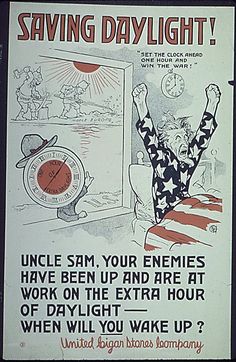
World War Wednesdays: Illuminating Daylight Savings Time


     Get your hoe ready! I hope everyone is enjoying their extra hour of sleep this week following the weekend's 'fall back' for Daylight Savings Time. I thought it might be interesting to discuss how the concept of moving the clocks forward and back has connections to both World Wars. A few weeks ago, we talked about how Winston Churchill had a perfect quote for just about everything, and his description of Daylight Savings Time sums it up with poetic charm:
   
     "An extra yawn one morning in the springtime, an extra snooze one night in the autumn... We borrow an hour one night in April; we pay it back with golden interest five months later."

Since the Beginning of Time Itself
     The idea of DST existed long before it was actually implemented around 100 years ago. It is known that ancient civilizations practiced a similar concept where they would adjust their daily schedules according to the Sun.

Power to the People 
     Throughout history, the idea of conserving daylight was suggested by multiple famous scientists with varied responses. In 1784, American inventor and politician Benjamin Franklin penned an essay titled "An Economical Project for Diminishing the Cost of Light" to the editor of The Journal of Paris. In it, he jokingly suggested that Parisians could economize on their use of candles by getting people out of bed earlier to make use of the natural light.
     A major contribution to modern DST came from New Zealand entomologist George Vernon Hudson in 1895. In a paper presented to the Wellington Philosophical Society, he proposed a two-hour shift forward in October and a two-hour shift back in March (seasons are opposite in the two hemispheres). He followed this up with an article in 1898 but despite some interest, the idea never caught on.
     British builder William Willett proposed an introduction of DST independently from Hudson in 1905. His suggestion was to turn the clocks ahead 20 minutes on each of the four Sundays in April, and switching them back by the same amount on each of the four Sundays in September. This plan caught the attention of Member of Parliament Robert Pearce, who introduced a bill to the House of Commons in February 1908. The first Daylight Saving Bill was drafted in 1909 and repeatedly presented to Parliament, but since it was opposed by many including farmers, it was never made into a law. Willett died in 1915 before he could see his idea come to life.
William Willett
In Times of War
     The first country to implement DST was Germany, during the First World War. Clocks were first turned forward at 11:00pm on April 30, 1916 with the rationale being the minimization of artificial light in order to conserve fuel for the war effort. Britain and many other countries soon followed suit, including the U.S. After the war was over, many countries reverted back to standard time.
"Morgenstunde hat Gold im Munde"-- The German equivalent of "The early bird gets the worm"
A British advertisement for the setting back of the clocks in September
     In the U.S., DST or "fast time," as it was called then, was introduced in 1918 when President Woodrow Wilson signed it into law to support the First World War effort. The idea had been sparked by Robert Garland, an industrialist who had encountered it in the U.K. He is often called the "Father of Daylight Saving" for his passionate campaign for the use of DST in the U.S.

     From February 9, 1942 to September 30, 1945, year-round DST or "War Time" was in force in America during the Second World War. The change went into effect only 40 days after the bombing of Pearl Harbor, and after the war ended the U.S. time zones were re-named "Peace Time". In Britain, "Double Summer Time" was adopted by setting the clocks two hours ahead  of GMT in the summer and one hour ahead during the winter.

Contemporary Continuation 
     From 1945 to 1966, DST caused major confusion and craziness in the U.S. for trains, buses, and broadcasting because states and localities were free to choose when and if they observed DST. Congress's Uniform Time Act of 1966 put an end to that and stated DST would begin on the last Sunday of April and end on the last Sunday of October. Since then, there have been numerous changes and updates as recent as 2005.

     Hopefully this post sheds some light on this interesting event on our calendars. Shoutout to timeanddate.com for the info! How do you feel about DST? Should we still be observing this system? Let me know what you think!

     Before I sign off I'd just like to encourage everyone to see your local Legion members for a poppy during the poppy campaign, and pin it on your left side as close as possible to your heart! Please, please don't stick it on your hat or purse strap or alter it in any way! I hope I'm preaching to the choir on that one!
     Thanks for reading,
Delany

Wednesday, October 7, 2015

World War Wednesdays: The Wicked Wit of Winston Churchill


     Whew! Were there enough 'W's in that title for you? This week's topic features one of my top two most beloved historical figures: Sir Winston Spencer Churchill. Basically, I'll take every possible opportunity to talk about the iconic British Bulldog, and he has been the topic of much of my own research and writing. I've actually heard on good authority that it is now considered backward in the historical community to favor Churchill when researching and writing on the Second World War, and if that's the case then as per usual I would hate to be forward. If any of my readers this week tend not to favor Churchill, I hope this post causes you to find some place in your heart for him on a personal level. I have tried my best to compile just some of the numerous reasons why he is one of the biggest inspirations in my life, and say what you want about the old bugger but he was never short on inspiration!

     About a year ago, I was in the gift section of Chapters and stumbled upon a book called "The Wicked Wit of Winston Churchill" by Dominique Enright. Basically, she had compiled a series of recollections and quotations which featured instances of Winston Churchill's remarkable ability to say the most perfect thing at all the most perfect times. While most people get themselves involved in discussions, leave them, and are struck with the frustration of having thought of the perfect response a day later, Churchill always seemed to be able to strike with a paralyzingly witty remark which nullified any retort the other person could ever think of. I like to think that his almost constant state of drunkenness had only a minimal part to play in this. After combing through the Enright book I've made this compilation of my own favorites of these examples of The Wicked Wit of Winston Churchill.

On Politics
     When asked what qualities a politician required, Churchill replied, "The ability to foretell what is going to happen tomorrow, next week, next month, and next year. And to have the ability afterwards to explain why it didn't happen".

     When an Ulster Member shouted 'Contemptible' during an Irish Home Rule debate in the House: "If I valued the honourable gentleman's opinion I might get angry".

On Words
     In one of the many documents that came his way throughout his career, a civil servant had gone out of his way to be grammatically correct, and had clumsily avoided ending a sentence with a preposition. Churchill scribbled in the margin: "This is the sort of English up with which I will not put."

     In September 1943, General Sir Henry Maitland Wilson was selected to take the Greek island of Leros with a small number of troops. Churchill encouraged him, saying, "This is the time to play high. Improvise and dare." Later, he wrote: "He improvose and dore."

     After a march of over a hundred miles during a 1907 tour in Africa, Churchill turned to his private secretary Eddie Marsh and said, "So fari-- so goodi!"


On Himself
     When a woman came up to him and declared that her baby looked just like him, he responded with "Madam, all babies look like me."

     On his seventy-fifth birthday, November 30, 1949: "I am ready to meet my Maker. Whether my Maker is ready for the ordeal of meeting me is another matter."

     "My idea of a good dinner is, first, to have good food, then discuss good food, and after this good food has been elaborately discussed, to discuss a good topic- with me as chief conversationalist."

On Nations
     At the Yalta Conference in 1945, Churchill was persuaded to follow Roosevelt's tribute to Soviet leader Josef Stalin, objecting all the while "But they do not want peace."He got to his feet and proposed a toast "to Premier Stalin, whose conduct of foreign policy manifests a desire for peace." Then, in a whispered aside out of earshot from the interpreter, "A piece of Poland, a piece of Czechoslovakia, a piece of Romania..."

     In 1943, Churchill sent Anthony Eden on a mission to bring Turkey into the war. After receiving a telegram from Eden reporting "Progress slow. What more can I tell Turkey", Churchill responded with, "Tell them Christmas is coming!"
Churchill and his wife, Clementine Hozier
On Women, Marriage, and Family
     "My wife and I tried two or three times in the last few years to have breakfast together but it was so disagreeable we had to stop."

     At a reception in Richmond, Virginia, in the USA, his hostess, an ample lady, led Churchill, the guest of honour, to the buffet table. When she offered him some cold chicken, he asked if he could have a breast. As she helped him to a particularly succulent-looking piece his hostess informed him genteelly that "We Southern ladies use the term 'white meat.'" The next day a corsage arrived for her with a card from Churchill which read, "I would be most obliged if you would pin this on your 'white meat.'"

     At a reception during a speaking tour in Canada he was seated next to a straight-laced Methodist minister when a young waitress came up to them with a tray of glasses of sherry. Churchill first took a glass, and when she turned to the minister, he was appalled at having been offered alcohol: "Young lady," he announced, "I'd rather commit adultery than take an intoxicating beverage." Churchill then beckoned the girl, "Come back, miss- I didn't know we had a choice."

     Leaving the Commons bar one evening, it is said that Churchill ran into another woman MP, the formidable Bessie Bradddock. "Winston," she said icily, "you're drunk." Churchill drew himself up: "Madam, you're ugly. But tomorrow I shall be sober."
Churchill and American General Eisenhower
On Drink
     In reply to Field Marshal Montgomery's smug statement, "I neither drink nor smoke and am a hundred percent fit," Churchill said, "I drink and smoke and I am two hundred percent fit."

     "Always remember, Clemmie (his wife), that I have taken more out of alcohol than it has taken out of me."

     "When I was younger I made it a rule never to take strong drink before lunch. It is now my rule never to do so before breakfast."

Wednesday, September 23, 2015

World War Wednesdays: the Battle of Britain 75th Anniversary Ceremony, Ottawa


      A few weeks ago, I wrote a post about the anniversary of the start of the Battle of Britain, a major  Second World War air battle between the British Royal Air Force and German Luftwaffe during the summer and autumn of 1940. The official date for recognition of the battle this year was September 20, 2015, also known as Battle of Britain Sunday. To mark the occasion, a ceremony was held on Parliament Hill, Ottawa, to commemorate this significant event in our history. I was very fortunate to have attended the ceremony, and wanted to share some of the highlights with you this week! (If the videos do not work automatically, there are links below to where I uploaded them on YouTube).

     One of the main highlights of the ceremony was the presence of two reproduction planes which were parked on the lawn in front of centre block so that people could see up close the aircraft involved in the battle. On the left in the photo is the Supermarine Spitfire, and on the right is a Hawker Hurricane. The Spitfire has become the symbol of the Battle of Britain, and the Hurricane proved a strong example of Britain's defiance against the seemingly unstoppable British advance.
Another view of the Spitfire

The Hawker Hurricane

The Spitfire in front of the Peace Tower

The Hurricane in front of the Peace Tower
    Before the ceremony, the bells in the Peace Tower had been programmed to chime the tunes of popular British WWII songs such as Vera Lynn's "When the Lights Go On Again" and "The White Cliffs of Dover". I'm not sure if you'll be able to hear them in the video, but I captured the main tune to "When the Lights Go On Again".


    The flag on the Peace Tower was also changed for the occasion to that of the Governor General of Canada's to signify his presence.
     
     The ceremony itself was very moving, as it incorporated some of the traditional sombre elements of ceremonial remembrance along with aspects more specific to the event, including quotes from Winston Churchill and some of the airmen involved in the battle. A poem by Pilot Officer John Gillespie Magee, Jr., a member of the No. 412 Squadron, RCAF who was killed in December of 1941, was read, which was particularly emotional.

     The ceremony culminated in a truly rare and remarkable sight-- flypasts from Royal Canadian Air Force aircraft past and present. I was lucky enough to capture them from the perfect spot, on what was a perfect day to be looking at the sky.

     In the centre is the Avro Lancaster bomber. The other planes are: a Curtiss P-40-N Kittyhawk, a Robillard Brothers North American Mustang IV (P-51 in the USA), a Hawker Hurricane Mk IV, and a Supermarine Spitfire XVI, all courtesy of Vintage Wings of Canada.


     The larger helicopter in the center is a CH-147F Chinook, and the other two are CH-146 Griffons.
    A CC-117 plane.

     A CC-150 Polaris and two CF-18 Hornets.

     And finally, the Canadian Forces Snowbirds flew the "missing man" formation to honour those who passed away in service of their country. You'll see the one aircraft depart from the group in a salute to the brave men and women who served during the Battle of Britain. 
Canada's Commander-in-Chief, His Excellency the Right Honorable David Johnston looks on as the Snowbirds emerge,  courtesy of Rideau Hall. 
     As seen in the pictures, it could  not have been a better day to honour this remarkable event. It was amazing to witness these aircraft in person, and I certainly will never forget it.

Thanks for reading, 

      Delany

Wednesday, July 15, 2015

World War Wednesdays: The Battle of Britain Anniversary


     This past week saw the 75th anniversary of the launch of the Battle of Britain during the Second World War, and that video of the Duke of Edinburgh definitely made sure it was in the news. The post for this week is all about what happened during that time, as part of the German plans for Operation Sea Lion. Winston Churchill was the new British Prime Minister at the time, so I hope you are a fan of his like I am, because he produced some of his greatest speeches during that period.
   
   
  1. Operation Sea Lion (German: Unternehmen Seelöwe) was Germany's plan to invade the United Kingdom during the Second World War, following the Fall of France. The entire plan relied on Germany having complete control of the English Channel, which, in turn meant that Germany had to have control of the skies so that the Royal Air Force could not attack German ships crossing the Channel. Hence victory in the Battle of Britain was an integral part of the plan.
  2. Head of the Luftwaffe Hermann Göering, on the right, overlooking the white cliffs of  Dover, England
         Operation Sealion looked simple in theory because geographically, Britain should have been an easy target. The Luftwaffe was very experienced in modern warfare, and the Wehrmacht had experienced astonishing success since the attack on Poland and the British had lost a vast amount of military hardware after the evacuation from the beaches of Dunkirk. The RAF and the Army in Britain looked weak; only the Royal Navy seemed to offer Britain some semblance of protection. It is said that Hitler was prepared to offer Britain generous peace terms. However, on May 21st, 1940, Admiral Raeder told Hitler about a plan to invade Britain and Hitler, it is said, was taken in by the plan. 
  3.      It was only when it became clear that Britain would not sign peace terms that Hitler gave his backing to an invasion. On July 2nd 1940, Hitler gave his first tentative orders regarding a possible invasion of Britain. It stated that
    “a landing in England is possible, providing that air superiority can be attained and certain other necessary conditions fulfilled…..all the preparations must be made on the basis that the invasion is still only a plan, and has not yet been decided upon.” Hitler, July 2nd 1940
  4.      Towards the end of June 1940, Hitler finally gave the order for the German military to make plans for an invasion of Britain, but they were one step ahead of him as all three branches of the German military had guessed that an invasion would be needed and had already started on their own plans. At a meeting with his service chiefs on July 21st, Hitler made it clear that he recognized that the plan had its dangers, but he was keen to press on with the plan so that he could turn his full attention to Russia once Britain had been defeated.
  5.      Beginning in July 1940, the Luftwaffe targeted its bomber campaign on coastal shipping convoys and shipping centres, such as Portsmouth. one month later, the attacks shifted to RAF airfields and infrastructure. As the battle progressed, the Luftwaffe also targeted factories involved in aircraft production and ground infrastructure. Eventually, it resorted to attacking areas of political significance and using terror bombing strategy such as the "Blitz" against British citizens to weaken morale.
  6. Children in the East End of London, made homeless by the Blitz
       Throughout the battle, the Germans greatly underestimated the size of the RAF and the scale of British aircraft production. Across the Channel, the Air Intelligence division of the Air Ministry consistently overestimated the size of the German air enemy and the productive capacity of the German aviation industry. As the battle was fought, both sides exaggerated the losses inflicted on the other by an equally large margin. However, the intelligence picture formed before the battle encouraged the Luftwaffe to believe that such losses pushed Fighter Command to the very edge of defeat, while the exaggerated picture of German air strength persuaded the RAF that the threat it faced was larger and more dangerous than was the case. Due to the failure of the Luftwaffe to establish air supremacy, a conference assembled on 14 September at Hitler's headquarters. Hitler concluded that air superiority had not yet been established and "promised to review the situation on 17 September for possible landings on 27 September or 8 October." Three days later, when the evidence was clear that the German Air Force had greatly exaggerated the extent of their successes against the RAF, Hitler postponed Sea Lion indefinitely. The Battle of Britain thus marked the first defeat of Hitler's military forces, with air superiority seen as the key to victory.
  7.      Ultimately, the Battle of Britain's legacy is that of utmost resiliency on the part of the British people during the darkest hour of their history. This can be attributed in part to the unwavering leadership of Winston Churchill, who coined the term "The Battle of Britain" before the attack began and used powerful speeches to bolster the spirits of the citizens. To conclude, here is a segment of one of his infamous pieces from July 14, 1940, called "War of the Unknown Warriors":
  8.  And now it has come to us to stand alone in the breach, and face the worst that the tyrant's might and enmity can do. Bearing ourselves humbly before God, but conscious that we serve an unfolding purpose, we are ready to defend our native land against the invasion by which it is threatened. We are fighting by ourselves alone; but we are not fighting for ourselves alone. Here in this strong City of Refuge which enshrines the title-deeds of human progress and is of deep consequence to Christian civilization; here, girt about by the seas and oceans where the Navy reigns; shielded from above by the prowess and devotion of our airmen-we await undismayed the impending assault. Perhaps it will come tonight. Perhaps it will come next week. Perhaps it will never come. We must show ourselves equally capable of meeting a sudden violent shock or-what is perhaps a harder test-a prolonged vigil. But be the ordeal sharp or long, or both, we shall seek no terms, we shall tolerate no parley; we may show mercy-we shall ask for none.
  9.      They are shattering words for undoubtedly the most shattering of times. Seventy-five years later, we are incredibly fortunate to recognize them as such.
  10. Thanks for reading,
  11. Delany