Showing posts with label Shipwreck. Show all posts

Wednesday, August 30, 2017

World War Wednesdays: In the News: The USS Indianapolis

USS Indianapolis in Pearl Harbor, Hawaii in 1937. US Navy Photo
     Among the many hot topics to hit the airwaves in the past few weeks was the discovery of the WWII USS Indianapolis wreck at its final resting place in the Philippine Sea. In the spirit of this remarkably tragic piece of American history, I've elected to discuss the life and legacy of its captain, Charles McVay III, in the hopes of a renewed discussion of the story's human element.
U.S. Naval Institute
      Capt. Charles McVay III was a 1920 graduate of the US Naval Academy and a career naval officer with an exemplary record, whose father had commanded the Navy's Asiatic Fleet in the early 1900s. Before taking command of the Indianapolis in November 1944, he was chairman of the Joint Intelligence Committee of the combined chiefs of staff in Washington, the Allies' highest intelligence unit. According to ussindianapolis.org, "Captain McVay led the ship through the invasion of Iwo Jima, then the bombardment of Okinawa in the spring of 1945 during which Indianapolis anti-aircraft guns shot down seven enemy planes before the ship was struck by kamikaze on March 31, inflicting heavy casualties, including 13 dead, and penetrating the ship's hull. McVay returned the ship safely to Mare Island in California for repairs.

     On July 16, 1945, the Indianapolis sailed from California with a top secret cargo to Hawaii for refuelling, then to Tinian where it unloaded its cargo, the uranium and major components of the atomic bomb to be dropped on Hiroshima by the Enola Gay on August 6. The Indianapolis was then routed to Guam that the seeds for the destruction of the Pacific had long since ceased. The Japanese surface fleet no longer existed as a threat, and 1,000 miles to the north preparations were underway for the invasion of the Japanese mainland. These conditions resulted in a relaxed state of alert on the part of those who were to route the Indianapolis across the Philippine Sea."

     ussindianapolis.org includes a list of evidence as to the details of the ship's fateful final journey:

  • Although naval authorities at Guam knew that on July 24, four days before the Indianapolis departed for Leyte, the destroyer escort USS Underhill had been sunk by a Japanese submarine within range of his path, McVay was not told.
  • Although a code-breaking system called ULTRA had alerted naval intelligence that a Japanese submarine (the I-58 by name which ultimately sank the Indianapolis) was operating in his path, McVay was not told. (Classified as top secret until the early 1990s, this intelligence -- and the fact it was withheld from McVay before he sailed from Guam -- was not disclosed during his subsequent court-martial.)
  • Although no capital ship (unequipped with antisubmarine detection devices such as the Indianapolis) had made the transit between Guam and the Philippines without a destroyer escort throughout World War II, McVay's request for such an escort was denied.
  • Although the routing officer at Guam was aware of dangers in the ship's path, he said a destroyer escort for the Indianapolis was "not necessary" (and, unbelievably, testified at McVay's subsequent court-martial that the risk of submarine attack along the Indianapolis's route "was very slight").
  • Although McVay was told of "submarine sightings" along his path, none had been confirmed. Such sightings were commonplace throughout the war and were generally ignored by navy commanders unless confirmed.
    "Thus, the Indianapolis set sail for Leyte on July 26, 1945, sent into harm's way with its captain unaware of dangers which shore-based naval personnel knew were in his path. Captain McVay's orders were to "zigzag at his discretion." Zigzagging is a naval maneuver used to avoid torpedo attack, generally considered most effective once the torpedoes have been launched. No Navy directives in force at that time or since recommended, much less ordered, zigzagging at night in poor visibility. At about 11pm on Sunday night, July 29, the Indianapolis traveling alone was about halfway across the Philippine Sea. There was heavy cloud cover with visibility severely limited. Captain McVay gave orders to cease zigzagging and retired to his cabin. Minutes later the ship was  spotted as an indistinct blur by Japanese submarine commander Mochitura Hasimoto of the I-58. It was coming directly toward him from the east. Shortly after midnight the ship was struck by two torpedoes and sank in about twelve minutes. 

     When the ship failed to arrive at Leyte on Tuesday morning, a series of blunders ensued. First, there was confusion as to which area the Indianapolis was to report when it arrived. Second, there was no directive to report the non-arrival of a combatant ship. And, third, there was no request to retransmit a garbled message which would have clarified the Indianapolis' arrival time. As a result, the surviving crew of the Indianapolis was left floating in shark-infested waters until 11am on Thursday, August 2, when Lt. Wilbur C. Gwinn, the pilot of a Ventura scout-bomber, lost the weight from his navigational antenna trailing behind the plane, a loss which was to save the lives of 316 men. While crawling back through the fuselage of his plane to repair the thrashing antenna, Gwinn happened to glance down at the sea and noticed a long oil slick. Back in the cockpit, Gwinn dropped down to investigate, spotted men floating in the sea, and radioed for help. At 3:30 that afternoon Lt. R. Adrian Marks, flying a PBY Catalina, was the first to arrive on the scene. Horrified at the sight of sharks attacking men below him, Marks landed his flying boat in the sea, and, pulling a survivor aboard, he was the first to learn of the Indianapolis disaster." ussindianapolis.org

     Capt. William J. Toti, USN (Retired) describes the legal scandal that ensued:         "The Indy controversy erupted in August 1945, just after the atomic bombs were dropped. The American public was outraged at the loss of more than 800 lives in the waning days of the war, and a Navy court of inquiry was convened to investigate. Its recommendation was that Captain McVay be court-martialed for hazarding his vessel by failure to zigzag, but Admiral Chester Nimitz disagreed and instead issued the captain a letter of reprimand. Admiral Ernest King later overturned Nimitz’s decision and recommended a court-martial, which Secretary of the Navy Forrestal later convened.
In doing so, King intervened directly with the Secretary of the Navy to move forward with the court-martial in parallel with an investigation by the Inspector General (IG). But a court-martial is a trial, not an investigatory tool. If King’s problem was simply a lack of information, why didn’t he allow the Inspector General to issue his report before ordering the court-martial? Some believe it is because King was not satisfied that the IG’s conclusions would support his decision to court-martial.
The Navy Judge Advocate General also was asked to review the referral. His response contained the curious statement that the charges included in the initial referral were “the only ones that can be supported,” as if an agenda was at work to establish a greater foundation for prosecution. Whatever the truth, this statement certainly creates the perception that the Judge Advocate General was under direction to discover more charges to refer against McVay.
     
     In the end, McVay was charged with two counts: suffering his vessel to be hazarded by failing to zigzag, and failure to order abandon ship in a timely manner. His counsel, reportedly hand-picked by King, had never argued a case in court before. The court claimed that McVay was not being charged for any deficiency that led to the sinking of his ship. They made a strong case that the “Indianapolis was hazarded before she was ever detected by I-58, and would have been hazarded if she had never been detected by I-58.” In essence, McVay could have been found guilty in a court– martial even if his ship had not been sunk. This is a meaningless legal distinction, however, since absent the sinking, there would have been no way for anyone to know that the vessel had been hazarded.

     Hence, despite the fact that McVay was convicted only on the first count—for suffering his vessel to be hazarded by not zigzagging—there is no way to escape the fact that Captain McVay was court-martialed for having his ship sunk. Put all these facts together, and it is understandable why most of the survivors believe that Admiral King was doing all he could to tilt the scales of justice against McVay. Even Admiral Nimitz later would say to one survivor that the entire affair involving the court-martial was a mistake and should never have happened."
     From a statement submitted at a September 1999 Senate hearing by Paul J. Murphy, USS Indianapolis survivor: "The charge upon which he was convicted for failing to zigzag contained a phrase 'in good visibility.' The visibility that night was NOT good as all of us know who were there that night."

     Like Murphy, many of Indianapolis's survivors said that McVay was not to blame for the sinking, the families of some of the men who died thought otherwise. One piece of mail read: "Merry Christmas! Our family's holiday would be a lot merrier if you hadn't killed my son." The guilt that was placed on McVay's shoulders mounted until he committed suicide in 1968, using his Navy-issued revolver. He was discovered on his front lawn with a toy sailor in one hand. He was 70 years old.
     In 1996, sixth-grade student Hunter Scott began his research on the sinking of the Indianapolis, which led to a United States Congressional investigation. In October 2000, the United States Congress passed a resolution that Captain McVay's record should state that "he is exonerated for the loss of Indianapolis", which was signed by President Bill Clinton. The resolution noted that, although several ships of the U.S. Navy were lost in combat in World War II, McVay was the only captain to be court-martialed for the sinking of this ship.
     In July 2001, the United States Secretary of the Navy ordered McVay's official Navy record cleared of all wrongdoing.
     In July 2016, new details about the sinking emerged which helped lead to the wreck's discovery this month. Read about those details here: http://www.cnn.com/2016/07/29/us/uss-indianapolis-sinking-anniversary/index.html and the discovery here: http://www.bbc.com/news/uk-41041013

     Credits to ussindianapolis.org and the U.S. Naval Institute for the information in this post. 
     Thanks for reading,
Delany (@DLeitchHistory on Twitter)

Wednesday, August 16, 2017

World War Wednesdays: SS Caledonia

Advertising card for the ship, Norway Heritage
     For those who remember the series of posts from a few weeks back about local First World War hero Maj. George Stirrett, this week's edition ties in as a bit of a spin-off. On June 9, 1915, Stirrett and the rest of his squadron, including Lieut. Billy Bishop, sailed for England on the SS Caledonia. I decided to investigate further into the history of that ship, a la the traditional WWW boat stories that seem to be a trend, and the results were quite interesting!
 Photograph of Caledonia dated 1904, possibly shortly after being launched, but it probably was actually taken in 1905 around the time of the ship’s maiden voyage on 25 March. Courtesy of the Peabody MuseumSalem, Massachusetts.
     The SS Caledonia was a 9,223-ton British passenger ship built for the Anchor Line by David and William Henderson and Company at Glasgow, Scotland. She was approximately 500 feet wide and could reach a top speed of 16 knots. Launched 22 October, 1904, her maiden voyage was 25 March, 1905. Primarily used for trips between Glasgow, Scotland and New York City, she could accommodate roughly 250 first class passengers, 350 second class passengers, and 850 third class passengers.
Main staircase and lift, Gjenvik-Gjønvik Archives
Italian veranda cafe, Gjenvik-Gjønvik Archives

Corridor Lounge, Gjenvik-Gjønvik Archives

Another view of the Corridor Lounge, Gjenvik-Gjønvik Archives

Italian smoking room, Gjenvik-Gjønvik Archives

An alcove in the Caledonia smoking room, Gjenvik-Gjønvik Archives

Caledonia stateroom with private bath, Gjenvik-Gjønvik Archives
     Between 1905 and 1914, the Caledonia was "one of the premier passenger liners that steamed between Glasgow and New York City on a weekly basis," and her fastest time between the two cities was 6 days and 20 hours. A 1911 travel brochure printed by the Anchor Line boasted of the Caledonia's amenities:
     "First Cabin passengers are furnished with a liberal table, including all the delicacies of the season, and everything necessary on the voyage. Wines and liquors pf the finest quality can be had on board at moderate prices. The Dining Saloons, Music Hall, Ladies' Boudoir Promenade Decks, and by means of electric bells, are in communication with the Steward's department. Every steamer carries a duly qualified Surgeon and experienced Stewardesses, and is provided with a select Library, including all the latest Guide Books of European travel. Staterooms are located on the Main and Upper Decks, are large, have electric lights, and are perfectly ventilated and elegantly furnished, accommodating two, three, and four passengers each. All Staterooms are provided with electric bells connected with Steward's department."
A stateroom on board Caledonia. Photograph taken from an Anchor Line travel brochure dated 1911, Naval Warfare Blog. 

First class dining saloon aboard Caledonia. Photograph taken from an Anchor Line travel brochure dated 1911, Naval Warfare Blog.

 First class music saloon aboard Caledonia. Photograph taken from an Anchor Line travel brochure dated 1911, Naval Warfare Blog. 

Anchor Line dinner menu from S.S. Caledonia on 4 July 1905, during a trip from Glasgow, Scotland, to New York City, Naval Warfare Blog.
     Rates for adult passage ranged from $67.50 to $125 depending on the accommodations, children between the ages of 1 and 10 traveled for a half fare, and infants under one year made the trip for only $5. 
_________________________________________________________________________________

     When the First World War began in August 1914, the British government requisitioned the Caledonia and converted the elegant liner into a troopship with the capacity to carry 3,074 troops and 212 horses. For over two years, the ship carried soldiers and their equipment to France, as well as to various locations around the Mediterranean. 
For
     On 5 December, 1916 (a year and a half after Maj. Stirrett's voyage), while on a trip carrying mail  but no troops from Salonica, Greece to Marseille, France, Caledonia was attacked by the German submarine U-65 under the command of Cpt. Hermann von Fischel. She was torpedoed without warning approximately 125 miles east of Malta. Although his ship was sinking, Caledonia's commanding officer, Captain James Blaikie, steered the troopship towards the U-Boat and tried to ram her. Caledonia actually managed to hit the submarine, causing severe damage, but the U-Boat stayed afloat as Caledonia sank, with the loss of only one life, and there was evidently enough time for the rest of the crew to abandon ship and make it to the lifeboats before Caledonia went down. Fortunately, the absence of troops on board the ship helped keep the number of fatalities low.

     Captain Fischel of U-65 was so enraged by being rammed that he took Captain Blaikie prisoner from one of the lifeboats. For a time, Germany threatened to execute Captain Blaikie for trying to sink U-65. But, the British government made it known to the German government (through the US ambassador in Berlin, since the US was still neutral at that time) that a German officer would be shot in retribution. Ultimately, Captain Blaikie was sent to an officer prisoner-of-war camp at Freidburg, Germany. 

     I came across two different news reports from two very different newspapers that covered the sinking of the Caledonia: 

From the Barrier Miner, Broken Hill, NSW, Australia, Tuesday, 12 December, 1916 (courtesy of the National Library of Australia)
Sinking of the Caledonia
German Official Report
(Reuter's Message)
Washington, Monday
     The German Embassy has received an official message from Berlin that the British Anchor liner Caledonia was sunk by a U submarine on December 4 after she had tried to ram a submarine and that the captain was made a prisoner.

From the Cornell Daily Sun, Ithaca, New York, Sunday, 11 December, 1916 (courtesy of the Cornell University Library)
Sinking of Caledonia Officially Announced
By The Associated Press
     Berlin, Dec. 10- The British steamer Caledonia was sunk by a German submarine on December 4 after she had tried to ram the undersea boat, it was officially announced today. Her captain was taken prisoner.

     Information this week is courtesy of the Naval Warfare Blog. I hope you enjoyed this glimpse inside and overview of a ship with a fascinating story!
      Thanks for reading, 
Delany (@DLeitchHistory on Twitter)
     

Wednesday, October 21, 2015

World War Wednesdays: Shattered Innocence: The SS City of Benares


     In case you're wondering why I always seem to write about sunken ships and disasters at sea, my best attempt at an answer is that my interest was piqued with my first taste of history as a child through the story of the Titanic, and throughout my studies I've repeatedly stumbled upon similar tragedies.
     If any of my readers follow History at Western University, you might recognize this week's topic, but I assume most of you understandably do not, so I'll fill you in on how I got acquainted with it!
     A couple of weeks ago, I stumbled across a gal named Claire Halstead on Twitter who is a PhD candidate at Western researching British child evacuees in Canada during the Second World War. She recently featured excerpts from original letters and quotes of accounts related to the sinking of the ship the SS City of Benares in 1940. I found these tweets to be especially moving and made a mental note to someday research the topic for a blog, but then I saw in the news the other day that Claire successfully defended her dissertation on the topic two days ago and officially earned her PhD. Congratulations, Dr. Halstead, and thanks for inspiring this post!

Wednesday, April 22, 2015

World War Wednesdays: Torpedoed Treasure: The SS City of Cairo

World War Wednesdays: Torpedoed Treasure: The SS City of Cairo
 
SS City of Cairo
 
     It always blows my mind whenever I read the news and  find stories related to the Second World War. Studying it all the time tends to make it feel almost fictional and far away when the information is broken down into textbook facts, but its impact is brought home when it still appears in the news 70 years later. It is very exciting for the field to know that every day, more knowledge is being added, which generates new topics of discussion and an even better understanding. This week, I came across the story of the SS City of Cairo, and I thought that both its wartime and current story were worth a share.
 
    
     The SS City of Cairo was a British passenger steamship built in 1915 and registered in Liverpool. During the Second World War, she was requisitioned to bring supplies to the United Kingdom. Her last voyage was to depart from Bombay on 1 October 1942, bound for the UK via Durban, Cape Town and Pernambuco, Brazil. The ship departed Cape Town at 0600 hours on the morning of 1 November, carrying 101 passengers, including 28 women and 19 children. Also on board were 10 DEMS Gunners from the Army and Royal Navy. She was carrying 7,422 tons of general cargo, including pig iron, timber, wool, cotton, manganese ore and 2,000 boxes of silver coins.
She sailed north for 800 miles (1,300 km), zigzagging during the day and keeping about 45 miles (72 km) off the African coast, before turning westwards across the South Atlantic towards Brazil and her next port of call. She was unescorted (a dangerous thing during the Atlantic war) and capable of only 12 knots (22 km/h). Her problems were heightened by the excessive smokiness of her engines which increased her visibility.
     On 6 November, the smoke trail was sighted by the German submarine U-68 under the command of Karl-Friedrich Merten. At 2136 hours, U-68 fired a torpedo at the lone merchant ship. The torpedo struck City of Cairo abreast of the after-mast. The master gave the order to abandon ship. All of the women and children left the ship safely; only six people, two crewmen and four passengers, were lost in the evacuation. The ship, still underway, had stabilised, but she was slowly settling by the stern. A distress call was sent, which was acknowledged by the U-68, and provided the callsign of the Walvis Bay station in South Africa.
Captain Karl-Friedrich Merten
     Merten fired a second torpedo 20 minutes after the first, which caused the ship to sink by the stern about 480 miles (770 km) south of St Helena. One of the two crewmen lost in the sinking, Chief Radio Officer Harry Peever, was killed by this strike. He had remained in the wireless room to send distress signals. Once City of Cairo had sunk, U-68 surfaced alongside the six lifeboats that had been launched. Merten spoke to the occupants of No. 6 boat, asked the ship's name, cargo and whether it was carrying prisoners of war. He then gave a course for the nearest land, which by now was either the Brazilian coast, approximately 2,000 miles away. Merten then left them, with the words "Goodnight, and sorry for sinking you". He privately thought that they had little chance of survival.

     However, there were 189 survivors. After assessing the situation, it was decided to attempt to reach the nearest land, St Helena, but over the next three weeks, most of the lifeboats lost contact with each other, and numerous occupants died. Most of the lifeboats were picked up by various other vessels, including one German merchant ship which was also sunk. Out of a total of 311 people aboard City of Cairo, 104 died, including 79 crew members, three gunners and 22 passengers, with 207 surviving. Six are known to have died in the sinking, 90 in the boats, and seven after being rescued.

     Last Friday, the City of Cairo made the news once again when a Mauritius-based firm called Deep Ocean Search released details of the salvage 400 miles south of the South Atlantic island of St. Helena, saying the recovery from the wreck, lying at a depth of 5,150 metres, was a world record.
     The ship was broken in two and filled with mud, but the crew was still able to recover the silver coins worth $50 million which had been intended to fund the British war effort. The operation was completed in 2013 but kept under wraps until this year.

After Deep Ocean had taken its cut under international marine salvage rules, the remainder of the treasure was returned to its original owner - Britain's Treasury, a spokesman confirmed.
     An interesting topic that may be less so for family members of the City of Cairo victims. Should ships like this one which serve as underwater gravesites for hundreds of victims be respected as such, or is the valuable cargo worth recovery regardless? We've seen this topic in previous posts regarding the Empress of Ireland (nautical disasters seem to be a theme). Feel free to weigh in!

 Thanks for reading,
     Delany Leitch


Wednesday, October 1, 2014

World War Wednesdays #3


World War Wednesdays: The Empress of Ireland
     When people think of major disasters in the last century, Titanic is one that is at the forefront of their memories. Over a hundred years later, it is amazing to think that people still know or even care about such a faraway event. This is of course due in part to the cinematic adaptations which have done a good job of making the horror of that fateful night come to life. However, thanks to a recent visit to the Canadian Museum of History in Gatineau, Quebec, I learned about a similar tragedy which was much less publicized and much closer to home: The Empress of Ireland.
The Empress of Ireland
 
     Called Canada's Titanic, The Empress of Ireland is an equally chilling and arguably more terrible story which turns one hundred years old this year. In 1914, Canadian history was experiencing a pivotal period in which economic activity was booming, and hundreds of thousands of immigrants were arriving to be a part of this great new country. These people would travel by sea, on such a magnificent ship as The Empress of Britain or her sister, The Empress of Ireland.


     The Empress of Ireland was owned by the Canadian Pacific Railway, and was used to make the transatlantic journey from Quebec City to Liverpool, England. The final fateful crossing, which began May 28th, 1914, was her 96th. 1,477 people boarded that day, among them 171 members of the Salvation Army who were en route to London for  World Congress, 87 first class passengers, 253 second class passengers, 717 third class passengers, 420 crew members, and a total of 138 children.
     In order to complete its journey, the ship needed to travel down the St. Lawrence River to get to the Atlantic Ocean. It was boasted that this short portion of a couple of days contributed to the Empresses' swift reputation. It was here that the tragic events unfolded.

The Empress of Ireland Glenbow
The Empress of Ireland McCord
The Empress of Ireland Music Room


     On the foggy night of May 29th, 1914, the lack of visibility and a confused encounter resulted in a Norwegian collier called the Storstad colliding with the Empress at a 45 degree angle near her center. The captain of the collier ordered 'full ahead' to remain inside the ship, but a strong current separated the two ships and allowed water to begin flooding into the gaping hole. At 1:55 AM, just fifteen minutes after the two vessels came close enough to see each other, the Empress began listing to the starboard side. Some of the port steel lifeboats broke loose and crushed passengers, but a few still managed to make it onto the water. Just ten minutes after impact, the ship completely turned over to starboard, the two huge smokestacks hit the water and crushed a lifeboat, and many passengers were hurled into the sea. After only fourteen minutes, the Empress of Ireland sank 6km off from Saint Luce-Sur-Mer, Quebec. By comparison, the RMS Titanic took two hours and forty minutes to sink.
    
The speed of the sinking, combined with its considerable death toll make this the greatest maritime disaster in Canadian history. Of the 1,477 souls on board, 1,012 were lost. Only 245 crew members survived from the original 420. Third class lost 584 of its 717, second class 205 of its 253, and first class 51 of its 87. The Salvation Army group lost 150 members. Of the 138 children on board, only five remained.
     These heartbreaking numbers were not the last tragedies to befall the horrific event. One month later, the First World War broke out, and the sinking of the ship was quickly forgotten by the world  along with its victims. It wasn't until fifty years later that a group of divers discovered the wreck. Despite dangerous conditions and numerous deaths, divers have been able to retrieve a number of items from the ship. These items have since been given to the Museum from a private collector.
The ship's bell
The ship's telegraph

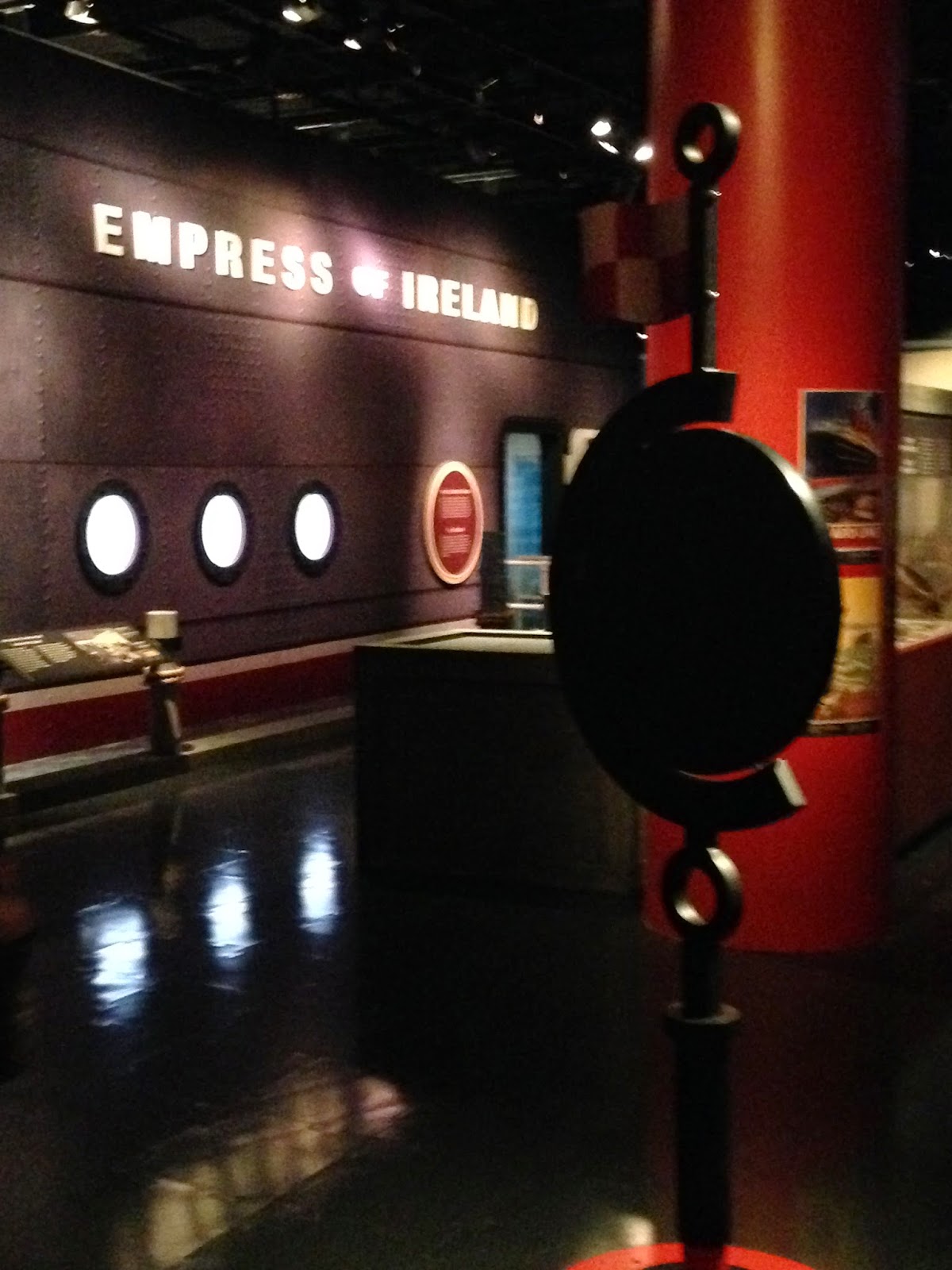
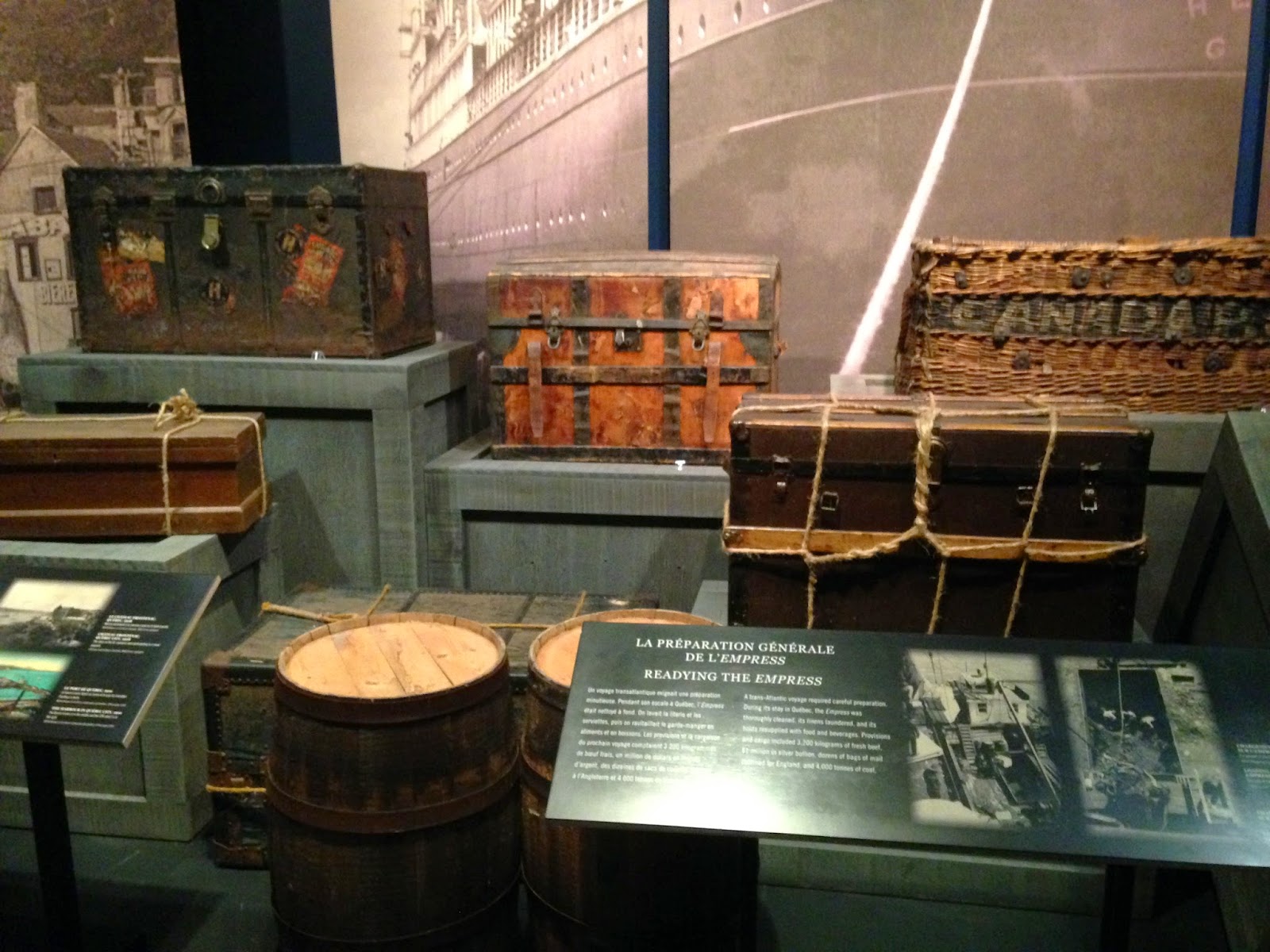
From May 30th, 2014 to April 6, 2015, the items are on display at the Museum as part of their main exhibit. The exhibit itself is expertly done in a re-creation of the actual ship, taking you on the journey from the excitement of boarding to the terror of the collision. I had the opportunity to visit the exhibit, which I found to be highly emotional and an incredibly eerie experience.


The exhibit sign


The exhibit entrance
Inside the ship
Baggage display


Model and artifacts
Quote from a passenger


 I also had the opportunity to attend a behind-the-scenes event where I met with the curator and conservationist who set up the exhibit. They shared with us a fascinating description of how the items were displayed, and their journey from salty ocean floor to pristine museum condition. It was fascinating to see the items up close and to learn more about them. This story is an incredibly interesting one, which I had never heard before, and I'm so thrilled to have been able to learn about it in such an interactive way.
                     Thanks for reading,
              Delany Leitch
Some examples of the dishes from the Empress' dining room. The fancier, more intricate pattern of the bottom two was designed for first class, the darker, block pattern of the upper corners was for second class, and third class received the plain white plate with the CPR logo stamped in the center.
The behind-the-scenes event, held in the museum's archival lab. The curator is the man in the grey shirt, and the conservationist is the woman in the white jacket. Notice the dishes and the wooden board with a faucet, which would have been in a passenger's cabin.


The Museum grounds, overlooking the Ottawa River and Parliament Hill


Here's where I found some supplementary information:
http://www.historymuseum.ca/empress
http://news.nationalpost.com/2014/05/28/canadas-titanic-the-sinking-of-the-empress-of-ireland/


On the Museum's website you can see a survivor's emotional account of her experience that night. I've also included some of the personal stories which are on display at the Museum.
Egildo Braga
Travelling with his wife Carolina and their son Rino
Third class
Birthplace: Italy
Place of residence: Fayal Camp, Minnesota
Occupation: Miner
Purpose of trip: The Bragas were going to visit family in Italy during a series of major strikes in the U.S. mining sector.
Fate:
Egildo Braga: Survived
Carolina Braga: Survived
Rino Braga (son): Perished
Egildo tried to save his family. He tied his son to his body and threw himself into the water with his wife. The force of the waves tore Rino from his father. Egildo searched desperately for his son in the dark, but in vain.
This photograph, taken in Northern Minnesota, shows Elgido Braga, his wife Carolina and their son Rino (in her arms). They appear in the upper row, between the guitar player and the accordionist. Within two months, they would board the Empress of Ireland for a trip home to Italy.
Wedding Photograph of Carlo and Giusseppa Braga, March 1914, Courtesy of Ernesto Milani

Grace Hanagan
Travelling with her parents Edward and Edith
Second class
Birthplace: Canada
Place of residence: Toronto
Purpose of trip: As an eight-year-old girl, she was happy to be going on a trip with her parents, who were travelling to London to take part in the Salvation Army’s International Congress.
Fate:
Grace Hanagan: Survived
Edith Hanagan: Perished
Edward Hanagan: Perished

Eight-year-old Grace lost sight of her parents after falling into the water. During the year that followed the tragedy, she continued to hope that her mother might still be alive, given that her body was not found.
View an excerpt from Grace Hannigan’s moving firsthand account of the sinking of the Empress.
Grace Hanagan, with the permission of The Salvation Army Archives, Canada and Bermuda Territory

Edward Seybold

Travelling with his wife Susanna

First class

Birthplace: Canada
Place of residence: Ottawa
Occupation: Entrepreneur
Purpose of trip: The couple celebrated their 43rd wedding anniversary on the day of departure. They were taking a trip to Europe for the occasion.
Fate:
Edward Seybold: Survived
Susanna Seybold: Perished
Edward followed the casket of his wife to Bonaventure station in Montréal on May 31.
© Library and Archives Canada, Topley Studio / e010973043 / e010973044