Showing posts with label mary storey. Show all posts

Tuesday, June 5, 2018

Trailblazer Tuesdays


🐢Trailblazer Tuesdays🐢 

       Ontario boasts eight turtle species, which is more than any other province in Canada. But that’s in danger of changing; of the eight species, seven are at risk. What humans have done through contributing to habitat loss, hunting, and poaching, is target adult turtles. That increased adult mortality is actually what’s driving the population down. This, combined with the fact that few young turtles live to adulthood; only seven of every 10,000 snapping turtle eggs; means that species are being driven toward endangerment. You’re most likely to spot turtles in marshy areas where there is native aquatic plant life. But during nesting season, which runs from late May to early July, you’ll also spot them crossing roads and in sandy or gravel areas. Spring is important time to watch for turtles. If you can save one turtle by moving it off the road, that makes a big difference to the overall conservation of the species. Take a picture of the turtle with your phone and upload it to Ontario Nature’s Reptiles and Amphibians Atlas, which features the most up-to-date maps of turtle species across Ontario.
If you see an injured turtle don't be afraid to contact  https://ontarioturtle.ca/ourmission/drop-off/ 
they will be able to help save and rehabilitate the turtle. 

1. Blanding’s Turtle
  • Unlike snapping turtles, which have yellow spots, look for a bright yellow chin and throat.
  • If you spot a turtle eating on land, it might be a Blanding; most aquatic turtles feed exclusively in the water.
  • They’re also likely to be seen on the move; Blanding’s make the largest overland movement of any Ontario turtle to move from their summer nesting spots to overwintering habitat.
Fun fact: These turtles can live to be 75.

2. Eastern Musk Turtle
  • With an upper shell that is brown with black flecking and a yellowish lower shell, these guys are easily confused with painted turtles, snapping turtles, and Blanding’s turtles. However, this small turtle only reaches a maximum length of 13 cm.
  • Keep an eye out for a light stripe above and below the eye on each side of the head in adult turtles.
  • Generally nocturnal creatures, Eastern musk turtles also rarely swim.
Fun fact: This turtle is named for the odour it emits when it’s threatened, which; you guessed it; is strong and musky. It’s also called “stinkpot.”

3. Midland Painted Turtle & Western Painted Turtle 
  • Painted turtles feature distinctive black shells with dark red or orange markings. No other species native to Ontario claims these colours.
  • Easily spotted on the move, painted turtles will move over large areas overland in search of nesting sites.
  • These are the only non-threatened turtle species in Ontario, but they are still susceptible to the threats that face other turtles.
Fun fact: With a natural “antifreeze” that prevents them from freezing, these turtles can survive temperatures as low as -9º C.

4. Northern Map Turtle

  • Named for its markings, this turtle has contour lines on its upper shell that look like a topographical map.
  • They also feature a yellow spot behind their eyes. Don’t confuse them with snapping turtles though; snapping turtles are larger and lack the distinctive shell markings of the map turtle.
Fun fact: One of the largest threats to this turtle’s pollution is water pollution. It can cause mass die-offs of mollusks, one of their primary food sources.

5. Snapping Turtle
  • The most prehistoric-looking of all of Ontario’s native species, the snapping turtle has triangular spikes along its tail.
  • Most likely to be confused with musk turtles, snapping turtles are significantly larger and grow up to 47 cm long.
  • Not the strongest of swimmers, these aquatic turtles are usually observed walking on the bottom of small ponds and rivers or crossing roads.
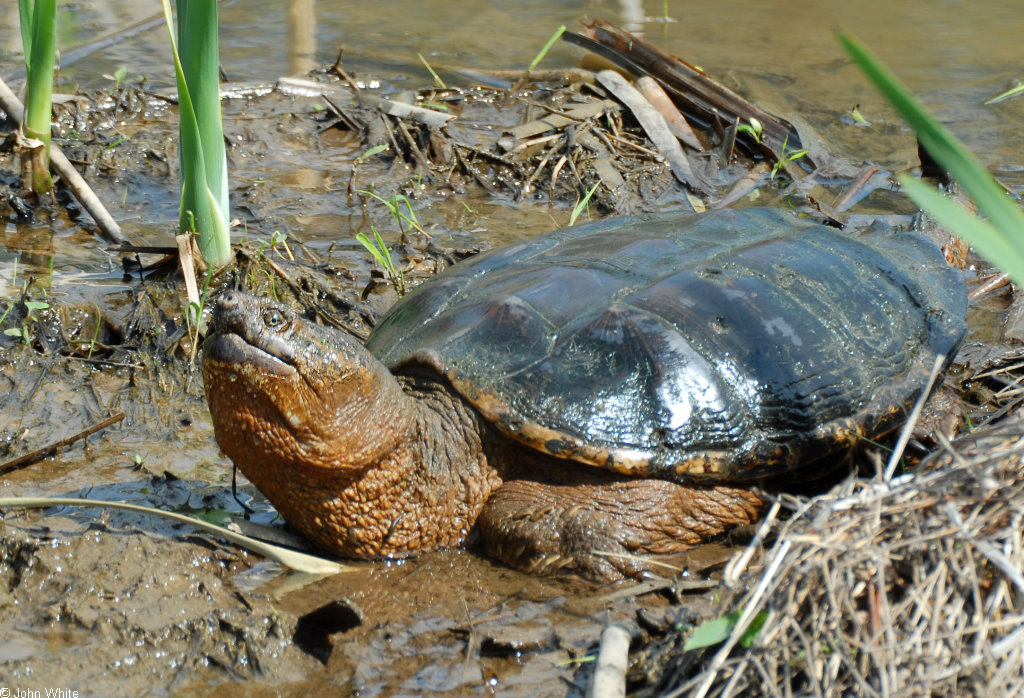
Fun fact: Most Ontario turtles only lay somewhere between three and 15 eggs. The snapping turtle lays around 50.

6. Spiny Softshell 

  • As the name implies, the softshell turtle has a soft, leathery shell.
  • A long snout makes this peculiar-looking creature unmistakable from its counterparts.
Fun fact: With the ability to get nearly half the oxygen they require by breathing through their skin in the water, they’re able to stay submerged for up to five hours.

7. Spotted Turtle

  • The spotted turtle features orange-yellow markings on its limbs, neck, and legs. However, it’s most clearly identifiable from the yellow spots marking its shell.
  • While males have dark eyes and a dark chin, females of this species have orange eyes and a yellow chin.
Fun fact: Unlike most other turtles, spotted turtles spend the summer or dry season in a state of inactivity to avoid hot dry weather.

8. Wood Turtle

  • With a highly sculpted upper shell, Ontario Nature calls this species “one of Ontario’s most attractive turtles.”
  • The neck, chin and and front legs are a vivid orange-yellow colour.
  • Like their name implies, these turtles are likely to be found in woodlands or floodplains during the summer months.
Fun fact:  They’re considered extremely intelligent and have been documented using creative methods to get their food, including stamping their feet to cause earthworms to come to the surface.

References:
Sabrina Merks

Tuesday, May 29, 2018

Trailblazer Tuesdays


🌳Trailblazer Tuesdays🌳

     This week the outlook opens and we cant be more excited! The John. E Pearce park was named after the John. E Pearce who generously donated the land in the 1950s and this property had been held by his family since it was first settled in 1809.  The park was classified as a natural environmental class farm but has been re-classified as a nature reserve to more appropriately recognize the heritage aspects and earth/life science characteristic found here. The park incorporates a sample of eroding Lake Erie Bluffs in association with the deciduous forest. A small picnic area sitting atop 30 m bluffs on the lakeside provides visitors with a beautiful vista looking out over Lake Erie, this opens June 1st! 
And as erosion continues, the fence will be moved inland when needed.

     Plant diversity is very high in the park. 405 species of plants were found in the park. 15 of which are considered rare in Ontario and 3 of which have not been recorded elsewhere in Elgin County. The most common tree found in the park is the sugar maple. Walnut, ash, hickory, ironwood and beech are also found in the park as well. Covering the forest floor is a lush matt of wild flowers. Trilliums, hepaticas, touch-me-nots, violets, jack-in-the-pulpits, and blood roots can be seen blooming in their respective seasons. Bird migrations can be seen from the lookout as well, especially in the fall with the hawk migration. 

Don't forget that the museum is park of the provincial park too, walk the Spicer trail and the Mary Storey Wetlands trail. How can you be a trailblazer of conservation and help to foster an appreciation of nature in your community? 

Sabrina Merks 


Tuesday, May 15, 2018

Trailblazer Tuesdays

🌿 Trailblazer Tuesdays 🌿

       In Southern Ontario there are so many deer that there are collisions between cars and deer almost daily.We get many deer here at the park! Just this week I saw two beautiful deer across the street from me. The reason is  the female  deer often leaves her fawn unattended for hours at a time while she searches for food. And in Southwestern Ontario, and across the province, the White Tailed Deer is the most common deer found.  This graceful white-tailed deer Odocoileus virginianus is well known to most North Americans and is easily recognized.  Hunters and non-hunters alike recognize the animal by its habit of flipping its tail over its back when it is startled, revealing the white underside and white buttocks.

      This "flag" of the white-tailed deer is often glimpsed as the high spirited animal dashes away from people. The tail has a broad base and is almost a foot long. When lowered, it is brown with a white fringe. Male Deer can grow to a height of 1 meter at the shoulder and can weigh around 110 kg when full grown and occasionally weigh up to 200 kg in the northern part of their range. In the summer time there is abundant food which makes almost any forested or bushy area suitable for deer. In the winter and the snow deepens, the deer concentrate in "deer yards," or areas that provide food and shelter from storms and deep snow.


      Human activities, such as the cutting and burning of blocks of forests, the seeding of agricultural crops, the winter feeding of cattle, the reduction of competitors such as mule deer, elk, moose, and the restriction on hunting of white-tails have helped this deer to extend its range northward and westward. In addition the long-term easing of the severity of winters may have been an important factor. Whatever the exact combination of causes, the range of the white-tailed deer extended considerably during the late 19th  and the first half of the 20th centuries. Now the deer is found throughout the majority of northern Ontario, but also through Manitoba, Saskatchewan and parts of Alberta and British Columbia. 

      If you are wanting to spot a White Tailed Deer the best times of the day to take a picture are the first two hours after day break, and the last two hours before sunset. Grab your camera, head down to John. E Pearce park, take a walk down Spicer Trail, or Mary Storey wetlands trail and see if you can take a picture of these beautiful deer. 

How can you be a trailblazer of conservation and help to foster an appreciation of nature in your community? 

Sabrina Merks 

Wednesday, November 29, 2017

Wetlands Storey Trail Grand Opening Speech

We had a great turn out on November 18, 2017 for the grand opening of the wetlands in John E. Pearce Provincial Park.  Even though it rained, 84 people turned out to walk the trail, enjoy activities and free food.  Below are some pictures from the day and Angela Bobier's speech.  Videos will be posted to YouTube in the coming weeks as well.  


Good afternoon everyone.  I want to thank all of you for attending the Grand Opening of the Wetlands Restoration and the 60th Anniversary of John E. Pearce Provincial Park.  I’m Angela Bobier, Cultural Manager here at Backus-Page House Museum.  Before I introduce our special guests who will each have a few words for you, I want to extend a thank you to the board of directors and volunteers of Tyrconnell Heritage Society for their contributions all year long, but especially with this Wetlands Project.  I also want to mention our summer staff Benjamin Buchanan and Sabrina Merks, Delany Leitch for her work this summer, fall and today, plus special recognition to our Education Coordinator who planned this opening, Kaitlin Crow.  Please give them all a round of applause for their dedication and work. 

There is more recognition for me to give but I’m going to do that when I introduce each of our dignitaries.  First I’d like to welcome and introduce our Member of Parliament for Elgin -Middlesex-London, Karen Vecchio

KAREN VECCHIO

Karen, thank you for being here.  We had big plans for Canada150 and were thrown a curve ball when we found out that historic projects weren’t eligible for funding.  When the idea of turning the farm fields into a wetlands was mentioned, I immediately applied to the Canada 150 fund under the environment, youth and education components.  I did haggle and was allowed 4 trail signs that were historic in nature.  Last November I got the call that we had been approved for $50000.  So we have to thank Canadian Heritage for their contribution.    

Since we are in a provincial park I’d like to have our Member of Provincial Parliament, Jeff Yurek say a few words.

JEFF YUREK

Jeff thank you for being here.  Many groups and organizations came forward to assist with funding and in kind services.  I’d like to recognize Forests Ontario, Rural Lambton Stewardship Network; Littlejohn Farms who up until last year were still farming part of what is now the wetlands; Kettle Creek Conservation Authority and the Boy Scouts for planting all those trees, Elgin Clean Water Program and the Elgin Stewardship Council.  Our most important partner not only with the Wetlands Restoration, but also because we are located inside the park, is Ontario Parks.  I want to mention Rhonda Card who is our Park Superintendent who couldn’t be here today.  She did so much coordinating of schedules and people.  She’s asked her Assistant Park Superintendent Trevor to be here today to say a few words.

TREVOR DOUCET

Thank you for being here Trevor and for all the work I know you did as well.  Another exciting phone call was from TD Friends of The Environment Foundation.  They had a special Canada 150 fund and we were lucky enough to be chosen to receive $30000 towards the Trail Development, Viewing Platform, Tall Grass Prairie seed and Habitats.  This afternoon you can build bird nesting boxes that will go in the ponds thank you to their funding.  They have sent a representative today as well. 

TIM EDGAR

Thank you so much Tim for attending today.  Kaitlin was great at getting some sponsors for todays event so I want to make sure you know that some of the food was donated by Schinkels Gourmet Meets in Chatham and Food4Less.  We have got to work with some fantastic contractors too including Fontasy Signs; MacLaughlin Excavating & Contracting; Hermes Translation Services; Darrel Dick Excavating; DJW Mini Backhoe Service and more. 

Last but not least for partners was the Municipality of Dutton Dunwich and we have our Mayor Cameron McWilliam here with us.

CAMERON MCWILLIAM

There are still a few upcoming items to put in place before this project is complete.  The viewing platform is still to be finished and one last trail sign will be posted on that.  Teacher and parent educational resources will be made available on our website and field trips for children of all ages will be happening in the wetlands.  We will watch the growth of the trees, tall grass prairie, pollinator habitats, and add snake hibernariums and nesting boxes.  It’ll be wonderful to see the changes with every season so please continue to visit frequently.  Lastly, an English and French audio guide will be recorded and uploaded to the museum website so you can download it and listen to a tour while you walk the new trail. 

Speaking of the trail, there are interpretive signs throughout discussing the environment and wetlands, but you know I couldn’t leave out the history of the land.  I really did negotiate with Canadian Heritage to let me have 4 history related signs.  There is a sign for the Neutral Nation, the indigenous people who lived here about the same time as the Southwold Earthworks.  One sign is about Colonel Thomas Talbot because of course this is the heart of the Talbot Settlement.  One is on 20th Century Farming and gives a nod to Andrew & Mary Jane Backus, their son Storey Backus, the Kennedy’s, Morley and Grace Page who all lived in this house and John E. Pearce gets a mention. 

I was asked a few months ago if there was a name we should give the trail.  I immediately said the most deserving person is Mary Patterson Storey.  Mary arrived with the other members of the founding families in 1809 and got this 200 acre land grant from Colonel Talbot.  She donated part of her land for St. Peter’s Anglican Church and the cemetery.  She left the rest to her grandson Andrew Backus who built what you now know as the Backus-Page House Museum.  Back in 1809, as a 51 year old widow born in Ireland, how could Mary have known that over 200 years later her land would include not only the church and cemetery, but the community’s museum, a Provincial Park, 2 private homes, and a trail named in her honour.  She is the matriarch of this settlement and I have always felt she has rarely received the credit she is due.  So today we dedicate this trail through the new wetlands to Mary Storey.  I hope she approves. 


So let’s get this party started!  In the house you can tour through (we have a brand new artefact in the parlour that arrived yesterday), there are activities for the children and children at heart inside too.  The second floor of the barn is open for tours and you can build a nesting box for the ponds under the tent.  The hot dogs and cold drinks plus the bathrooms are just outside the door.  We are going to head outside for a ribbon cutting and photos which you are welcome to come out if you brought an umbrella.  After that we will come back and cut the cake.  Again thank you all for being here.  Congratulations to everyone who participated in this Wetlands Restoration Project we did an amazing job.  Happy 150th to both Ontario and Canada and Happy 60th Anniversary to John E. Pearce Provincial Park.  

Thursday, April 28, 2016

Museum Opening May 1 with New Exhibits

Backus-Page House Museum starts the 2016 season on Sunday, May 1st at noon.  There are updates to the Mary Storey Textile Arts Room exhibit.  Brand new until June 30th on the second floor of the house is the must see Kist exhibit.  Stop in to see what Scottish settlers brought with them to the New World.  In case you missed it last season we've left our Beds, Baths and Beyond exhibit intact with the addition of a tub suitable for babies.

Hours of Operation from May 1 to Thanksgiving Monday
Tuesday - Friday  10am - 4:30pm
Saturdays, Sundays and Holiday Mondays  Noon - 4:30pm

Admission: Adults $5, Children/Students $2.00
Group Rates with 6 or more adults are $3.00/adult

Group Tours, Tea Parties, Catered Picnics, and Facility Rentals by appointment.  519-762-3072
Tell your Grade 3 teachers that we are taking bookings for pioneer studies field trips.  info@backuspagehouse.ca

Monday, June 22, 2015

Memory Mondays: Private Walter Storey

Private Walter Storey
By Sandra Sales


Very little is available about Walter Storey. He was 29 at beginning of war of 1812. He was born in Ireland about 1783, moved to Pennsylvania in 1800 and then to Upper Canada in 1809 with his extended family, settling in the Talbot Settlement on Lake Erie. He farmed and remained single. He died 12 February 1831, and was buried in St. Peter’s Cemetery, Dunwich Township.

During the War of 1812 he served under:  Captain Leslie Patterson (Walter’s uncle) 1812, 1813, 1814; Captain David Secord 1812; and Captain Gilman Willson 1814. He was entitled to Land Claim Certificate Unit – Flank Company 1st Regiment Middlesex Militia, Vol 24, File 81, pages 381-382.
It is documented that Walter saw action as a member of the militia when it was called out to repel a raid on 20th May, 1814.  Because the Talbot Settlement was raided 6 times between November 1813 and November 1814, Walter was probably called out numerous times.

It is also documented that he and his mother, Mary (Patterson) Storey, were victims of the Indians and American Raid on Port Talbot on August 16, 1814. He was recorded as living at the northwest end and southwest half of lot 11, concession 10 Dunwich Township. His mother was a “widow” and “elderly”, living on part of lot 11, concession 10 Dunwich. After this August raid, led by Captain Walker, Walter and his mother claimed the loss of an ox, bed clothing, men’s clothing, shirts, new linen, women’s clothing, and household furniture.

The lot on which Walter and his mother lived was granted to Mary Storey in 1808. Sometime after the War of 1812 she donated 10 acres of her land for a church and burial ground. In the autumn of 1827 the Port Talbot community came together to frame, shingle, and furnish St. Peter’s Anglican Church. Col. Patterson, her brother, went by boat to Buffalo to purchase the glass for the windows as well as the lead and oil for the paint and the putty. The extended Patterson family (the Pearces, Storeys and Backuses) each pledged 70 pounds to the project. The church contains a window representing Christ knocking at the door, with the inscription: “In Memory of Mary Storey, grandparent, donor of St Peter’s glebe lands, and Stephen and Ann Backus, father and mother, who with two or three other families erected St Peter’s Church in 1827.” Many members of the extended family are buried there.

Thank you to Sandra Sales for her research and work in honouring our War of 1812 veterans.

Through the War of 1812 Graveside Project, Private Walter Storey and others will be remembered with a ceremony in St. Peter's Anglican Church Cemetery on Sunday, July 12 at 1pm during Backus-Page House Museum's Living History Weekend July 11-12, 2015


Friday, May 1, 2015

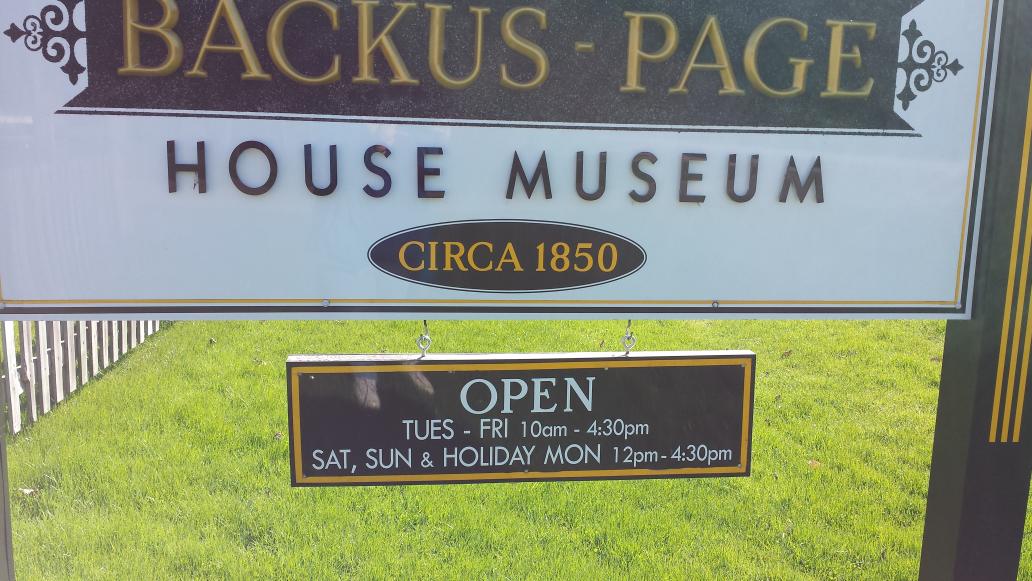
Come In We're Open

Embedded image permalink

It's May 1st and that means Backus-Page House Museum is open and operating on regular hours (see photo above for days and times).  If you've been here before you must come back because there have been changes, new additions and updates.  Bring some friends with you as well.
Admission for Adults is $5.00 with Students/Children $2.00.  For groups of 6 or more adults you can tour for a discounted rate of $3.00/person.

What's New?
Our new exhibit has been installed.  Wander through "Beds, Baths, and Beyond" and find out about washing, bathing, sleeping, and more.  Play the Name Game while you're there.

In honour of settler, Mary Storey, who gave this land to her grandson, Andrew Backus, we have turned one room into the Textile Arts Room where you can hand quilt or rug hook.  Our collection of spinning wheels, yarn winders, and textile pieces are displayed, plus on exhibit is a winding sheet that reportedly Colonel Thomas Talbot was wrapped in before being readied for burial.  There's quite a story with that piece.

On the Talbot theme, we have borrowed two panels about the Talbot Settlement from the Elgin County Museum for our visitors.  There are lots of new items in the period room settings and most importantly.....the parlour now has curtains!!!  Here's a sample of the pattern (the one in the centre).


I look forward to seeing you soon for a tour.
Angela Bobier, Cultural Manager