 |
| Letterhead of a note dated July 1916, from Pte. C. Ramey to the Secretary Treasurer of the Aylmer Travel Club |
Showing posts with label world war wednesdays. Show all posts
Showing posts with label world war wednesdays. Show all posts
Wednesday, January 6, 2016
World War Wednesdays: First World War Fondness from Aylmer, Ontario


Wednesday, November 4, 2015
World War Wednesdays: Illuminating Daylight Savings Time

Get your hoe ready! I hope everyone is enjoying their extra hour of sleep this week following the weekend's 'fall back' for Daylight Savings Time. I thought it might be interesting to discuss how the concept of moving the clocks forward and back has connections to both World Wars. A few weeks ago, we talked about how Winston Churchill had a perfect quote for just about everything, and his description of Daylight Savings Time sums it up with poetic charm:
"An extra yawn one morning in the springtime, an extra snooze one night in the autumn... We borrow an hour one night in April; we pay it back with golden interest five months later."
Since the Beginning of Time Itself
The idea of DST existed long before it was actually implemented around 100 years ago. It is known that ancient civilizations practiced a similar concept where they would adjust their daily schedules according to the Sun.

Power to the People
Throughout history, the idea of conserving daylight was suggested by multiple famous scientists with varied responses. In 1784, American inventor and politician Benjamin Franklin penned an essay titled "An Economical Project for Diminishing the Cost of Light" to the editor of The Journal of Paris. In it, he jokingly suggested that Parisians could economize on their use of candles by getting people out of bed earlier to make use of the natural light.
A major contribution to modern DST came from New Zealand entomologist George Vernon Hudson in 1895. In a paper presented to the Wellington Philosophical Society, he proposed a two-hour shift forward in October and a two-hour shift back in March (seasons are opposite in the two hemispheres). He followed this up with an article in 1898 but despite some interest, the idea never caught on.
British builder William Willett proposed an introduction of DST independently from Hudson in 1905. His suggestion was to turn the clocks ahead 20 minutes on each of the four Sundays in April, and switching them back by the same amount on each of the four Sundays in September. This plan caught the attention of Member of Parliament Robert Pearce, who introduced a bill to the House of Commons in February 1908. The first Daylight Saving Bill was drafted in 1909 and repeatedly presented to Parliament, but since it was opposed by many including farmers, it was never made into a law. Willett died in 1915 before he could see his idea come to life.
 |
| William Willett |
The first country to implement DST was Germany, during the First World War. Clocks were first turned forward at 11:00pm on April 30, 1916 with the rationale being the minimization of artificial light in order to conserve fuel for the war effort. Britain and many other countries soon followed suit, including the U.S. After the war was over, many countries reverted back to standard time.
 |
| "Morgenstunde hat Gold im Munde"-- The German equivalent of "The early bird gets the worm" |
 |
| A British advertisement for the setting back of the clocks in September |
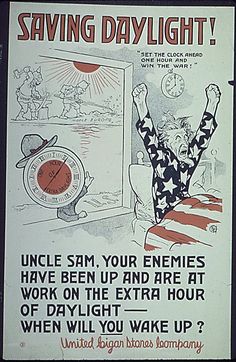
From February 9, 1942 to September 30, 1945, year-round DST or "War Time" was in force in America during the Second World War. The change went into effect only 40 days after the bombing of Pearl Harbor, and after the war ended the U.S. time zones were re-named "Peace Time". In Britain, "Double Summer Time" was adopted by setting the clocks two hours ahead of GMT in the summer and one hour ahead during the winter.
Contemporary Continuation
From 1945 to 1966, DST caused major confusion and craziness in the U.S. for trains, buses, and broadcasting because states and localities were free to choose when and if they observed DST. Congress's Uniform Time Act of 1966 put an end to that and stated DST would begin on the last Sunday of April and end on the last Sunday of October. Since then, there have been numerous changes and updates as recent as 2005.

Hopefully this post sheds some light on this interesting event on our calendars. Shoutout to timeanddate.com for the info! How do you feel about DST? Should we still be observing this system? Let me know what you think!
Before I sign off I'd just like to encourage everyone to see your local Legion members for a poppy during the poppy campaign, and pin it on your left side as close as possible to your heart! Please, please don't stick it on your hat or purse strap or alter it in any way! I hope I'm preaching to the choir on that one!
Thanks for reading,
Delany
Tuesday, October 27, 2015
Genealogy Jam: Writing Your Own Family's World War Wednesdays

Something that seems to be a hot topic lately with Remembrance Day around the corner is genealogy, as people want to discover their own family's involvement in wartime. If this is something you've never looked into before, or at least haven't done in a few years, then this is the post for you!
Family history is something I've gotten pretty well acquainted with in the past year, so I thought I would pass along some of the things I've learned in the hopes of making other people's searches easier. I cannot stress enough to people how much this field has changed in the past ten years, so even if you consider yourself an expert, you should really try seeing what else is out there. With digitization and the number of different resources available, you will be very surprised at the kinds of things not only available for access but possible to view online and at home. In all my experiences both working in an archives and conducting my own searches, I've never met a curator who wasn't enthusiastic, supportive, and helpful with genealogical questions of any kind, and they really do work tirelessly to preserve these records. They may have all the information you're looking for, and they get excited when they have someone who's interested!
Before you start out on this seemingly daunting journey, there are some things you should think about and ask yourself. Depending on where you're looking, it's not quite as easy as going into an archives and saying "I'd like to see anything you might have on the .... family." It's important to make the most of your search by doing your homework beforehand and figuring out what holes need to be filled. Plus, if you've ever looked up the visiting hours of an archives, you'll know that your window of opportunity can be pretty limited, so you want to ensure that your session is worth the trip!

Step One: Who are you Looking For?
Who arethe people you're interested in researching? A great first step in your search is to start with what you do know, rather than what you don't. Your assistant and all search engines are most reliable when you've provided as many details as possible, so I really recommend doing your homework! Genealogy Services at Library and Archives Canada has researchers fill out a pedigree chart before beginning the search (one for each of your parents). These trace your family tree back at least five generations, and once you've filled in as much as you can you'll be able to identify what needs further research.
Step Two: What are you Looking For?
While this may sound broad, it's the first thing an archivist will ask you, and you'll want to have the answer narrowed down beforehand. What's important for a potential researcher to know is that there are different archives and resources for different types of information, and the person you're meeting with will need to assess whether or not your question can best be answered through their collection. Are you interested in immigration, census data, land records, military, birth/marriage/death records?
Step Three: What is the Geography of your Search?
This question is essential for deciding the best place to visit in order to have your questions answered. If your question involves information with a national focus (military, census, immigration records), then Library and Archives Canada would be your source. However, the LAC is not recommended as a resource for specialized local study. If you're looking for information specific to a city, town, municipality, church, etc., you'll need to look into where the local archives are housed as well as any other historical societies or libraries which may also have some records.
Step Four: How Will you Go About your Search?
Based on the general audience of this blog, I'm assuming that your searches will be conducted in and around Elgin County, so this part will be specific to those readers. If this doesn't apply to you, I encourage you to investigate what the equivalents would be for your own area! Elgin County is very fortunate to have an extensive municipal archives which are housed in the basement of the Elgin County Administration Building at 450 Sunset Drive, St. Thomas. You can visit them from Tuesday-Friday, 10am-4pm to have your local questions answered, or email archives@elgin-county.on.ca. Their website is also located here: http://www.elgincounty.ca/archives. If your search includes the western end of Elgin County with the Townships of Dunwich and Aldborough, the Backus-Page House Museum is also home to a variety of helpful sources. Lastly, local library branches are also great resources! Most libraries have paid subscriptions to Ancestry.ca, which is something I recommend everyone take advantage of (these subscriptions can cost thousands!) This provides access to census data, most notably the 1921 Canadian Census, which was fully digitized in 2013 and is the largest source of Canadian genealogical information found online.

How the heck will you get the national information without making the trek to Ottawa?? Well, you've got a couple of options here. As I mentioned before, there is a great deal of information available to access online, which you should check out first. However, from my experience, it can be difficult to maneuver if you aren't totally comfortable with online database searches, and even if you are, the LAC website is definitely not user-friendly. So, I will make myself available for assistance should anyone need help finding something from the LAC. You can always send me an email at delanyleitch@gmail.com and I'll do my best to get you the links!
In terms of military records, the process can be mildly to extremely frustrating for researchers. If you're looking for someone who fought in the First World War, all records have been made fully available for consultation. However, the Second World War records are not so easy, which I found out last week. If you're looking for information on a WWII veteran, living or deceased, you have to send away an application for military service information to the LAC's ATIP and Personnel Records Division. If the veteran is living, you must have his or her written consent to do so. If the veteran is deceased, you must have proof of their death as well as proof of your relationship (an obituary was recommended). Once you've filled out the form and provided this information, you can request a Genealogy Package, which includes copies of the significant documents which summarize their service, and takes about 4-8 months to receive. This will not give specific details of campaigns and battles they served in, and you must then use their service number and regiment information to track them through the LAC military records. If this is something that you would be interested in doing, I have received copies of the necessary form from the LAC and can send you a digital copy for printing, just send me an email with a request! Also, for anyone who has completed this step and would like to have their relative traced to see the campaigns their veteran was a part of, I would be more than happy to go to the LAC and have that done for you. Our local veterans deserve to have their stories told and remembered with accuracy, and if I can be of any help with that I will do my best!
I've tried to include a guide for useful online resources which will be of use in your searches, courtesy of Library and Archives Canada:
-Ancestry.ca www.ancestry.ca
-Automated Genealogy (census indexes) http://automatedgenealogy.com/index.html
-Canadian Gravemarker Gallery www.rootsweb.ancestry.ca/~cangmg/
-Canadian Headstone Photo Project www.canadianheadstones.com
-Ellis Island (passenger lists, New York, 1892-1924, includes transit to Canada) www.ellisisland.org
-FamilySearch (Family History Library) https://familysearch.org/
-Legion Magazine's Last Post Death Notices http://legionmagazine.com/en/last-post/
-Obituary Daily Times www.rotsweb.ancestry.com/~obituary/
-Our Roots (local histories online) www.ourroots.ca
-Ontario Cemetery Finding Aid http://ocfa.islandnet.com
-Ontario Cemetery Ancestor Search http://ogs.andornot.com/CemeteryIndex.aspx
-Ontario Vital Statistics Project www.rootsweb.ancestry.com/~onvsr
-And of course, Library and Archives Canada http://www.bac-lac.gc.ca/eng/discover/genealogy/Pages/introduction.aspx
Hopefully this helps with any family history hesitation you may have! As always, feel free to ask questions.
Thanks for reading,
Delany
Wednesday, September 16, 2015
World War Wednesdays: FIRST BLOGIVERSARY!!!

You heard me! I've officially been cranking out my weekly historical ramblings FOR A WHOLE ENTIRE YEAR. For some reason it's actually oddly emotional to think that I've been able to do something I love for a whole year, and every day I'm amazed at where it's taken me. Looking back on the last 365 days is bittersweet in a lot of ways, but this blog has always been one of the sweetest parts. Even when it seems like I've run out of things to
Since I've kept this blog personal as well as informative, it's actually been a great way to map my growth as an historian as well as (at times) a sort of public diary. I thought it would be interesting to look back on the past year's posts to see how much has been experienced, discussed, and learned. If you've been with me from the beginning, it'll be a trip down memory lane, and if you're new it'll be a good catch-up! (All of these posts are available to revisit if you click on the corresponding months to the right).
Fall 2014
My first few posts were from some experiences that I had at the beginning of my second year at uOttawa which in hindsight were some pretty pivotal moments. After a Facebook post on the anniversary of Canada's entry into WWII sparked some sharing, I realized the significance of personal connections to the greater events in our history. Meeting historian Martin Middlebrook and hearing him speak on WWI soldiers was an incredible reinforcement of my values as an historian who cares about what has been said just as much as what is being said. During the 100th anniversary of the start of the First World War I had the opportunity to interview Canadian War Museum acting director of research Dr. Andrew Burtch, which illuminated the legacies left behind by the first global conflict in human history. A return trip to the War Museum prompted a post on one of my favorite pieces in its collection, the little bear from WWI.

Winter 2014
Posts from this period were extensions of the development of my own areas of interest thanks to some truly great classes and professors. I wrote about film, selected topics in Canadian history, and scratched the surface of what I now hope to be my Master's thesis topic, the Bombing and Gunnery School at Fingal, Ontario. I also had a memorable experience at the Fighting at Flanders: Gas. Mud. Memory. exhibit at the Canadian War Museum.

Spring 2015
Things got a bit more personal in the spring when History People Problems started identifying themselves, and the topics took a turn for the local (Elgin County, Ontario, and area). My most popular post to date happened in April: "Panic in Port Stanley: The Loss of the Olga, 1944", which had 228 views!
Summer 2015 to Present
Through the summer and up until now I still write about whatever interesting war-related stories find their way into my life, with some brief interludes of History People Problems and commemorative anniversary posts. Now that I'm starting my third year, the learning and experiences continue, and I can't wait to see what I'll have to reflect on a year from now!
A huge thanks to all of you who follow these posts and care about history as much as I do. It's been a remarkable year and having people read all about it makes everything so much better. I also owe some major gratitude to Backus-Page House Cultural Manager Angela Bobier for making it all possible!
Thanks for reading,
Delany
P.S. Please check out my new historical Twitter account to stay in the loop, @DLeitchHistory
Wednesday, June 24, 2015
World War Wednesdays Brain Log: Faces of History

World War Wednesdays has definitely followed my historical career over the past year in a lot of ways, and I'm really excited to be able to look back on it in the future to see how far I've come. I figured it's been a while since I checked in and did a post for where I'm at right now, so here's a bit of a brain log for this week!
If you didn't already know, I'm working for the summer at Elgin County Archives and it's already been almost a month! In this short time, I've already learned a lot and it's made me think a lot about my perspective on life and ideas about history. Most significantly, I've been thinking a lot about what is left to remember a person long after they are gone.
Since my job involves newspaper digitization, I deal with materials that sometimes cover the better part of a person's life. Newspapers in the past covered so much more of the events in people's lives, and I've come across so many unbelievable, interesting, and tragic stories about the fine folks of Elgin County. I've also learned a lot just by flipping over some of these articles. I've encountered articles about historical events involving some of the more notable Canadians that I read about more often, and some that are comically indicative of how much things have changed (like why people should think about buying a smoke alarm and how women should react to their husband's cheating). Reading these newspapers and the people's stories has really added a personal element to the history, and that's one of my favorite parts.
This brings us to the topic that literally makes me feel sick and want to curl up in a ball of tears. The fact that more and more, the little pieces of the past that we have in print are becoming the only thing we have of that time as the people themselves disappear. There are fewer and fewer people everyday who can tell us what life was like when Diefenbaker was Prime Minister or when ladies followed etiquette books.
I guess what I'm trying to say is that we should all take advantage of the faces of history that are near to us before they are just a photograph in a newspaper. Go call your grandma and ask her something out of left field about her life in, say, the 1960s and I guarantee she'll love answering. It's something that people love talking about but rarely get the chance, and I promise you'll appreciate the new perspective.
I've had the privilege of meeting several Holocaust survivors and veterans, and those are some of the most memorable experiences of my life. As time marches on, such experiences have become increasingly rare, but I hold them very dearly when they do happen. I've also come to realize and appreciate the histories of the people a bit closer to me, and I think that we could all benefit from tuning in to what our older relatives can tell us about life. And if you've missed an opportunity or wish you knew more, you'd be surprised at the kinds of things you can find at Elgin County Archives.
Here's a link if you'd like to start exploring:
http://inmagic.elgin-county.on.ca/ask/
Thanks for reading,
Delany
Wednesday, February 11, 2015
World War Wednesdays: The Darker Side of Canada's War
World War Wednesdays: The Darker Side of Canada's War
 |
| Canadian Prime Minister William Lyon Mackenzie King in Berlin, with Swastikas in the distance |
When we left off last week, Canada had just entered the turbulent storm of the Second World War despite seemingly all efforts do avoid doing so. For all Canadians, this time meant widespread uncertainty and fear. The people knew very well what being at war meant for the country, having just experienced what they had thought was "The Great War", and were certainly not eager to relive such terrible memories. Before we get into the events of the war itself, it is important to also consider some of the situations which were also occurring during the outset of the war, both inside and outside of Canada.
(Apologies in advance if this post ends up being lengthier than usual, I just completed a massive research paper on the topic and I'm trying to make it sound as interesting as I find it!)
When we returned two weeks ago, we focussed on the 1936 Olympic Games in Berlin, Germany. This event ties into this week's post, and I will soon explain how. In the meantime, consider this image of William Lyon Mackenzie King in Berlin, watching the Olympic Opening Ceremonies (second from the left, in the light suit):
 |
|
A bit of background on King is important for explaining his actions later on. He was born in the Canadian city of Berlin, Ontario (which was later changed to Kitchener), which is a significant fact and reoccurring theme. After attending the University of Toronto in the 1890s, he became the Minister of Labour. From there he established a strong political presence which led to his becoming Prime Minister; a surprising feat considering his lack of charm and typical physical characteristics for popularity. However, he compensated for this by forming a strong belief system and consistently reinforcing it, ultimately proving people wrong on their judgement of his appearance.
 |
| King in 1899
|
"Seeing where I lived 37 years ago, the association with Berlin, etc., is all most remarkable. My thoughts went back to the earliest days in Berlin, Ont."
When he met with Hitler, King presented him with a book depicting his childhood home in Berlin, Ontario, and told him all about the connections which he had with Germany. Hitler's feelings about the encounter are unknown, but King felt that it went very well:
"My sizing up of the man as I sat and talked with him was that he is really one who truly loves his fellow-men, and his country, and would make any sacrifice for their good." (Diary, June 29, 1937) Hitler appeared to be "a man of deep sincerity and a genuine patriot." (Diary, June 29, 1937) King saw similarities between himself and Hitler, writing, "As I talked with him, I could not but think of Joan of Arc. He is distinctly a mystic .... He is a teetotaller and also a vegetarian; is unmarried, abstemist in all his habits and ways." (Diary, June 29, 1937)
The important thing to take away from this event is that King ultimately praised Hitler's policies at the time (1937) and greatly admired him as a leader.
Through an examination of Canadian immigration policy during the time , it can be said that King employed some of these shared beliefs in his own country's policies. When Jews began fleeing Europe to escape persecution, Canada's immigration policy regarding those of Jewish origin was that they belonged to a "Special Permit" group, which consisted of those people with the least desirable racial characteristics, making them least likely to fit into Canadian society and therefore a threat to Canadian culture. This policy was not changed due to the circumstances in Europe, and King even advocated for and defended it.
 |
| The SS St. Louis in Havana harbour |
This fact is exemplified in the case of the 1939 St. Louis Incident. On the morning of 13th May, the SS St. Louis departed for Havana, Cuba, from Hamburg, Germany with 937 Jewish refugees on board. It was the last chance for many of them to escape the concentration camps, and the plan was for them to live in Cuba until their names reached the quota list to enter the U.S. Previously, on 5th May, the Cuban president had closed the loophole allowing them to enter Cuba based on anti-Semitic sentiment, refusing to allow the passengers to disembark, and when the ship arrived anyway it was forced to remain in Havana's harbour as many groups tried to change the president's mind. At that time, the Germans used the case as leverage to prove that no nation wanted the Jews, therefore making it hypocritical for Germany to be criticized for the same thing.
On 7th June, King was in Washington, and his response to the plight of the refugees was similar to that of America when he said that he was "emphatically opposed to the admission of the St. Louis passengers". Ultimately, the ship was denied from all ports and was forced to return to Hamburg. France, the UK, Belgium and Holland stepped in just before its return to admit shares of the refugees, but in the end only 240 of the 937 passengers survived the Holocaust. This tragic event put King's race-based immigration policy to the test and failed considerably on a moral level.
As Canadians, it is difficult to imagine that something like this could be attributed to our famously kind and accepting nation, and we do not like to reflect upon this darker time in our history. Personally, I feel that events like this are crucial for showing us how far we have come as a nation since that time. I think that the best possible outcome of the St. Louis Crisis is that we can reflect on it today in 2015 and feel disbelief that it could ever have happened in the Canada we know. The best that we can do as people living in the legacy of these events is read about them, discuss them, never forget them, and continue to use them as lessons for the future.
If you're still with me, I'd like to thank you so much! This is such an amazing outlet for me to share the things that I find interesting and/or am currently working on. I'm so lucky to be able to study what I love every day and be to able to share it with people who are also interested.
Until next week,
Delany Leitch
Wednesday, February 4, 2015
World War Wednesdays: Canada's Role in the Outbreak of the Second World War
World War Wednesdays: Canada's Role in the Outbreak of the Second World War

Most of us know at least a little bit about the role that Canada played in the Second World War. We have family members and community members who were involved, and even if we don't always tune into the media regarding these topics, every Remembrance Day we reflect on the sacrifices made by our great country. My hope for this blog is that we can become better acquainted with what the generation before us really experienced during the war, and how these experiences fit in with those of the rest of the world.
Following the crash of the New York Stock Exchange in 1929 the world experienced a time of economic hardship commonly known as the Great Depression, and Canada was no exception to the widespread suffering. Population growth in the 1930s reached its lowest point since the 1880s, the number of immigrants dropped to less than 12,000 by 1935 (consisting mostly of those from preferred countries only), and by 1933, 30% of the labour force was unemployed. Understandably, Canadians looked to their leadership during such hard times, and the people began to see the weaknesses in Canadian politics. In an effort to alleviate the effects of the Depression, Prime Minister William Lyon Mackenzie King utilized some of American President Franklin Delano Roosevelt's programming ideas of the New Deal in order to create a social safety net: welfare. As a result of focussing on solving its domestic problems, Canada turned away from Europe and the issues that continues there after the First World War. Mackenzie King adopted another American concept, that of Isolationism, which meant that Canada would not become involved in foreign issues.
 |
| Unemployed men line up for free food during the Depression |
Two distinct phases are evident in regard to Canada's attitude towards another war. From the mid-1920s to 1937, people generally felt that war must be avoided at all costs. The First World War had been a devastating and drawn-out conflict which claimed the lives of almost an entire generation of young men, and the effects of the Depression left the country in no shape to be entering another such conflict. The technology developed in the First World War meant that new conflict would be devastating and costly. It was also popularly thought that Italy and especially Germany had been poorly treated in the postwar Treaty of Versailles, which crippled the country with reparation payments and loss of territory. It is also important to note that a fear of communism was particularly strong, a sentiment shared not only by the Germans. From 1937-1939, British Prime Minister Neville Chamberlain attempted negotiations with Hitler, which proved to Britain, Canada, and other sympathetic nations that negotiation rather than force could resolve the claims which were creating tension.
 |
| The famous photo of Neville Chamberlain shaking hands with Adolf Hitler |
Canada's neutrality was not the only thing threatened during this time. King's position as Prime Minister became under fire as it was clear that English and French Canada had very different views regarding war. Francophones wanted neutrality, since they had no connections to any European countries, and felt that Canada's involvement would be sticking its nose in where it had no business being. English-speaking Imperialists stood behind Britain and were willing to fight Germany. However, all of Canada was relieved by the policies commonly known as Appeasement in 1938, which allowed Hitler to have his claims of previously lost land areas on the grounds that he would be satisfied, making war unnecessary.
 |
| Neville Chamberlain famously waves Hitler's signature, proclaiming 'Peace in Our Time" and the end of German hostility |
The events that followed established a new Canadian identity on the world stage amidst the uncertainty and horror of the early days of war. Next week's post will pick up from here, and explore Canada's contributions and unique initiatives throughout the conflict.
As mentioned last week, I would like to hear more from readers! Have something you'd like to be discussed in a blog post? Always wondered about the how or why of a Canadian historical event? Send me your questions via commenting on this post, the blog itself, or the Backus-Page House Facebook page! I'll be posting a Q&A once I've gathered some questions.
Thanks for reading!
Delany
Wednesday, November 26, 2014
World War Wednesdays: The Wars on Film
World War Wednesdays: The Wars on Film
Perhaps it is just my experience of being a history student who is also in German cinema, but there seems to be a strong connection between those who love history and those who love film. So often when a professor or fellow student is explaining a historical concept, they mention a scene in a film which covers that topic. Perhaps this aspect plays into the historian's constant quest to relive and re-enact the past. It can also be a highly useful and fascinating method to bring to life the events which we read about but have difficulty imagining in real life.
These ideas are what caused me to want to write about this topic, and it is something that plays a major role in my day to day life. I suppose I am a bit predisposed to talk about it after just having finished watching Ken Burns' seven-part documentary The War. Each part is roughly two hours and length, tracing the WWII experiences of four U.S. towns and the people who lived in them. I will be honest, many a tear was shed over the course of the story, and I highly recommend watching it (on Netflix).

What makes a good war film is the ability to make us feel such a depth of emotion. The wars themselves were such a complexity of hardship, togetherness, love and fear. For a film to have the capacity to give its audience a similar emotional experience is something that everyone, not just historians, can appreciate.
Of course, this tradition of impactful war films began during the wars themselves. (Due to technology advancements of the times and my personal preference I will be focusing on some of my favorites of the Second World War). I'm sure (I hope) we've all had the chance to see Casablanca, a true classic, whose infamous lines have become a part of common phrases to this day ("Here's looking at you, kid", "Play it again, Sam", "We'll always have Paris"). This film captures the experience of displacement due to the war, with lost love, and with the threat of world conflict on peoples' personal lives.
 |
The United States entered the war in December 1941, after Britain had been fighting for almost three years. It was rare for an enemy to be explicitly stated in Hollywood films much before then, since America provided a great deal of funding and supplies to all sides. The first film to clearly depict the enemy as being Germany was Charlie Chaplin's 1940 satire The Great Dictator (Chaplin was a Socialist himself). After becoming part of the conflict, however, there was no secret as to America's stance. This can be seen in wartime films such as Thirty Seconds Over Tokyo, 49th Parallel, and Mrs. Miniver. There was also the concept of the propaganda war, with Hollywood competing against Dr. Goebbels' team in Germany. Some of the most fascinating works of propaganda come from this time, when companies like Walt Disney and Warner Brothers teamed up with groups such as the U.S. Air Force to create animated cartoons depicting well-loved characters being involved in the war. Disney's "Der Fuhrer's Face", which features Donald Duck sticking it to a group of overweight, dopey Nazis, won the Oscar in 1943 for Best Animated Short. Jack Warner and the Warner Brothers' collaboration with the air force produced such cartoons as "Herr Meets Hare" and "Draftee Daffy" featuring Bugs Bunny and Daffy Duck. These films spoke not only to children but to a full spectrum of audiences, using characters who held a great deal of emotional and ideological sway among fans young and old.
 |
| Donald Duck reads Hitler's infamous book, a far cry from the Donald we know today |
Of course, not all films during the war were designed to reinforce ideological beliefs or depict the glory and struggle of real events. Both America and Germany recognized the importance of lighthearted films during times of stress and hardship, and especially in America, the escapist style of film was perfected. This trend was carried on from the films of the Great Depression, which sought to provide an alternate place for audiences to imagine themselves as a way to distract from rough times. In Germany, even these films were covertly filled with propagandistic themes. America's escapist films depicted idealistic, joyful people and situations which gave people not only something else to think about but something to hope for. My favorite example of this is 1940's We Who Are Young featuring Lana Turner, which is the ultimate cheesy and overdramatic film but so incredibly touching. This period perfected the iconic Hollywood love story, featuring the famous pairings of Humphrey Bogart and Lauren Baccall, and actors such as Cary Grant, Barbara Stanwyck, Ingrid Bergmann and Judy Garland.
 |
| Lana Turner and John Shelton in We Who Are Young |
Even to this day, filmmakers continue to create new depictions of wartime stories. This year saw the release of box office hits Monuments Men and Fury. Recent times have provided just as many classics as those actually from the war, such as Saving Private Ryan, Valkyrie, Inglorious Basterds, The Boy in the Striped Pyjamas, Defiance, and Nuremberg. All of these are so well loved by both lovers of history and film fans. They give us the gift of seeing our past as close as possible to the way it really was, which is such an amazing experience. It is so fascinating to know that the ability to see a depiction of the way things really happened is just a click away.
Have you seen any of the films I discussed? Do you have any favorite war films that you didn't see mentioned? I'd love to hear from you!
Thanks for reading,
Delany
Subscribe to:
Posts (Atom)