Showing posts with label 1914. Show all posts

Wednesday, July 5, 2017

World War Wednesdays: He Served His Country: Maj. George Stirrett, M.C. D.C.M

     I was recently looking into the history of the 1st Hussars for the annual D-Day post and came across the name of George Hunter Stirrett, a highly decorated local First World War soldier who served with the Hussars. When I looked into his story a bit more, I was very pleasantly surprised to find a full transcript of his wartime memories that has been archived by Petrolia Heritage. I thought that nobody could tell George's stories better than the man himself, and hope you enjoy reading his accounts as much as I did!

     To begin, some background on George will be of interest. He was born in Forest on March 2, 1891, raised in Petrolia, and spent his adult life in Sarnia. He joined the cavalry shortly after war was declared in 1914 and trained in London. Here is part one of his experiences:

     "The 1914 War as it came to the average young man in Canada was unexpected, unimportant, and certainly nothing to interfere with hockey, rugby, baseball, and lacrosse. Our gang, or boy's club at Petrolia had no one in the militia who went to the yearly camp at Niagara Falls. Military things never were referred to or thought about. We knew that General Wolfe had captured the Plains of Abraham from Montcalm and that Napoleon had been defeated by Wellington at Waterloo. These were things we got marks for in exams, so we had to learn them. Then for memory work, our class had to learn "The Charge of the Light Brigade" by Tennyson. And, if you had a Scottish teacher like I did, you learned "Scots, Wa He we Wallace blead. Scots whom Bruce had often lead." This was about the extent of our military knowledge or training.


     On August 4th, 1914, the Methodist Sunday School picnic was going by train from Petrolia to Courtright. Then the Tashmoo steamer from Sarnia picked us up to take us to Tashmoo Park at the entrance to Lake St. Clair. It would return us to Petrolia about dark. As we got to Port Algonac, about 10 AM, a news boy was calling from the dock that England declared war on Germany. He sold all his Detroit newspapers to our boat. Very little was said about the news. There were far more important things that affected us. The war was not as important as the Detroit team beating the Chicago Red Sox at Detroit that afternoon.

     On reaching home after dark, I saw Harry Bolt turning into our house. He had been the trainer for our rugby team and he was very popular with anyone who played games of any kind. Harry wanted to see my father who was Mayor of Petrolia. My father was busy at a council meeting, but was expected home any minute. So I sat with Harry on the veranda and found that he wanted my father to sign a paper that would allow the Grand Trunk Railway to provide Harry with a ticket to Montreal and then to England. Harry told me that he had been a Reserve soldier with the Lincolns of England. Now that war had been declared, he had received his call to rejoin the regiment he had trained with for five years before he came to Canada. He was leaving a wife and two children and they would receive a pension of a dollar a day while he was in the service. Harry got away at 6:00 AM the next morning. The idea of his going was a shock to me and the other boys I told. The local paper said nothing about him quitting his job at the wagon works. His job was soon filled.

     Rugby in 1914 ended in a playoff between London and Sarnia at London. I was asked to referee the game. Four of us on the train started talking about the war which had not ended in ten days or a month like the papers had said it would. After the game, we decided to visit the Armouries in London and try to find out about Army matters and what it was all about.

     At the armouries, we ran into McEwen, who had scored the winning touchdown for London that afternoon against the team from Sarnia. He had been down to Valcartier where his brother was with the artillery. The 1st Division, mostly infantry and artillery, were being collected at Valcartier. He had heard some important persons say there and then that the war would likely last for four or five years and, as a member of the First Hussars, he was going to start recruiting in two weeks time. They would likely go to Egypt as cavalry. He also told us that a military school was starting the next week in the London Armouries. Up to this time we had thought of the war as a joke but now we started to think of it as a serious thing. Two of us decided to take the course starting the following Thursday.


     On our way home to Sarnia on the train, we saw in the evening paper that Harry Bolt of Petrolia had been killed while fighting with the Lincolns in the retreat from Mons. This was our first knowledge that wars would kill people we knew. We had all known and liked Harry.

     At the military school the following week, we found out things about the army. Canada had already sent the First Division and was now raising the Second Division. I found that a Division was usually about 16,000 men, composed of 12,000 infantry (12 Battalions of 1,000 each in 3 Brigades), The other 4,000 were support troops, artillery, signals, supply troops, a cyclist company, and a squadron of cavalry. Before the school closed, it became known that the First Hussars were to form a Squadron of about 160 men for the Second Canadian Division. The 19th Alberta Dragoons had sent a squadron with the First Canadian Division which was now in England.

     After class each day, about a dozen of us would go to talk to McEwen who seemed to know more than our instructors. When the course ended, about a dozen of us, now lieutenants, joined the First Hussars as private soldiers. McEwen, who was the Recruiting Officer, asked me if there were any more young men in Petrolia who might sign up. I said I thought so and contacted Dr. Fairbanks, a fairly wealthy man who lived in Petrolia. He held a banquet to bring all the young men in Petrolia together and McEwen came to town as well. Dr. Fairbanks paid for everything, even the hotel room for McEwen. At the banquet, Dr. Fairbanks told us that he was in California when war was declared and that he immediately sent a telegram to Ottawa saying he was ready to go in any capacity they wish to use him in. Nine of the Petrolia rugby team signed up with us. By January, 1915, we were in barracks at the Exhibition Building at Queen's Park in London.

     Lieutenant Colonel Leonard, who was given command of the First Hussars Squadron, hired Jim Widgrey, an old retired Royal Canadian Dragoon Sergeant Major. Colonel Leonard paid Widgrey out of his own pocket to train our Officers, NCOs and Men. Widgrey put us into shape in about half the time it would otherwise have taken. We had plenty of horses for training from the remount depot at London. Let me tell you of a personal experience relating to Widgrey. I gave evidence one day while I was a Lance Corporal and in my evidence I said I thought a certain thing. Widgrey later found me and said "When you were giving evidence you said you thought something. I want you to get it through your head that there are people in this army paid for thinking, and you are not one of them." Through similar incidents, he was able to help nearly everyone in the First Hussars.


     The First Hussars, or the 7th Canadian Mounted Rifles, as we were then known, had a H.Q. and two Squadrons in London and one Squadron in Toronto. Within a few weeks, "A" and "B" Squadrons in London had progressed to the level of squadron tactical exercises and were able to conduct training schemes in cooperation with infantry units stationed in the London area. On 30 March, 1915, the Regiment was honoured by being ordered to supply the Divisional Cavalry Squadron for the Second Canadian Division. This squadron was organized and commanded by Lt Col Leonard, who selected as his officers Captain C. F. McEwen, Lieutenants A. C. Spencer, J. A. G. White, W. A. Bishop, and H. M. Campbell. Volunteers for service with the squadron were called for. Virtually all other ranks volunteered - the squadron was organized and we began intensive cavalry training.

     On 06 June, 1915, orders were received for the Second Canadian Divisional Cavalry Squadron to proceed overseas. By this time, I was a Corporal with the Second troop. Lieutenant Billy Bishop was our Troop Officer. The squadron entrained two days later for Montreal and, at 11:00 a.m., 09 June, 1915, sailed for England on the S. S. Caledonia."
A comical photo of Billy Bishop taken by George Stirett aboard the Caledonian
     Stay tuned next week for when George goes to war. Many thanks to Petrolia Heritage for the wonderful digitized material!
     Thanks for reading,
Delany (@DLeitchHistory on Twitter)

Wednesday, May 17, 2017

World War Wednesdays: The First World War Munitions Industry in St. Thomas and Beyond

Female workers making munitions at St. Thomas Metallic Vaults plant, St. Thomas, ON, during the First World War, Elgin County Archives
     Something I feel like I haven’t written much about so far is the industrial aspect of war and how the Elgin County area was implicated by manufacturing demands. I was a bit disappointed to find that there really isn’t much written on this topic in the local context, and hope to see some more resources in the future. This week, I’ve compiled what I was able to find in terms of the First World War! 

     To begin, I think it's of interest and importance to mention the state of hydroelectric power in Ontario at the time that the war broke out. As an example for all my local readers, the town of Dutton did not get hydro until August 1915, and was the first municipality in the province to receive its power by using the existing telephone lines along the Pere Marquette Railroad. When that was achieved, Dutton became the 121st municipality in Ontario to get hydro. Thus, hydroelectricity in the area was in its infancy at a time when it was on the precipice of its greatest possible demand. Great Britain had declared war on Germany on 4 August 1914 (automatically including Canada as well), and as an historical record compiled by Entegrus observes, "To manufacture weapons of war, munitions factories needed ever greater amounts of power, The demands made on the Hydro Electric Power Commission system increased enormously."

     According to a pamphlet compiled from government records called "Shell and Fuse Scandals: A Million-Dollar Rake-off," "The history of the war shows that the British Government was quite unprepared, at its outbreak to furnish the necessary supply of munitions. Realizing this- strenuous efforts were made to manufacture quickly large quantities of shells to cope with this situation and the enormous reserves which Germany had for years piled up. Shells were of vital importance; shells meant protecting the lives of our Canadian and British soldiers. Shells were the one thing that was needed."

     The pamphlet also observes that "The Canadian Government was asked to assist in the manufacture of shells and were given an initial order of 200,000. The Government appointed a shell committee composed of four military and four civilian members [the Dominion Shell Committee]." doingourbit.ca recognizes that "having a strong industrial base was as important as having good men at the front. Furthermore, Sam Hughes, Minister of Militia, impressed upon the Dominion Shell Committee that all components of the shells to be used on the front be produced in Canada." However, the process of awarding manufacturing contracts was more complex than would be expected. The site highlights that industrial contracts for munitions production "were very difficult to come by as there was a very strict set of conditions and standards that had to be met, but again, the demand was for locally produced munitions." Contracts were secured through the efforts of local politicians and Boards of Trade, who had to impress the Dominion Shell Committee and Minister of Militia. 

     At that time, the city of St. Thomas was among a group of similarly-sized municipalities for manufacturing and industry which included Stratford and Guelph, which were cited as examples of 'organizing cities' whose wartime industrial production secured a viable economic future that would carry on into peacetime. 

     Elgin County Archives holds only one accessible example of a wartime munitions factory in St. Thomas, though I am sure there are others. This is the St. Thomas Metallic Grave Vaults Ltd. plant, which was located at 155 Curtis Street, on the northwest corner of Curtis and St. Catharine Streets (now the site of the St. Thomas Police and Administration of Justice Building). A publication by the Elgin County Board of Trade and Publicity Association from around 1930 describes the peacetime purpose was for the factory: "The St. Thomas Metallic Vault Co., in their large two story brick building, are making vaults of a new type for inclosing [sic] coffins for interment, which are burglar proof, the demand for which is growing apace." Here are some photos of the interior of the factory when it was producing shells for the war, ca. 1917:


     There is very little information regarding that period in the factory's history besides these images, or the rest of its operation. A St. Thomas Times-Journal article published February 18, 1961 was captioned: "St. Thomas Metallic Industries Ltd., a direct subsidiary of H.A. Astlett & Co. (Canada) Ltd. has been sheet metal fabricators in St. Thomas for over 49 years. The principal items manufactured being "ST. THOMAS" metallic grave vaults which are produced in various sizes and distinctive colors. In recent years other products such as roofers' maintenance kettles, road maintenance equipment, portable torches, salamanders, and steel door frames have been fabricated for municipalities, contractors and railroad companies. Equipment for the tobacco industry has also been made and custom machining done for local industries." 

     Please let me know if you have any more details to help me fill in the blanks! 
     Thanks for reading,
Delany (@DLeitchHistory on Twitter)

Wednesday, December 21, 2016

World War Wednesdays: The Christmas Truce, 1914


     When we think of the First World War, which, for many of us, was a regular occurrence this year, we often think of a period marked by unprecedented levels of horror and hardship with no clear rationale. Indeed, between 1914 and 1918, over twenty-five million people were killed or wounded around the world. However, what we do not often reflect upon are the moments of joy that did come from those mud-filled trenches; the few periods of respite from the suffering and carnage. I feel that World War Wednesdays would be remiss if we did not dedicate one of the most legendary of such moments to the annual Christmas post, and hope it will serve as another humbling reminder of how fortunate we are today.

     It was during the first Christmas of the war when men from both sides of the Western Front laid down their arms, emerged from the trenches, and shared in food and drink, games, and fellowship in an unofficial and illicit truce. While it lasted, it was an extraordinary flicker of humanity amid one of civilization's darkest hours, even prompting the sober Wall Street Journal to observe: “What appears from the winter fog and misery is a Christmas story, a fine Christmas story that is, in truth, the most faded and tattered of adjectives: inspiring.”


British and German troops meeting in No-Mans's Land during the unofficial truce. (British troops from the Northumberland Hussars, 7th Division, Bridoux-Rouge Banc Sector), Imperial War Museums

   
The first signs of abnormality began appearing on Christmas Eve, when at around 8:30 p.m. an officer of the Royal Irish Rifles reported to headquarters: “Germans have illuminated their trenches, are singing songs and wishing us a Happy Xmas. Compliments are being exchanged but am nevertheless taking all military precautions.” Further along the line, both sides serenaded each other with carols, including the German "Stille Nacht" (Silent Night) and "The First Noel" by the British, as scouts cautiously began meeting in No Man's Land between the two sides. The war diary of the Scots Guards reads that a Private Murker “met a German Patrol and was given a glass of whisky and some cigars, and a message was sent back saying that if we didn’t fire at them, they would not fire at us.” 

     An important thing to remember is that this same basic understanding seemed to occur in various places all down the Front, with various groups of enemy soldiers arranging their own form of spontaneous Christmas truce. The most detailed estimate, made by Malcolm Brown of Britain’s Imperial War Museums, is that the truce extended along at least two-thirds of British-held trench line that scarred southern Belgium. Private Frederick Heath on the British side included in a letter home that “all down our line of trenches there came to our ears a greeting unique in war: ‘English soldier, English soldier, a merry Christmas, a merry Christmas!’” Then, the voices added: "‘Come out, English soldier; come out here to us.’ For some little time we were cautious, and did not even answer. Officers, fearing treachery, ordered the men to be silent. But up and down our line one heard the men answering that Christmas greeting from the enemy. How could we resist wishing each other a Merry Christmas, even though we might be at each other’s throats immediately afterwards? So we kept up a running conversation with the Germans, all the while our hands ready on our rifles. Blood and peace, enmity and fraternity—war’s most amazing paradox. The night wore on to dawn—a night made easier by songs from the German trenches, the pipings of piccolos and from our broad lines laughter and Christmas carols. Not a shot was fired."
British and German soldiers fraternizing at Ploegsteert, Belgium on Christmas day 1914, Imperial War Museums 

     According to Smithsonian Magazine, several factors contributed to the Christmas Truce. For one, the men in both sides of the trenches would have become veterans by December 1914, familiar enough with the realities of combat to have diminished the idealism they had carried with them to war that August, and most longed for an end to the bloodshed. They had so firmly believed that the war would be over by Christmas, but yet still they fought, freezing in rudimentary dugouts. Then, on Christmas Eve itself, several weeks of mild yet miserably soaking weather yielded to a sudden and hard frost which created a dusting of ice and snow along the lines. As a result, men on both sides felt that something spiritual was taking place.

     Interestingly, it was only in the British sector that the troops noticed at dawn that the Germans had placed small Christmas trees along the parapets of their trenches and responded with conviviality. As the Smithsonian discusses, this could be attributed to the fact that the Russians at that time still adhered to the old Julian calendar, which observed Christmas as January 7, and the French would have generally been far more sensitive to the fact that Germans were occupying about a third of France at the time. 

     The obvious language barrier between English and German meant that communication was difficult among the newly-acquainted troops, but they quickly found a common interest in "football" (soccer). Somehow, in one section a ball was produced, and British and German soldiers proceeded to take pleasure in kicking it about in a match which the Germans claim to have won 3-2. Due to the subsequent atmosphere of downplaying and condemning the truce on the part of the British, some of the most detailed accounts of the football matches come from the German side. These report that the 133rd Royal Saxon Regiment played a game against Scottish troops, which was reflected upon in a 1960s interview by 133rd participant Johannes Niemann: 
     "The mist was slow to clear and suddenly my orderly threw himself into my dugout to say that both the German and Scottish soldiers had come out of their trenches and were fraternizing along the front. I grabbed my binoculars and looking cautiously over the parapet saw the incredible sight of our soldiers exchanging cigarettes, schnapps and chocolate with the enemy. Later a Scottish soldier appeared with a football which seemed to come from nowhere and a few minutes later a real football match got underway. The Scots marked their goal mouth with their strange caps and we did the same with ours. It was far from easy to play on the frozen ground, but we continued, keeping rigorously to the rules, despite the fact that it only lasted an hour and that we had no referee.  A great many of the passes went wide, but all the amateur footballers, although they must have been very tired, played with huge enthusiasm... Us Germans really roared when a gust of wind revealed that the Scots wore no drawers under their kilts—and hooted and whistled every time they caught an impudent glimpse of one posterior belonging to one of “yesterday’s enemies.” But after an hour’s play, when our Commanding Officer heard about it, he sent an order that we must put a stop to it. A little later we drifted back to our trenches and the fraternization ended."

     Overall, the Christmas Truce was a temporary respite from the horrors of battle for both sides of No Man's Land that fateful night. In most places, it was accepted that the peace would be short-lived, but in a few cases the ceasefire was allowed to persist into the new year. After that, there were no further truces until the armistice of 1918 which many, if not most, of the Christmas Truce participants did not live to see. For those who did survive the war, it was certainly not something to be forgotten, and that story lives on in infamy a hundred and two years later.
     Many thanks to Smithsonian Magazine for the information. If you are interested in a phenomenal filmic portrayal of this story, I encourage you to check out Joyeux Noel (2005), which is based on a true story and includes the perspectives of Scottish, German and French forces during the truce. I'd like to take this opportunity to wish you and your families a Merry Christmas and safe and relaxing holiday, and thank you for taking the time to read this post.
       Gratefully,
Delany Leitch (@DLeitchHistory on Twitter)

Wednesday, November 23, 2016

World War Wednesdays: The Menin Gate and Remembrance in Belgium

The Menin Gate, 1927
     Confession time: this is the first week in my two whole years of blogging that I ever seriously considered having to take a week's hiatus. Things are pretty crazy up here on the schoolwork front, with a twenty-five page paper for one seminar (among other things) due on Friday that is so insanely long even my other seminar's classmates gasped at the thought! But, I thought about it a bit more and decided that if I have made it this long without having to resort to such a thing then I can certainly come up with something for you now. I'd like to give an anonymous shoutout to one of my colleagues who presented on this topic as part of her research project, which was fascinating enough to jolt me out of this funk I've been in and actually be excited to learn new things! Hopefully you find this story as amazing as I did and I appreciate your taking the time to read it this week more than ever.

     Here's some backstory: Ypres is an ancient town in Belgium which became renowned for its linen trade with England during the Middle Ages. Since it played such an important role in the textile industry and was a major hub of trade, it was decided to fortify the village with stone ramparts which were gradually expanded over the centuries.
The Menin Gate before the outbreak of war, Summer 1914


     During the First World War, the town of Ypres occupied a strategic position because it stood directly in the path of Germany's planned sweep across the rest of Belgium and into France from the north (the Schlieffen plan). The German army surrounded the area on three sides, bombarding it through most of the war. As a result, British, French, and other Allied forces made costly advances in counterattack from what became known as the Ypres salient into the German lines on the surrounding hills.

Another prewar shot of the Menin Gate- note the two lions on either side which were removed during the war for preservation
     By that time, the majority of the wall around the town had fallen into disrepair due to both the prolonged shelling and lack of upkeep in the years preceding the war. The Allied soldiers who marched to the front in the First and Second Battles of Ypres would have all passed through a gap in the old ramparts in order to cross a small stretch of water. Many thousands of men passed over that spot and marched to their deaths, with the stone walls on either side of the gap being among the last things they saw before doing so. As the war raged on, with some of the most horrific elements of the entire conflict happening at Ypres (including gas attacks), the nature of the conditions meant that thousands of bodies were lost in the muddy earth which essentially swallowed up the fallen. Overall, over 50,000 Allied soldiers lay missing at Ypres by the end of the war, with around 40,000 makeshift headstones dotting the area which read either "Known Only Unto God" or "A Soldier of the Great War."
The Menin Gate area at the end of the war
     In 1921, the British Imperial War Graves Commission felt it would be appropriate to build a splendid monument at the Menin Gate to commemorate the men who had died in battle but had no final resting place. Designed by Sir Reginald Blomfield, the memorial was finished in July 1927.
The unveiling ceremony
     In 1928, a year after the memorial was opened, a number of prominent Ypres residents decided that some way should be developed for the Belgian people to express their gratitude for the men who had passed through their town and were killed in their efforts to protect it. The Superintendent of Ypres Police presented the idea of a daily sounding of the Last Post-the traditional salute to a fallen warrior- at the Menin Gate. The privilege of playing the homage was given to members of the local volunteer Fire Brigade. They played their first tribute on July 1, 1928 and continued the tradition every day for the next four months of the summer. When fall arrived, the Brigade decided to suspend playing, but there was such a public outcry from the people of Ypres that they decided to continue. Amazingly, the Last Post ceremony has taken place EVERY DAY since July 1, 1928, and was only not held at the Menin Gate during the years that Belgium was occupied by the Germans during WWII (it was instead held in Brookwood Military Cemetery in Surrey, England by the Belgian government-in-exile).
     To this very day, the ceremony still happens, with crowds gathering every night at the memorial to witness this spectacular tradition. At 7:30pm the police arrive, and traffic is stopped from passing through the Menin Gate for a full hour. The crowd is hushed, the echoing sound of traffic ceases, and I'm sure it is an incredibly powerful experience.

     I just thought this was an amazing story and something that I hope we all get to experience someday as part of the history people bucket list. Information courtesy of greatwar.co.uk and historylearningsite as well as the presentation in my European History seminar.
     Thanks for reading,
Delany (@DLeitchHistory on Twitter)

Wednesday, October 14, 2015

World War Wednesdays: Profile of a Hero: The Incredible Edith Cavell


     Yesterday, October 12 marked the centenary of a truly unbelievable event that occurred during the First World War. A lot of readers may recognize the name in the title from the name of the prominent Port Stanley Boulevard, which originates from this story, as do countless schools and landmarks around the world. They all serve as tributes to a truly remarkable lady who is an example to all of us.

     Edith Louisa Cavell was born on 4 December, 1865 in Swardeston, a village near Norwich, England, where her father was vicar for 45 years. After a period as a governess, she trained as a nurse at the London Hospital and worked in various hospitals in England. In 1907, she was recruited to be the matron of a newly established nursing school in Belgium. By 1910, Miss Cavell launched a nursing journal and a year later was a training nurse for three hospitals, 24 schools, and 13 kindergartens in Belgium.

     When the First World War broke out in 1914, she was visiting her widowed mother in Norfolk, England. She returned to Belgium, where her clinic and nursing school were taken over by the Red Cross.

     After the German occupation of Brussels in November 1914, Cavell began sheltering British soldiers and funneling them out of occupied Belgium to the neutral Netherlands. Wounded British and French soldiers and civilians of military age were given false papers and sent through various guides to the houses of Cavell and others in Brussels, where they were given money and guides to reach the Dutch frontier. This placed Cavell in violation of German law, which made German authorities increasingly suspicious of both her actions and outspokenness.

     On August 3, 1915, Cavell was arrested and charged with harboring Allied soldiers. She had been betrayed by a man who was later convicted by a French court as a collaborator. She was held in a prison for 10 weeks, the last two of which were in solitary confinement. She made three depositions to the German police admitting her role in conveying about 60 British and 15 French soldiers and about 100 French and Belgians of military age to the frontier and had sheltered most of them in her house.

     In her court-martial she was prosecuted for aiding British and French soldiers, in addition to young Belgian men, to cross the border and eventually enter Britain. She admitted her guilt when she signed a statement the day before the trial, and stated that the soldiers she had helped escape had thanked her in writing after their safe arrival in Britain. The penalty, according to German military law, was death.

     While the first Geneva Convention ordinarily guaranteed the protection of medical personnel, the protection was forfeit if used as a cover for any belligerent action. The British government could do nothing to help her, but since the U.S. was not yet in the war, they were in a position to apply diplomatic pressure. Hugh S. Gibson, First Secretary of the U.S. legation at Brussels, made clear to the German government that executing Cavell would further harm Germany's already damaged reputation. He later wrote:
     We reminded [German civil governor Baron von der Lancken] of the burning of Louvain and the sinking of the Lusitania and told him that this murder would rank with those two affairs and would stir all civilised countries with horror and disgust.
   
     Despite not being a German national, Cavell was arrested not for espionage but for treason. When in custody, she was questioned in French but minuted in German, which gave the interrogator the opportunity to misinterpret her answers. Despite this, she made no attempt to defend herself.

     The night before her execution, she told the Anglican chaplain who had been allowed to see her that, "Patriotism is not enough. I must have no hatred or bitterness towards anyone." Her final words to the German Lutheran prison chaplain were recorded as, "Ask Father Gahan to tell my loved ones later on that my soul, as I believe, is safe, and that I am glad to die for my country."

     At 7:00 AM on October 12, 1915, sixteen men forming two firing squads carried out the sentence pronounced on Edith Cavell and four other Belgian men at the Tir national shooting range in Schaerbeek.

     In the months and years following her death, she became an iconic propaganda figure due to her sex, nursing profession, and heroic approach to death. Her death was represented as an act of German barbarism and moral depravity.
A poster showing Edith Cavell

A stamp commemorating her death

A postcard featuring Cavell's story

Her story was used extensively for recruitment


     As part of the ceremony for the centenary of her death, a bust in her honor was unveiled in the park of Mountjoie in Uccle, Belgium by the city's mayor, as well as Princess Anne of Britain and Princess Astrid of Belgium.


     Among many other memorials around the world in her honor, the one in Paris was ordered to be destroyed by Adolf Hitler during his 1940 visit to the city.

     100 years later, the story of Edith Cavell still incites a sentiment of grave injustice and a cold absence of humanity. However, her bold sense of duty and profound bravery in the face of death remain just as enduring. In this day and age, it seems hard to imagine such an act of absolute selflessness, but as long as her story is told, there are small pieces of Edith Cavell still alive in this world.

Thanks for reading,
     Delany

Wednesday, October 1, 2014

World War Wednesdays #3


World War Wednesdays: The Empress of Ireland
     When people think of major disasters in the last century, Titanic is one that is at the forefront of their memories. Over a hundred years later, it is amazing to think that people still know or even care about such a faraway event. This is of course due in part to the cinematic adaptations which have done a good job of making the horror of that fateful night come to life. However, thanks to a recent visit to the Canadian Museum of History in Gatineau, Quebec, I learned about a similar tragedy which was much less publicized and much closer to home: The Empress of Ireland.
The Empress of Ireland
 
     Called Canada's Titanic, The Empress of Ireland is an equally chilling and arguably more terrible story which turns one hundred years old this year. In 1914, Canadian history was experiencing a pivotal period in which economic activity was booming, and hundreds of thousands of immigrants were arriving to be a part of this great new country. These people would travel by sea, on such a magnificent ship as The Empress of Britain or her sister, The Empress of Ireland.


     The Empress of Ireland was owned by the Canadian Pacific Railway, and was used to make the transatlantic journey from Quebec City to Liverpool, England. The final fateful crossing, which began May 28th, 1914, was her 96th. 1,477 people boarded that day, among them 171 members of the Salvation Army who were en route to London for  World Congress, 87 first class passengers, 253 second class passengers, 717 third class passengers, 420 crew members, and a total of 138 children.
     In order to complete its journey, the ship needed to travel down the St. Lawrence River to get to the Atlantic Ocean. It was boasted that this short portion of a couple of days contributed to the Empresses' swift reputation. It was here that the tragic events unfolded.

The Empress of Ireland Glenbow
The Empress of Ireland McCord
The Empress of Ireland Music Room


     On the foggy night of May 29th, 1914, the lack of visibility and a confused encounter resulted in a Norwegian collier called the Storstad colliding with the Empress at a 45 degree angle near her center. The captain of the collier ordered 'full ahead' to remain inside the ship, but a strong current separated the two ships and allowed water to begin flooding into the gaping hole. At 1:55 AM, just fifteen minutes after the two vessels came close enough to see each other, the Empress began listing to the starboard side. Some of the port steel lifeboats broke loose and crushed passengers, but a few still managed to make it onto the water. Just ten minutes after impact, the ship completely turned over to starboard, the two huge smokestacks hit the water and crushed a lifeboat, and many passengers were hurled into the sea. After only fourteen minutes, the Empress of Ireland sank 6km off from Saint Luce-Sur-Mer, Quebec. By comparison, the RMS Titanic took two hours and forty minutes to sink.
    
The speed of the sinking, combined with its considerable death toll make this the greatest maritime disaster in Canadian history. Of the 1,477 souls on board, 1,012 were lost. Only 245 crew members survived from the original 420. Third class lost 584 of its 717, second class 205 of its 253, and first class 51 of its 87. The Salvation Army group lost 150 members. Of the 138 children on board, only five remained.
     These heartbreaking numbers were not the last tragedies to befall the horrific event. One month later, the First World War broke out, and the sinking of the ship was quickly forgotten by the world  along with its victims. It wasn't until fifty years later that a group of divers discovered the wreck. Despite dangerous conditions and numerous deaths, divers have been able to retrieve a number of items from the ship. These items have since been given to the Museum from a private collector.
The ship's bell
The ship's telegraph

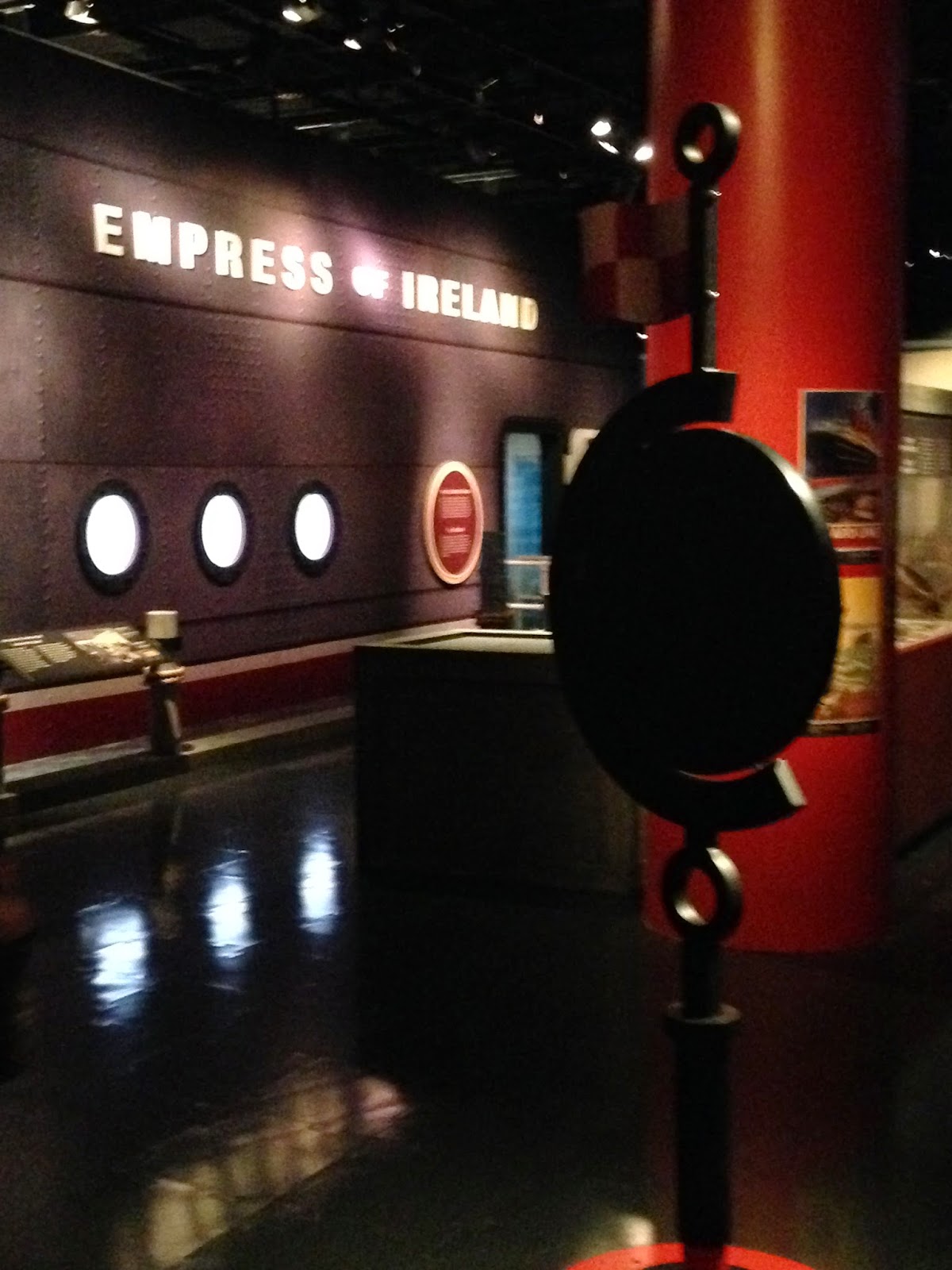
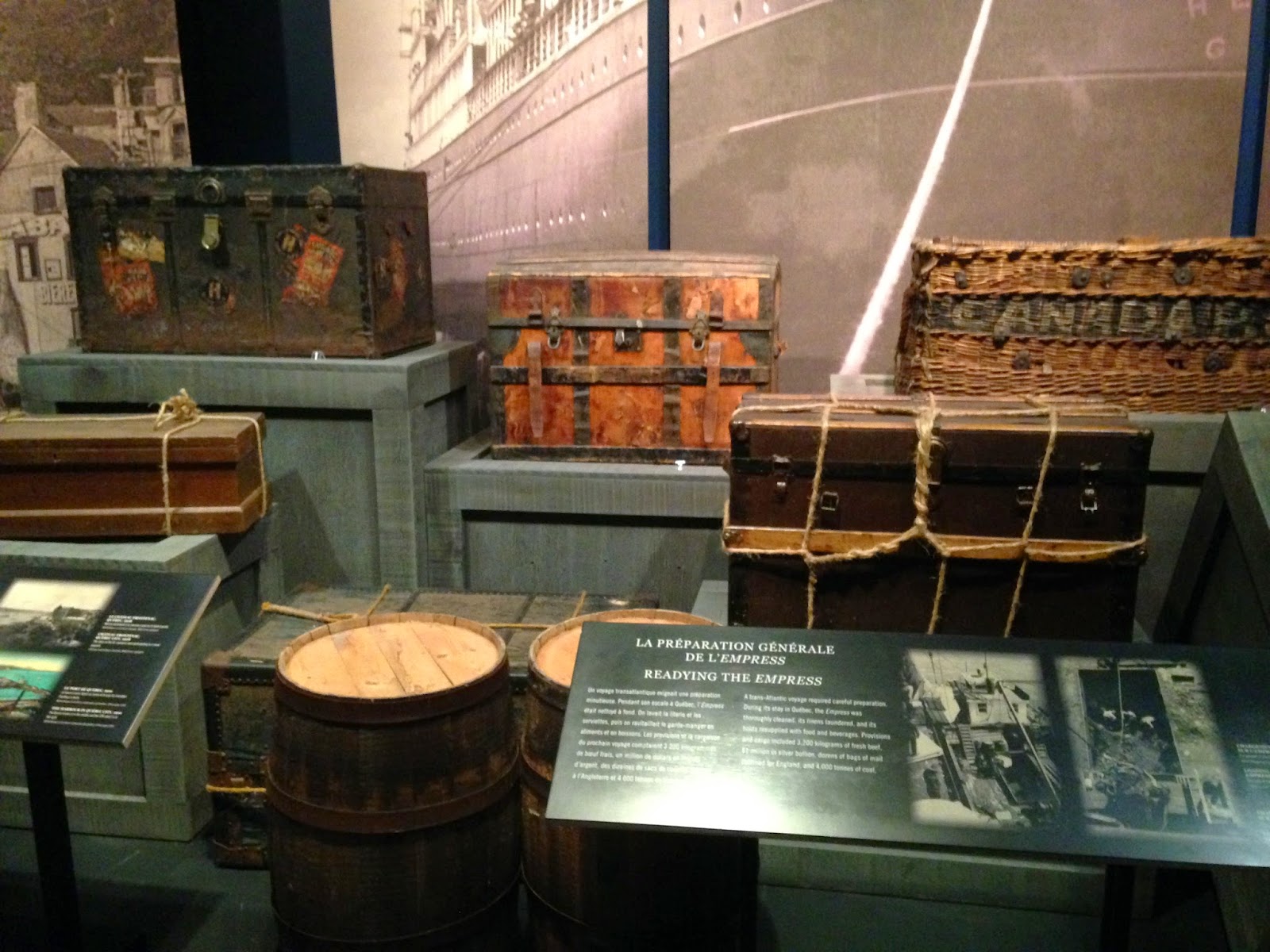
From May 30th, 2014 to April 6, 2015, the items are on display at the Museum as part of their main exhibit. The exhibit itself is expertly done in a re-creation of the actual ship, taking you on the journey from the excitement of boarding to the terror of the collision. I had the opportunity to visit the exhibit, which I found to be highly emotional and an incredibly eerie experience.


The exhibit sign


The exhibit entrance
Inside the ship
Baggage display


Model and artifacts
Quote from a passenger


 I also had the opportunity to attend a behind-the-scenes event where I met with the curator and conservationist who set up the exhibit. They shared with us a fascinating description of how the items were displayed, and their journey from salty ocean floor to pristine museum condition. It was fascinating to see the items up close and to learn more about them. This story is an incredibly interesting one, which I had never heard before, and I'm so thrilled to have been able to learn about it in such an interactive way.
                     Thanks for reading,
              Delany Leitch
Some examples of the dishes from the Empress' dining room. The fancier, more intricate pattern of the bottom two was designed for first class, the darker, block pattern of the upper corners was for second class, and third class received the plain white plate with the CPR logo stamped in the center.
The behind-the-scenes event, held in the museum's archival lab. The curator is the man in the grey shirt, and the conservationist is the woman in the white jacket. Notice the dishes and the wooden board with a faucet, which would have been in a passenger's cabin.


The Museum grounds, overlooking the Ottawa River and Parliament Hill


Here's where I found some supplementary information:
http://www.historymuseum.ca/empress
http://news.nationalpost.com/2014/05/28/canadas-titanic-the-sinking-of-the-empress-of-ireland/


On the Museum's website you can see a survivor's emotional account of her experience that night. I've also included some of the personal stories which are on display at the Museum.
Egildo Braga
Travelling with his wife Carolina and their son Rino
Third class
Birthplace: Italy
Place of residence: Fayal Camp, Minnesota
Occupation: Miner
Purpose of trip: The Bragas were going to visit family in Italy during a series of major strikes in the U.S. mining sector.
Fate:
Egildo Braga: Survived
Carolina Braga: Survived
Rino Braga (son): Perished
Egildo tried to save his family. He tied his son to his body and threw himself into the water with his wife. The force of the waves tore Rino from his father. Egildo searched desperately for his son in the dark, but in vain.
This photograph, taken in Northern Minnesota, shows Elgido Braga, his wife Carolina and their son Rino (in her arms). They appear in the upper row, between the guitar player and the accordionist. Within two months, they would board the Empress of Ireland for a trip home to Italy.
Wedding Photograph of Carlo and Giusseppa Braga, March 1914, Courtesy of Ernesto Milani

Grace Hanagan
Travelling with her parents Edward and Edith
Second class
Birthplace: Canada
Place of residence: Toronto
Purpose of trip: As an eight-year-old girl, she was happy to be going on a trip with her parents, who were travelling to London to take part in the Salvation Army’s International Congress.
Fate:
Grace Hanagan: Survived
Edith Hanagan: Perished
Edward Hanagan: Perished

Eight-year-old Grace lost sight of her parents after falling into the water. During the year that followed the tragedy, she continued to hope that her mother might still be alive, given that her body was not found.
View an excerpt from Grace Hannigan’s moving firsthand account of the sinking of the Empress.
Grace Hanagan, with the permission of The Salvation Army Archives, Canada and Bermuda Territory

Edward Seybold

Travelling with his wife Susanna

First class

Birthplace: Canada
Place of residence: Ottawa
Occupation: Entrepreneur
Purpose of trip: The couple celebrated their 43rd wedding anniversary on the day of departure. They were taking a trip to Europe for the occasion.
Fate:
Edward Seybold: Survived
Susanna Seybold: Perished
Edward followed the casket of his wife to Bonaventure station in Montréal on May 31.
© Library and Archives Canada, Topley Studio / e010973043 / e010973044