Showing posts with label world war. Show all posts

Thursday, April 13, 2017

World War Trips Available

I bet you didn't know we have a local resident that organizes group tours and getaways featuring World War locations.  Darlene Ford of Wallacetown, at my request, has provided the following information about Vimy Ridge - 100th Anniversary Tours and D-Day Tours. 

The Vimy RidgeTour is available from 5 day land tours up to 14 day tours, escorted by specialists on WWI history. Available from end of April -- mid Sept. 2017.  

If you are interested in WWII there are 5 day land tours or up to 14 days of WWII D-Day Landing Beaches & Battle of Normandy with well informed local guides as well as your escorted tour guides.  

Contact Darlene Ford at 519-762-2990 and follow Group Getaways By Farlene on Facebook by clicking here.  
A note from Darlene about her trip with husband Jim in 2016.  "We went on the Great Canadian War Memorial Tour last Sept. 2016.  Both of our Fathers fought in France, Holland & Belgium and I have an Uncle buried in Beny-sur-mer near Juno Beach were he was killed on D-Day.  His name is on the maple leaf shaped plaque on Canada House on Juno Beach. We are both changed and with great pride and respect for all men and women who served and the ones that gave their lives for our freedom which most people take for granted.  Like the old saying goes you had to be there to understand."  Darlene Ford  519-762-2990

No automatic alt text available.

No automatic alt text available.

Wednesday, October 15, 2014

World War Wednesdays: A Bear at War

A Bear at War: The Story of Lt. Lawrence Browning Rogers
     For anyone who visits the Canadian War Museum, there are countless exhibits and objects that cause one to pause and be overwhelmed at the magnitude of human conflict. There is an entire floor dedicated to showcasing tanks, vehicles and large weaponry, a section of the Berlin Wall, and a mock D-Day landing craft. However, there is one tiny little item located in the Canada and the First World War section which can be considered to be the most evocative. It is a dirty, mangled little teddy bear, and the story behind it is one that touches the hearts of historians and visitors alike.
     Before we explore the bear's story, it is important that we first get acquainted with the people involved in it. Lieutenant Lawrence Browning Rogers, born December 17, 1878, was the son of the late Maj. John and Hattie Duncan Rogers, of Montreal. He was married to Janet May Weaver Rogers, with whom he had two children, Howard and Aileen. According to his enlistment information, he was a farmer from Montreal, Quebec. He enlisted with the Canadian Mounted Rifles in Sweetsburg, Quebec on February 11, 1915. He was 36 years old at the time. He was sent to serve as a medic with the regiment in Belgium and France.
Lieutenant Lawrence Browning Rogers in uniform
 
      Before he made his journey overseas, ten-year-old Aileen gave a teddy bear to her father as a good luck charm and a memento of home. He promised to take good care of it, and to keep it with him always.
The little bear

      The family exchanged hundreds of letters during Lawrence's time at war. Below are a few examples of their correspondence.
Lawrence's wife, May feeding the chickens at their farm
Oct. 17, 1917
Dear Laurie
Think of it. I have sent you Christmas boxes already. What they said is we must do so early to ensure delivery. There will be such a lot. I had to pack in two boxes I marked them 1 & 2.
There are a couple of little gifts for Dan, they are marked from children and from me. Aileen made a sweater herself…excuse some uneven places. There is a lot of love and devotion knit into it. Howard saved up his money and that is hard, and bought your present himself and we did enjoy purchasing it.
I have been pretty sick for a week. Was not able to go out. Had to get what I could on Victoria Avenue. Have not been out for a week. Terrible pain in back across shoulders.
I guess it must be my age is breaking me up. Oh Laurie, I am so afraid it may make an invalid of me as it does of lots of women and the children need me. Pray for me to be spared that.
Children are working hard at school… Poor Aileen struggles along. I did not send her to dancing. Cost too much and she did not seem to want to go much.   So I want to give her music and can’t do everything. I have all the money I need. Don’t send me any. You may need it.
If only I could see you again I think it would make a different woman of me. Loneliness is eating my heart out and yours probably too.
I must go and get dinner for kiddies, love from us all and hoping for your leave.
I am always yours,
May

Lawrence and one of the horses, before the war
Sept. 3, 1917
Dear May
My how I dread the thought of putting in another winter in the trenches but I suppose it must be done for we have to win before we come back.
Russia may not be much use just now but she is coming along and the U.S. are doing fine, then Canada will buck up and there will be something doing. I would not be surprised if the actual fighting ceased this fall or early winter.
Wish I could just drop in for supper but suppose like a lot of things it will have to wait.
Tonight is almost a full moon over here but usually we do not appreciate moon-light nights. I don’t think you are getting very sentimental for I sure feel that way myself. I did not think you had gotten over it years ago but just perhaps fed up for a while and I sure don’t blame you for I was anything but good company at times.
Don’t worry dear about a cake although I like them, still it is an awful lot of work and I don’t want you to do it when you are not feeling well. I am glad that Aileen is able to ride her bicycle also Gray but she wants to be careful with him in case he should stumble and throw her.
However I am sure it will do her the world of good learning to ride and then Gray is such a quiet beast to learn on. Glad to hear that you are feeling better but do take care of yourself for my sake.
Dan is going to write to you about his money as soon as he can get time. I heard that Major Hewson was over in England again but could not find out when I was over there.
I am just as anxious as you to see all again and I am hoping and trying all I can to get at least a furlough to come home but cannot tell yet if I can get it.
Well dear there is nothing very much to write about so will close and go to bed.
Lots of love for you all
Yours always
Laurie
Aileen's Christmas report card

May 4, 1917
Dear Aileen
I received a letter from mother today enclosing a copy of your Easter report. It was fine and Dad was so proud of it. He showed it to all the boys and Dan came in and of course I  had to show it to him, he was almost as pleased as I was.
I received the Easter parcel yesterday so was able to give Dan his bunny card also the bunch of grapes, which he and I are eating now. He had never seen anything like them before so was very pleased with them.
I would liked to have had Howard’s report too. It must have been fine and I am very much stuck up about you both.
The weather is sure lovely just now and the sun is fine and warm and as you know I like warm weather. It looks good to me.
I want to enclose a letter to Howard and so will finish this one.
Lots of love for you all from
Daddy
                                                                                                                                             
The teddy
Sept. 25, 1916
Dear May
I am awfully glad you decided to go to town for the winter and feel sure you will not regret it. First, there will not be so much to worry about, only the cooking for yourselves. Second you will be nearer to family should anything go wrong.  Thirdly you will be much nearer to your friends and will not get out of touch with civilization and last but not least, the kiddies will have a chance to go to school…
The weather here is very nice but for a while it was terrible, cold and wet and lots of mud. For two days we had to sleep out in the rain and mud and the consequence of that is most of us have colds and are full of rheumatism.
Tell Aileen I still have the Teddy Bear and will try to hang on to it for her. It is dirty and his hind legs are kind of loose but he is still with me.
Good night dear. Love to all. Hope you are all well.
Yours lovingly,
Laurie
Aileen feeding the chickens
Aug. 13, 1916
Dear May
I received a letter from you dated July 25. You are not the only one who is having a hot time for it is very hot over here but the nights are cold in fact it is necessary to have a blanket to sleep under.
Why does not Clinton try to get into the Canadian Army Medical Corps. I think it would be just the job for him and in my opinion is the best work in the whole army.
I had a nice letter from Harry Jackson the other day. He would like to come over but cannot, you know their little one has been in a plaster cast for a long time and he said that he could not come…the kiddie had to come first and I guess he is right.
How were you so lucky, or should I say successful, with the sweet peas this year. I never could make a success of them, perhaps Jan got them in earlier than I did and took more care of them. If you get anything like a decent offer for the hens let them go. It will be so much less work for you to do.
How did those apple trees come on, that I planted and was so proud of. They ought to have been in pretty good shape this year.
I can sleep on the floor or anywhere else for that matter now but would like to see a good, clean bed again for a while.
I have been put in charge of the dressing station for this trip and do not have to go into the frontline, which is something but don’t think it is all a picnic here for it certainly is not.
However, it is safer than the line. So we should be thankful for even that.
We had one busy day and then things seem to have quieted down, but one can never tell just how soon things will happen over here.
Tell Howard to write me a letter even if he does not like to write the practice will do him good and the letter will do me good. Also tell Aileen I am anxiously looking for another letter from her and some more cookies. The last were fine.
Well there is nothing much to write about, and as there are a few shells going overhead which makes me jumpy, will close. Love to all and hope you all sleep well.
Laurie
"The little ones", Aileen (10) and Howard (7)
Aug. 2, 1916
Dear May
I have just washed up my supper dishes – one plate, a cup and a spoon, so feel that I deserve a little leisure and cannot employ it better than writing home and letting you know that I am well.
There are two of us on this job in the medical hut and we get along fine. We have a little gasoline stove and cook our meals on it. We had some eggs, bread and butter and tea, then we managed to get a can of strawberry jam and our M.O. had a parcel sent him the other day and there was a tin of preserved cream in it, which he gave to us and we had that so we did not fare so badly.
Mind we don’t always live that way and there are times when we have to hustle for our grub. I got your parcel all okay and we were very glad to get it. The cake and candy was very acceptable.
I don’t know just when we are going to move again but I suppose it will be soon and then it will be to a new position but at present we cannot say for we don’t know.
I hope you can get an apartment in Westmount so the kiddies can go to school there. Things will right themselves. You know we have always put great faith in the Lord and everything has turned out all okay and I feel sure if we do the same now the Lord will take care of us.
It is wonderful to me to think of how well I have been and what I have gone through in these last 10 months and it’s certainly because a higher power is looking after and taking care of me.
All we can do now is to still put our faith to him and trust that all will come out all right. Kiss the little ones for me and lots of love for all from Daddy.


     Some of these letters were sent by Lt. Rogers while he was stationed at the legendary battle of Passchendaele. According to the Narrative of Operations 29-31 October 1917, 5th CMR War Diary, "At the battle of Passchendaele, the Regimental Aid Post with Capt. Ireland as Medical Officer, and Lieut. Rogers in charge of Stretcher Bearers was established in a Pill Box near the Advance Battalion Headquarters at Kron Prinz Farm." Sadly, the deaths of Lt. Rogers and Captain Ireland are reported on the subsequent page of the Narrative of Operations:
11.20 amReport from Advance Bn. H.Qs., timed 10.30 a.m., that Capt. IRELAND, M.O. and Lieut. ROGERS were killed and only two of Stretcher Bearer party left.
Request made immediately to A.D.S. to send up another M.O. at once. This was quickly responded to.
It was estimated at this time that our casualties (5th CMR) are about 300.
     It was said that he was tending to a wounded soldier, and was killed by enemy fire. His wife May received this letter:

France
Nov. 3, 1917
Dear Mrs. Rogers -
Words written or spoken would fail to express to you our sympathies with you in your sad bereavement.
Mr. Rogers was more than a comrade to both. Dan and myself and I can assure you we both feel the loss of such a comrade deeply.
We have at least one consolation. His sacrifice will not have been made in vain.
His medical work will be remembered by many who have been attended by him in the field and many a poor fellow has departed this world with little pain thanks to the untiring efforts of Mr. rogers.
Our Empire and our God I am sure cannot forget such deeds.
In your sorrow remember that our God knows best what is good for us, and I am sure it is God’s will that our comrade should be called to higher service.
Mr. Rogers died serving his God and Country, what better and nobler death could a man die.
In closing kindly permit Dan and myself to again offer you our sincerest sympathies.
Yours sincerely,
J.M. Wright
    
     Lieutenant Rogers was awarded the Military Medal, and was buried at Menin Gate (Ypres) Memorial, Belgium.

     Amazingly, when Rogers's body was found, the teddy bear given to him by Aileen was still in his pocket. It was battered and dirty, but it was there. It was returned home to his family, making its sad journey home without its carrier. Eighty-five years later, Lawrence's granddaughter found Teddy, the letters, and other war memorabilia packed away in a briefcase.The bear is now on display at the Canadian War Museum, along with a letter from Aileen. It remains one of the most moving historical objects in Canada.


The bear and letter display at the CWM

  
  The story of the bear has since been turned into a children's book called A Bear in War by Stephanie Innes, Harry Endrulat, and Brian Deines. " Accompanied by family photographs and Brian Deine's poignant art, A Bear in War is more than one family's testament to a brave soldier. It is a gentle introduction to war, to Remembrance Day, and to the honor of those who have served their countries." (Amazon)
    

     Thanks for reading about this sad but meaningful story. I consider it to be a timeless one, and powerful for all audiences.

                   Delany


Thanks to the following sources for supplementary information:

The Canadian War Museum http://www.warmuseum.ca/firstworldwar/history/life-at-home-during-the-war/the-home-front/the-childrens-war/
The Canadian Great War Project http://www.canadiangreatwarproject.com/searches/soldierDetail.asp?Id=58943
Pajama Press http://pajamapress.ca/tag/rogers/

Wednesday, October 1, 2014

World War Wednesdays #3


World War Wednesdays: The Empress of Ireland
     When people think of major disasters in the last century, Titanic is one that is at the forefront of their memories. Over a hundred years later, it is amazing to think that people still know or even care about such a faraway event. This is of course due in part to the cinematic adaptations which have done a good job of making the horror of that fateful night come to life. However, thanks to a recent visit to the Canadian Museum of History in Gatineau, Quebec, I learned about a similar tragedy which was much less publicized and much closer to home: The Empress of Ireland.
The Empress of Ireland
 
     Called Canada's Titanic, The Empress of Ireland is an equally chilling and arguably more terrible story which turns one hundred years old this year. In 1914, Canadian history was experiencing a pivotal period in which economic activity was booming, and hundreds of thousands of immigrants were arriving to be a part of this great new country. These people would travel by sea, on such a magnificent ship as The Empress of Britain or her sister, The Empress of Ireland.


     The Empress of Ireland was owned by the Canadian Pacific Railway, and was used to make the transatlantic journey from Quebec City to Liverpool, England. The final fateful crossing, which began May 28th, 1914, was her 96th. 1,477 people boarded that day, among them 171 members of the Salvation Army who were en route to London for  World Congress, 87 first class passengers, 253 second class passengers, 717 third class passengers, 420 crew members, and a total of 138 children.
     In order to complete its journey, the ship needed to travel down the St. Lawrence River to get to the Atlantic Ocean. It was boasted that this short portion of a couple of days contributed to the Empresses' swift reputation. It was here that the tragic events unfolded.

The Empress of Ireland Glenbow
The Empress of Ireland McCord
The Empress of Ireland Music Room


     On the foggy night of May 29th, 1914, the lack of visibility and a confused encounter resulted in a Norwegian collier called the Storstad colliding with the Empress at a 45 degree angle near her center. The captain of the collier ordered 'full ahead' to remain inside the ship, but a strong current separated the two ships and allowed water to begin flooding into the gaping hole. At 1:55 AM, just fifteen minutes after the two vessels came close enough to see each other, the Empress began listing to the starboard side. Some of the port steel lifeboats broke loose and crushed passengers, but a few still managed to make it onto the water. Just ten minutes after impact, the ship completely turned over to starboard, the two huge smokestacks hit the water and crushed a lifeboat, and many passengers were hurled into the sea. After only fourteen minutes, the Empress of Ireland sank 6km off from Saint Luce-Sur-Mer, Quebec. By comparison, the RMS Titanic took two hours and forty minutes to sink.
    
The speed of the sinking, combined with its considerable death toll make this the greatest maritime disaster in Canadian history. Of the 1,477 souls on board, 1,012 were lost. Only 245 crew members survived from the original 420. Third class lost 584 of its 717, second class 205 of its 253, and first class 51 of its 87. The Salvation Army group lost 150 members. Of the 138 children on board, only five remained.
     These heartbreaking numbers were not the last tragedies to befall the horrific event. One month later, the First World War broke out, and the sinking of the ship was quickly forgotten by the world  along with its victims. It wasn't until fifty years later that a group of divers discovered the wreck. Despite dangerous conditions and numerous deaths, divers have been able to retrieve a number of items from the ship. These items have since been given to the Museum from a private collector.
The ship's bell
The ship's telegraph

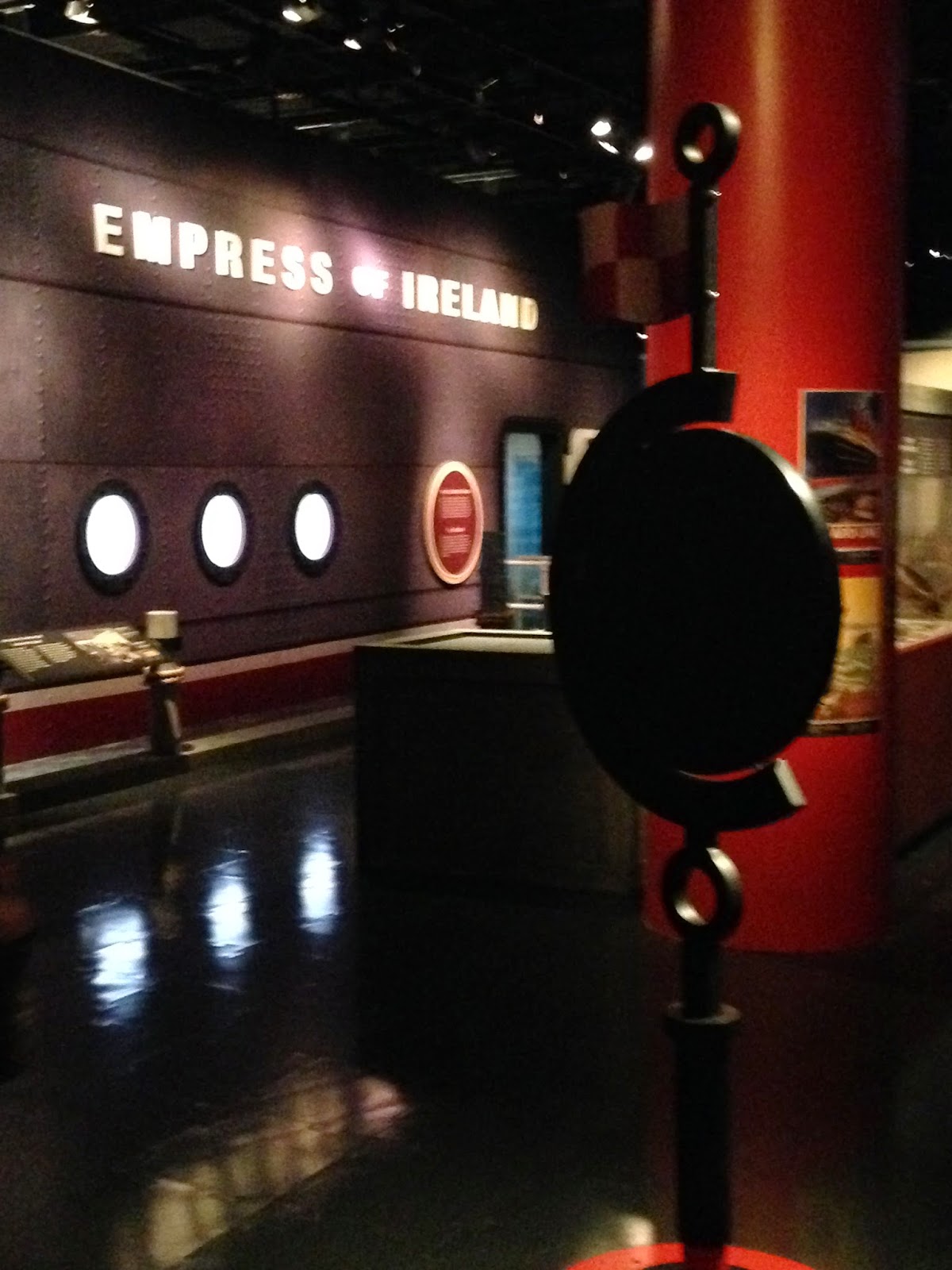
From May 30th, 2014 to April 6, 2015, the items are on display at the Museum as part of their main exhibit. The exhibit itself is expertly done in a re-creation of the actual ship, taking you on the journey from the excitement of boarding to the terror of the collision. I had the opportunity to visit the exhibit, which I found to be highly emotional and an incredibly eerie experience.


The exhibit sign


The exhibit entrance
Inside the ship
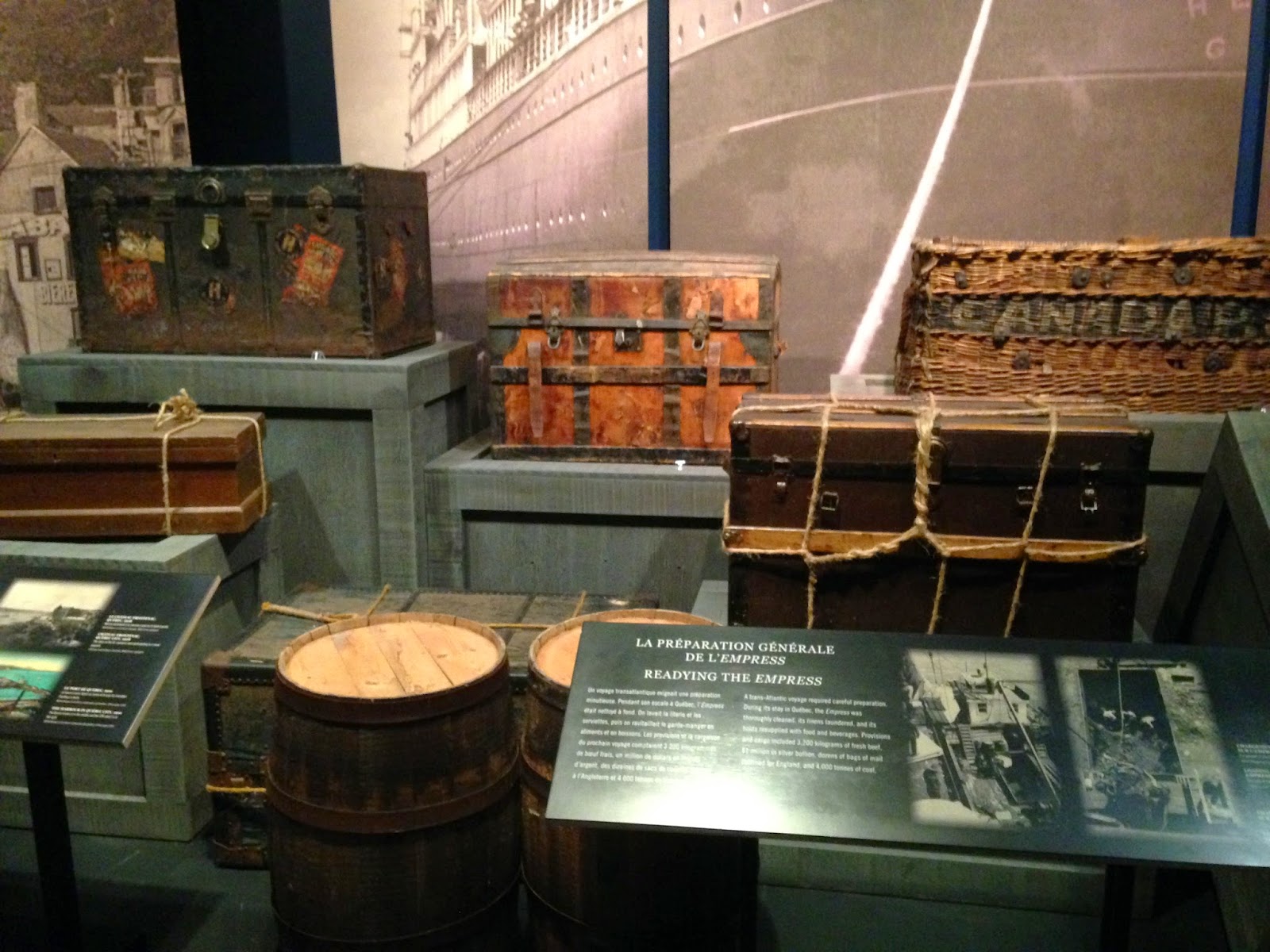
Baggage display


Model and artifacts
Quote from a passenger


 I also had the opportunity to attend a behind-the-scenes event where I met with the curator and conservationist who set up the exhibit. They shared with us a fascinating description of how the items were displayed, and their journey from salty ocean floor to pristine museum condition. It was fascinating to see the items up close and to learn more about them. This story is an incredibly interesting one, which I had never heard before, and I'm so thrilled to have been able to learn about it in such an interactive way.
                     Thanks for reading,
              Delany Leitch
Some examples of the dishes from the Empress' dining room. The fancier, more intricate pattern of the bottom two was designed for first class, the darker, block pattern of the upper corners was for second class, and third class received the plain white plate with the CPR logo stamped in the center.
The behind-the-scenes event, held in the museum's archival lab. The curator is the man in the grey shirt, and the conservationist is the woman in the white jacket. Notice the dishes and the wooden board with a faucet, which would have been in a passenger's cabin.


The Museum grounds, overlooking the Ottawa River and Parliament Hill


Here's where I found some supplementary information:
http://www.historymuseum.ca/empress
http://news.nationalpost.com/2014/05/28/canadas-titanic-the-sinking-of-the-empress-of-ireland/


On the Museum's website you can see a survivor's emotional account of her experience that night. I've also included some of the personal stories which are on display at the Museum.
Egildo Braga
Travelling with his wife Carolina and their son Rino
Third class
Birthplace: Italy
Place of residence: Fayal Camp, Minnesota
Occupation: Miner
Purpose of trip: The Bragas were going to visit family in Italy during a series of major strikes in the U.S. mining sector.
Fate:
Egildo Braga: Survived
Carolina Braga: Survived
Rino Braga (son): Perished
Egildo tried to save his family. He tied his son to his body and threw himself into the water with his wife. The force of the waves tore Rino from his father. Egildo searched desperately for his son in the dark, but in vain.
This photograph, taken in Northern Minnesota, shows Elgido Braga, his wife Carolina and their son Rino (in her arms). They appear in the upper row, between the guitar player and the accordionist. Within two months, they would board the Empress of Ireland for a trip home to Italy.
Wedding Photograph of Carlo and Giusseppa Braga, March 1914, Courtesy of Ernesto Milani

Grace Hanagan
Travelling with her parents Edward and Edith
Second class
Birthplace: Canada
Place of residence: Toronto
Purpose of trip: As an eight-year-old girl, she was happy to be going on a trip with her parents, who were travelling to London to take part in the Salvation Army’s International Congress.
Fate:
Grace Hanagan: Survived
Edith Hanagan: Perished
Edward Hanagan: Perished

Eight-year-old Grace lost sight of her parents after falling into the water. During the year that followed the tragedy, she continued to hope that her mother might still be alive, given that her body was not found.
View an excerpt from Grace Hannigan’s moving firsthand account of the sinking of the Empress.
Grace Hanagan, with the permission of The Salvation Army Archives, Canada and Bermuda Territory

Edward Seybold

Travelling with his wife Susanna

First class

Birthplace: Canada
Place of residence: Ottawa
Occupation: Entrepreneur
Purpose of trip: The couple celebrated their 43rd wedding anniversary on the day of departure. They were taking a trip to Europe for the occasion.
Fate:
Edward Seybold: Survived
Susanna Seybold: Perished
Edward followed the casket of his wife to Bonaventure station in Montréal on May 31.
© Library and Archives Canada, Topley Studio / e010973043 / e010973044


Wednesday, September 17, 2014

World War Wednesdays #1

Delany Leitch worked at Backus-Page House Museum during the summer of 2013 and is now volunteering her time to submit World War weekly blog posts for us. 

If I were to ask you what your favorite subject was in school, my best guess is that your answer probably wouldn’t be History, or anything related to a subject which requires the memorization of dates, places and names combined with a great deal of writing and reflection. I’ll be the first to say that I can’t blame you there. After all, for most people the subject is not directly related to the kind of knowledge and skills required in a workplace, so it’s a generally short-lived struggle. If this sounds at all familiar to you, I am sorry to hear that. You probably didn’t have the amazing luck that I’ve had in the history teacher department, which for me was a huge factor in sparking the inspiration which has led me to where I am right now.

I’m a second-year student at the University of Ottawa specializing in history, specifically the German side of the Second World War and the Holocaust, with additional interest in the German language and Sociology. I am so thrilled to be able to say that I absolutely love what I’m studying, and I could not be more excited about this stage in my educational journey.

If what I’m studying doesn’t sound appealing to you, that’s perfectly understandable. Studying the far-away concepts of times gone by can seem at best daunting and at worst useless. This isn’t the most employable field in the world, I know. But, for just a few minutes, I’d like to get you to see the value in studying and appreciating history, and if you don’t end up joining me in perpetual research and essay writing, maybe you’ll have a better understanding of why we do this.

I’ll start off with a little story which has sparked a lot of recent pondering for me. Last Wednesday, September 10th was the 75th anniversary of Canada’s official entry into the Second World War. It was a day I had been anticipating, and was looking forward to seeing how it would be recognized. On that morning, I went to my Facebook page, as I often do, to share with friends and family the interesting and humorous historical things I encounter. I uploaded a few pictures of my great-grandfather, Verne Frank in his uniform posing with family. You can see the photos enclosed in this blog. In the caption, I mentioned what a significant day it had been for my family, and asked how it had affected other people. I expected to not receive much response, but I was shocked to begin receiving the personal family war stories of people I don’t even know well. I was incredibly humbled and thrilled that these people would take the time to send pictures and stories in response to my casual little question.

This positive reception also made me think. These people were so proud to be able to tell me of their relatives’ participation in a war that spanned the entire globe, a war which I have become dedicated to study. It made me wonder why people are so quick to be bored and overwhelmed by studying history, but asking them to draw personal questions results in an outpouring of pride and sharing. I can now say that I recognize and appreciate the immense value in establishing personal connections with the history that has shaped all of us. This lesson is valuable in any field, but in history it can make or break how someone views it. For me, having the individual stories make the big concepts I study so much more impactful. I thought as I was reading them how great it would be if all parts of history could be explored in such an exciting a  manner as if it were our own relatives’ experiences. I thought about what a difference history teachers could make if they broke topics down from the key concepts to the little people who were a part of them.

This is just a little observation I have made and been thinking about. One of the greatest lessons I have learned from this is how a momentous event like the Second World War can bring people together not only during, but many decades after the dust has settled. I can’t express enough how honored I was to be entrusted with the amazing stories I have read. This is a lifelong discussion for me and I love when people add to it. If you want to be a part of the conversation, I’ll always want to hear it. Seeing other people get excited about history makes me happier than anything, and if you’d like to know more, feel free to follow my journey!

                 Thanks for reading,
                 Delany Leitch